How Good Bacteria Control Your Genes

Chemical signals that affect the human genome may help to fight infections and prevent cancer

17 Jan 2018
Lui Terry
Administrator / Office Personnel

Industry news

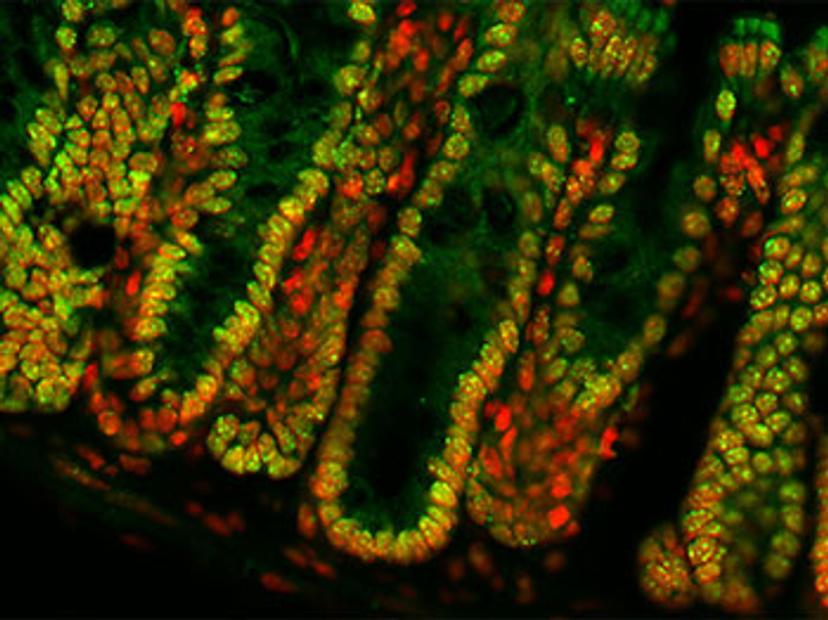
Cells in the lining of the large intestine of a mouse. Genome crotonylation is shown in green, DNA in red. Yellow areas are where both DNA and Crotonylation are found together. Image credit: Dr Juri Kazakevych

Scientists from the Babraham Institute near Cambridge in collaboration with colleagues from Brazil and Italy have discovered a way that good bacteria in the gut can control genes in our cells. The work, published in Nature Communications, shows that chemical messages from bacteria can change the location of key chemical markers throughout the human genome. By communicating in this way, the bacteria may help to fight infections and to prevent cancer.

This work, led by Dr Patrick Varga-Weisz shows how chemicals produced by bacteria in the gut from the digestion of fruit and vegetables can affect genes in the cells of the gut lining. These molecules, called short chain fatty acids, can move from the bacteria and into our own cells. Inside our cells, they can trigger processes that change gene activity and that ultimately affect how our cells behave.

This new research shows that the short chain fatty acids increase the number of chemical markers on our genes. These markers, called crotonylations, were only discovered recently and are a new addition to the chemical annotations in the genome that are collectively called epigenetic markers. The team showed that short chain fatty acids increase the number of crotonylations by shutting down a protein called HDAC2. Scientists think that changes in crotonylation can alter gene activity by turning genes on or off.

Get the biggest science stories direct to your inbox: Become a SelectScience member today

The team studied mice that had lost most of the bacteria in their gut and showed that their cells contained more of the HDAC2 protein than normal. Other research has shown that an increase in HDAC2 can be linked to an increased risk of colorectal cancer. This could mean that regulating crotonylation in the genome of gut cells is important for preventing cancer. It also highlights the important role of good bacteria and a healthy diet in this process.

This research was made possible by support from the bilateral BBSRC-Brazil fund established as part of an agreement between Research Councils UK (RCUK) and the State of Säo Paulo Research Foundation (FAPESP) to welcome, encourage and support collaborative research between the UK and Brazil.

First author, Rachel Fellows, said: “Short chain fatty acids are a key energy source for cells in the gut but we’ve also shown they affect crotonylation of the genome. Crotonylation is found in many cells but it’s particularly common in the gut. Our study reveals why this is the case by identifying a new role for HDAC2. This, in turn, has been implicated in cancer and offers an interesting new drug target to be studied further.”

Lead scientist Dr Patrick Varga-Weisz, said: “Our intestine is the home of countless bacteria that help in the digestion of foods such as plant fibres. They also act as a barrier to harmful bacteria and educate our immune system. How these bugs affect our cells is a key part of these processes. Our work illuminates how short chain fatty acids contribute to the regulation of proteins that package the genome and, thus, they affect gene activity.”

Links

Tags

Cell / Tissue CultureCell culture or tissue culture is used to study the biology of cells or tissues and to isolate cellular products in an environment which can be manipulated and well defined. Accurately control your culture environment with bioreactors or culture incubators, bind your cells to a surface or together with an extracellular matrix. Distinguish cell types with differential media or proliferate cells with certain characteristics using selective media. Enrich your media with supplements such as growth factors, sera and vitamins. Find the best cell and tissue culture products, kits and equipment in our peer-reviewed product directory: compare products, check customer reviews and receive pricing direct from manufacturers.MicrobiologyMicrobiology is the study of microorganisms including protists, prokaryotes, fungi, and, often, viruses. Microorganisms are a useful research tool as genetic vectors and, in immunology, for antibiotic susceptibility testing, cellular biology and genetics. Microorganisms commonly grow readily in incubators with microbial culture media; this can contain chromogenic supplements to differentiate between cell lines. Estimate your culture’s density of microorganisms with colony counters, or screen and select colonies for desirable clones with automated colony pickers. Additionally, equipment is available to monitor environments for the presence of microbes and identify with microbial identification instruments. Find the best microbiology products in our peer-reviewed product directory: compare products, check customer reviews and receive pricing direct from manufacturers.Light MicroscopyLight microscopes or optical microscopes are used to visualize microscale objects under magnification, including cells, clinical specimens and materials. Lab equipment for light microscopy includes confocal microscopes, fluorescence microscopes, zoom and stereo microscopes. Microscope slides and imaging reagents are available for visualizing samples, as well as various microscope stages and incubators for large or temperature-sensitive samples. Find the best light microscopes in our peer-reviewed product directory: compare products, check customer reviews and receive pricing direct from manufacturers.ImmunologyImmunological techniques measure and characterize immune responses. Immunology kits and analysis systems often use techniques such as ELISA, radioimmunoassay (RIA) and immunodiffusion assays, Immunohistochemistry, and flow cytometry. Immunologists use equipment such as flow Cytometers, plate readers, plate washers and fluorescent microscopes.EpigeneticsEpigenetics refers to heritable changes in gene expression. These changes are not caused by alterations to the DNA sequence. Three of the main systems responsible for the initiation of epigenetic change are DNA methylation, histone modification and non-coding RNA-associated gene silencing.BacteriaBacteria are microorganisms that play critical roles in the environment, human health, and biotechnology. Understanding bacterial genetics, growth, and metabolism is essential for developing antibiotics, vaccines, and improving industrial processes. Browse our peer-reviewed product directory to find the best bacterial research tools, compare products, check reviews, and get pricing directly from manufacturers.MicrobiomeMicrobiome research focuses on the complex communities of microorganisms living in and on humans, animals, plants, and environments. It plays a crucial role in health, disease, and ecological balance. Explore tools and resources for microbiome analysis, including sequencing platforms and bioinformatics software.
How Good Bacteria Control Your Genes