
Highlights and Key Innovations from RamanFest Conference 2017
15 Jun 2017
Industry news
HORIBA Scientific, the global leader in Raman spectroscopy systems, has successfully concluded RamanFest, which this year was held at Purdue University, in West Lafayette Indiana, on Thursday, June 1st, and Friday, June 2nd.
The RamanFest conference covers the current state of advanced applied Raman spectroscopy through presentations and discussions from today's leaders in the field, from both academia and industry. Our keynote lectures were presented by internationally renowned scientists.
The Thursday morning session included talks focused on Raman Spectroscopy in Life Sciences and Pharmaceuticals, while the afternoon session focused on Raman Spectroscopy on the Nanoscale. There were 32 posters presented by registrants highlighting the latest capabilities of Raman spectroscopy. Friday’s sessions were dedicated to innovations in Raman technology.
Speakers came from academia and industry in the United States, China, Germany, Japan and the UK.
The guest speaker at the gala dinner was Dr. Kelsey Cook, Program Director for the Chemical Measurement and Imaging Program, and co-leader for NSF activities related to forensics sciences, whose presentation discussed best practices for submitting a proposal for funding to the NSF. Another guest at the dinner was Professor Anant Ramdas, C.V. Raman's last surviving student, and professor emeritus at Purdue, with his wife, Vasanti.
RamanFest was co-sponsored by Professor Ji-Xin Cheng, of Purdue University, and Dr. Andrew Whitley, VP of Business Development at HORIBA Scientific.
“This year’s RamanFest was a resounding success,” said Dr. Whitley. “With registrants from the US, and from as far away as Switzerland, Italy, China, and the UK, the event brings together international perspectives and techniques in Raman, and enables unique networking opportunities.”
Related products
Request Quote for All Products
XploRA - Raman microscopy
HORIBA ScientificThe XploRA™ is a new concept in Raman microscopy, bringing Raman chemical identification directly to your microscope. The XploRA can be coupled to both upright and inverted microscopes, allowing analysis of all sample types, ranging from semiconductors and nano-materials, through to biological cells and tissues. The system provides the established performance of HORIBA Scientific Raman microscopes at a surprising price. Combining microscopy and chemical analysis the XploRA™ retains the full functionality of your microscope coupled with high performance Raman spectroscopy. The concept of the XploRA™ is straightforward – a smarter microscopy. A compact, high performance Raman spectrometer is coupled to a research grade optical microscope (upright or inverted geometry), allowing both standard optical microscopy and detailed chemical analysis on a single system. The unique design ensures full capability of the optical microscope, and complete flexibility, full automation and true research performance of the Raman analyzer.
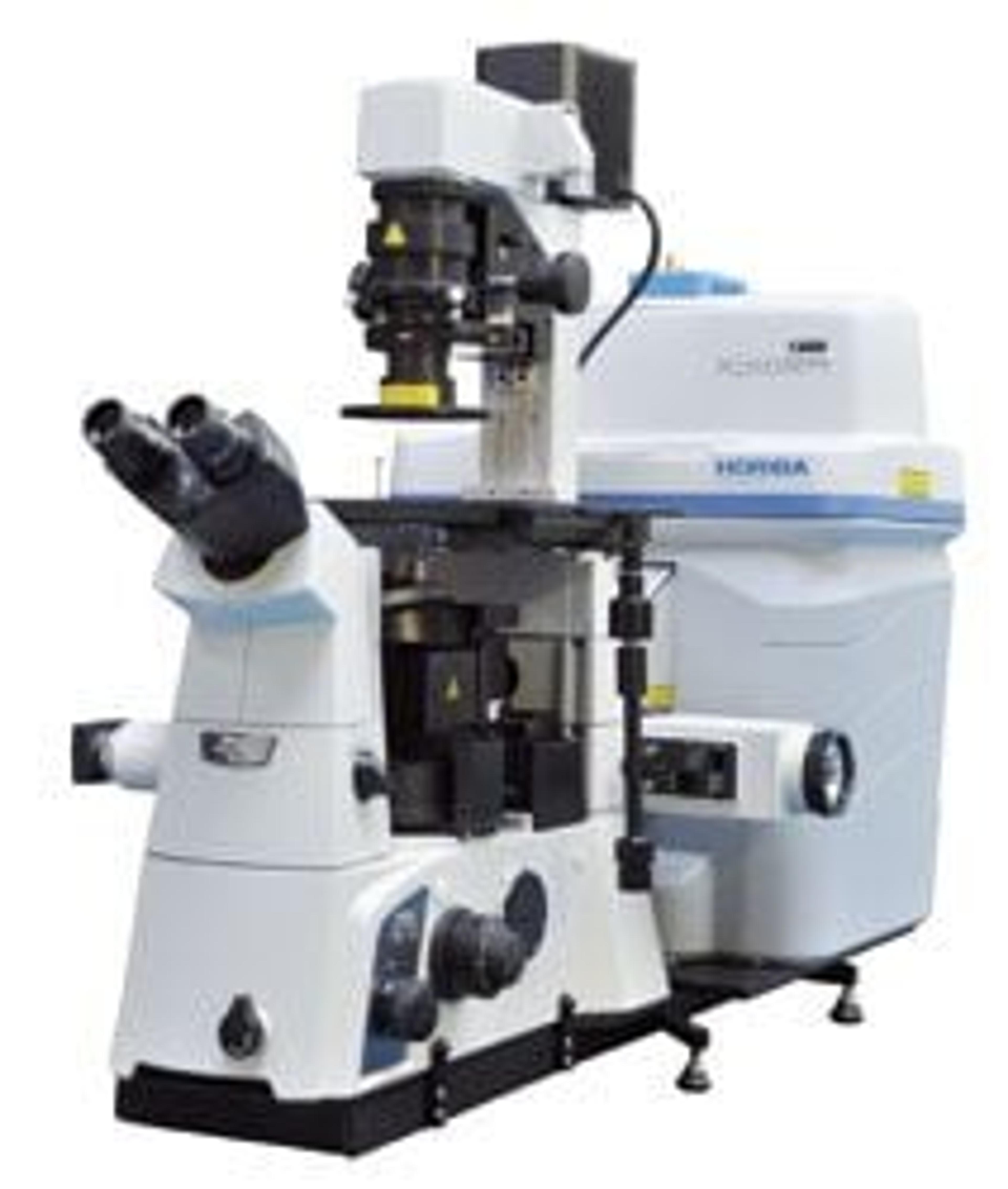
XploRA INV - Inverted Raman Microscope
HORIBA ScientificOptimized Raman Solution for Life Sciences from HORIBA Scientific The XpIoRA INV is an inverted Raman microscope designed specifically for use with biological samples requiring analysis from the bottom and/or open access to the sample from the top. Like all other XpIoRA series of Raman microscopes, the INV features a small footprint, complete automation (autofocus, autoexposure, autovalidation, autocalibration), and ease of use. Applications:• cell research • disease detection • characterisation of drug-cell interactions • pharmaceutical verification of intercellular activities In addition, the inverted geometry allows easy incorporation of AFM units for combined Raman-AFM and TERS (Tip Enhanced Raman Spectroscopy) for highest spatial resolution sample visualisation. The open structure of the XploRA INV also permits the use of virtually all options and add-ons for inverted microscopes, including micro manipulators and “optical tweezers”, specific enclosures for cell applications, etc. The XploRA INV also offers the option to integrate the unique scanning capabilities of HORIBA’s patented DuoScan for rapid spectroscopic multichannel Raman imaging, as well as the new 3D FCI (Fast Confocal Imaging) module, which allows ultra-fast fluorescence imaging for visualisation and verification.