
High-Content Screening for Phenotypic Profiling
15 Mar 2017Editorial article

A snapshot of the video from Labcyte Genomics Symposium 2016

The Institute of Cancer Research
The Institute of Cancer Research, London, is one of the world's most influential cancer research organisations, with an outstanding record of achievement.
Dr. Chris Bakal, Team Leader at the Institute of Cancer Research in London, spoke at the Labcyte Genomics Symposium about the benefits of high-content screening for phenotypic profiling and functional genomics. High-content screening can be used to examine signaling between cancer cells and their microenvironment. Cancer cells undergo multiple cell shape changes in order to metastasize, move in and out of the bloodstream and colonize a new tissue. 90% of cancer patient deaths are due to metastasis and understanding how cancer cells change shape could provide new therapeutics avenues.
Dr. Bakal describes the workflows employed for high-content phenotypic studies at the Institute of Cancer Research. RNAi is used to produce gene knock downs, the cells are then imaged and the images segmented to obtain morphological signatures of up to 600 different features, that capture the ‘shape’ of each cell. A complex picture of the cells with thousands of different RNAi and conditions is built up, which generates large data sets. The large data sets are examined in network models that assess the architecture, dynamics and remodeling. Experimental validation is then carried out using the network models, with emphasis given to in vivo models. By knocking down genes, quantifying the resultant cell shapes and using different computational methods to cluster morphological signatures, Dr. Bakal’s group has described more than 35 different local signaling networks that regulate different aspects of cell shape. Dr. Bakal describes how it is possible to extrapolate protein function, location and protein-protein interactions of unknown RNAi targets from morphological analysis alone, which enables the characterization of hundreds of unknown genes.
Integrative image-omics
Dr. Bakal gives examples of how his group applies high-content screening for ‘integrative image-omics’ to describe causal relationships between signaling network components. Dr. Bakal also describes the contribution of statistics and Bayesian inference and dependency modelling methods to build a picture of causality.
For several transcription factors, cell shape regulates signaling and not the other way around; this has important implications for screening. If cell shape is impacting signaling and therefore the phenotype, this must be taken into consideration when analyzing results from phenotypic studies. Dr Bakal describes a mathematical model to distinguish true ‘hits’ versus indirect effects, by correcting for cell shape changes in phenotypic screens. Problems with reproducibility between laboratories are common in RNAi screening and Dr. Bakal discusses how this could in part be due to failure to correct for these effects.
Watch the full presentation or learn more about the Echo® 555 Liquid Handler, Echo® 550 Liquid Handler and Echo® 525 Liquid Handler
Leave a product review today to be entered into a prize draw for the chance to win an iPad or $400 Amazon voucher (or equivalent currency)
Related products
Request Quote for All Products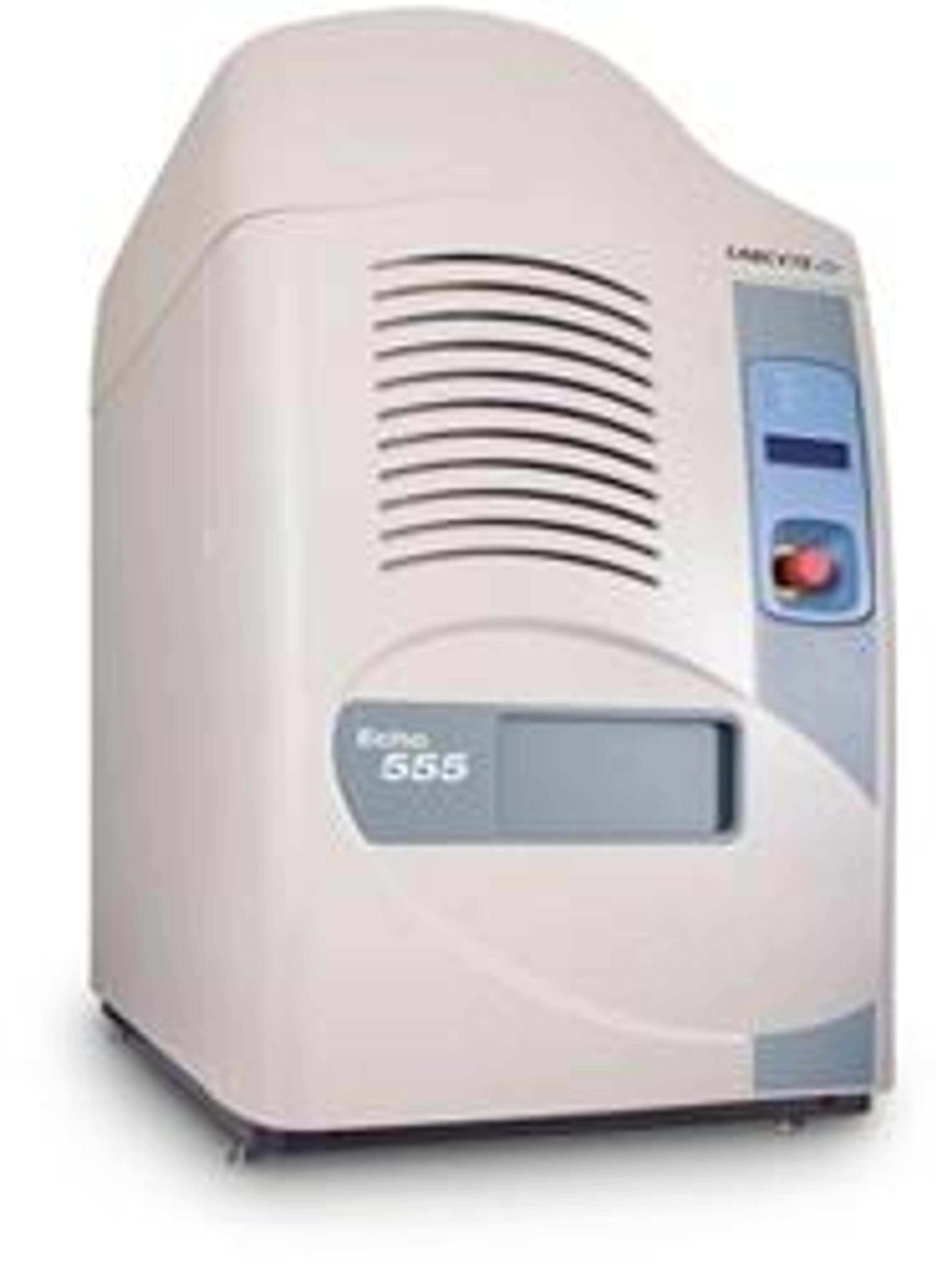
Echo® 555 Liquid Handler
Beckman Coulter Life SciencesEcho® 555 liquid handler - the world's fastest acoustic dispensing platform for life science applications. The Echo® 555 liquid handler is the world’s fastest acoustic liquid handling platform for life science applications. Laboratories that demand very high throughput rely upon the Echo 555 liquid handler for round-the-clock trouble-free operation to enable the fastest discovery.The Echo 555 doubles the throughput of the Echo 550 and provides transfers from as many as 660,000 wells per day. Like the Echo 520 and Echo 550 liquid handlers, the Echo 555 uses "touchless" ADE transfer technology. ADE uses sound energy to transfer 2.5 nL droplets from Echo-qualified 384- and 1536-well source plates into 96-, 384-, 1536- and 3456-well destination plates.This unique touchless technology eliminates consumable tip costs, washing, and cross-contamination. Unsurpassed volumetric precision (≤ 8% CV) and accuracy (≤ 10% CV) ensure superior results. Independent studies have shown that Echo liquid handlers eliminate false negatives due to sample loss on tip surfaces in low-concentration transfers. Like the Echo 550 liquid handler, the Echo 555 liquid handler reports both fluid volume and DMSO hydration.Echo® 555 Liquid Handler Features: Tipless transfer, resulting in dramatic cost savings Accurate, precise movement of nanoliter-scale quantities, enabling assay miniaturization and further reducing costs Elimination of cross-contamination, carryover or leachates Better results through direct dilution of compounds, an improvement over serial dilution methods Improved information about sample integrity and improved transfer quality through measurement of DMSO hydration level Applications: Compound management Compound screening siRNA screening Biochemical assays Cell-based assays PCR Genotyping Gene expression