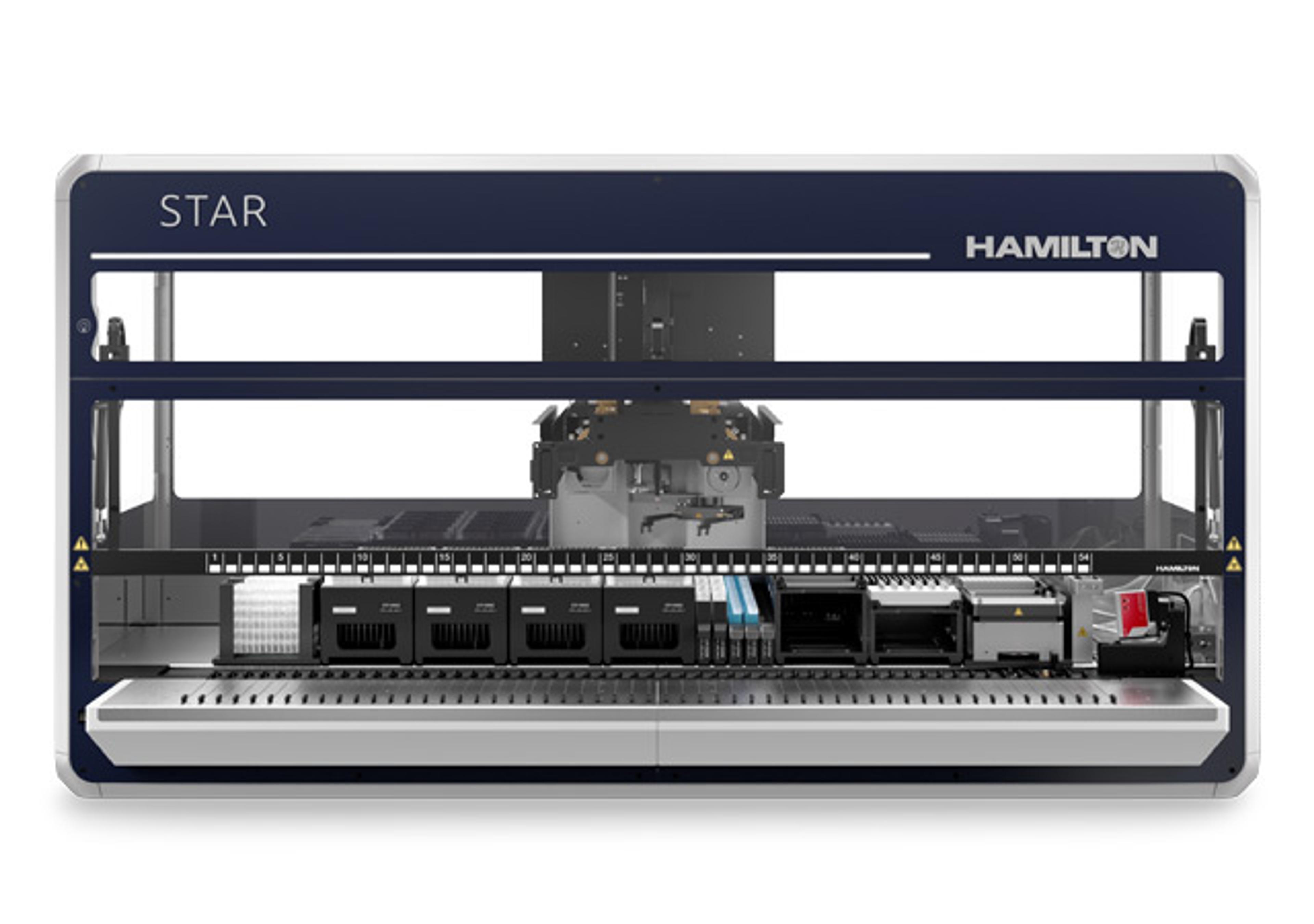
Hamilton Robotics provides Students at University of Nevada, Reno with Advanced Automation Technology

21 Oct 2013

Liam McNair
Administrator / Office Personnel

Industry news

Students and faculty at the University of Nevada, Reno will soon be exploring new robotic innovations and accessing state-of-the-art laboratory automation systems in collaboration with the Hamilton Company, a Reno-based international robotic manufacturing company.


The University's College of Agriculture, Biotechnology and Natural Resources is providing laboratory space in the Howard Medical Sciences building for several automated liquid handling stations, where Hamilton aims to develop new cell-, protein- and nucleic acid-based applications for their workstations. Students and faculty will be trained to use the high-throughput, accurate and complex instruments, which use precision robotic arms to automate a wide range of laboratory tasks.

“This project has the potential to increase the research productivity at the University and could lead to new research opportunities, said” David Shintani, biochemistry professor and associate dean of the college. “It will also provide an unprecedented training opportunity for our students, which will give them a competitive edge when they enter the job market.”

The workstations in the Hamilton Center for Laboratory Automation will perform tasks in minutes that would take technicians hours or even days to complete, without the risk of human error associated with repetitive and tedious motions. The instruments are most commonly used for the isolation, extraction, normalization, amplification, purification, cloning and analysis of nucleic acids (DNA or RNA) for all types of biological materials, including blood, bacteria cultures, cells, tissue and plants.

“Hamilton is thrilled to take part in educating the young scientists and clinicians of the future, especially within our own backyard," said Jose Carle, vice-president at Hamilton Robotics, a division of the Hamilton Company. “Not only does this opportunity provide a unique learning experience for the students, it also gives Hamilton new insights into the needs and expectations of potential future customers. In addition, it provides a broader employment pool when we look for talented researchers and technicians to be a part of our company,” said Carle.

Microlab STAR

Hamilton

Experience Automation Your Way. The Microlab STAR Line automates liquid handling tasks from simple to complex with exceptional precision and flexibility so that you can increase throughput, reduce errors, and gain confidence in results.

(75)

Links

Tags

Genome AnalysisGenomics, the study of genomes, includes functional genomics, evolutionary genomics and comparative genomics. There are many genomic technologies such as DNA sequencing of whole genomes, computational biology and bioinformatics. DNA and nucleic acids must be isolated and concentrated from cells for analysis with kits, automated analyzers and software. Other useful technologies for studying genomics include PCR, microarrays and electrophoresis.ProteomicsProteomics is the systemic bioinformatics study of proteins and amino acids, including their structure, size, function and identification. Tools used in proteomics include chromatography, blotting and gels, protein arrays, mass spectrometry and ELISA and associated analysis software. Analyzers and proteomic systems should be sensitive, high resolution, fast and may be automated for high-throughput.High-Throughput ScreeningHigh-throughput screening (HTS) is an automated drug discovery technique for identification of active compounds against a compound library. Use HTS readers and integrated assay preparation / analysis workstations to screen your compounds. Identify active compounds against various HTS libraries, including membranes, proteins and peptides and HTS cell lines. Find the best high-throughput screening products in our peer-reviewed product directory: compare products, check customer reviews and receive pricing direct from manufacturers.PCR and Thermal CyclingPolymerase chain reaction (PCR) kits and thermal cyclers are used for the in vitro amplification of DNA permitting subsequent analysis and experimental procedures. Explore a range of high-quality polymerase, primers and nucleotides or simplify your workflow with a PCR mastermix. Find reverse transcription PCR (RT-PCR) and cDNA synthesis kits for RNA products and libraries. Quantitatively measure the amplification of DNA with real-time PCR (qPCR) and droplet digital PCR (ddPCR) kits and systems, and discover automated PCR setup solutions to increase throughput. Alternative DNA amplification methods also include recombinase polymerase amplification (RPA) kits. Find the best PCR kits and thermal cyclers and purification equipment in our peer-reviewed product directory: compare products, check customer reviews and receive pricing direct from manufacturers.DNA / RNA Extraction and PurificationPurified DNA and RNA are required for numerous downstream molecular biology applications. Consequently, the importance of high-quality DNA/RNA extraction and purification equipment cannot be underestimated. Many purification kits are available and are typically optimized for nucleic acid type and source, including plasmid DNA, genomic DNA, mRNA, RNA and viral nucleic acid purification kits. Automated extraction and purification of nucleic acids can be implemented with magnetic bead separator instruments or high-throughput purification workstations. Find the best DNA/RNA extraction and purification equipment in our peer-reviewed product directory: compare products, check customer reviews and receive pricing direct from manufacturers.DNA SequencingDNA sequencing, such as sanger sequencing, is a biological technique that determines the precise order of nucleotide bases in a fragment or template of DNA. DNA sequencers and genetic analyzers are based on capillary electrophoresis, where labeled DNA fragments are electrophoretically separated by size as they migrate through a polymer. Find the best DNA sequencing products, including DNA sequencing kits, genomic libraries and genetic identity kits in our peer-reviewed product directory: compare products, check customer reviews and receive pricing direct from manufacturers.Gene Expression and Molecular CloningMolecular cloning is a set of techniques that utilizes vectors to transfer recombinant DNA into host cells and is an essential tool for investigating the expression of genes and proteins in bacterial or mammalian cells. A variety of vectors optimized for gene cloning and expression in a range of host organisms are available, alongside competent cells for genetic replication. Here, you can explore a range of molecular tools, high-quality genomic and cDNA libraries, premade clones, transformation and transfection reagents and mutagenesis or gene expression detection assays and expression arrays. Find the best gene expression and molecular cloning products in our peer-reviewed product directory: compare products, check customer reviews and receive pricing direct from manufacturers.Robotic InstrumentsRobotic instruments can be used for high-throughput automation of many lab processes. Such processes use instruments for assays like cell based assays and ELISA, for sample preparation like shakers, centrifuges and incubators, and for analysis such as sequencing and western blot analyzers. Useful features of robotic instruments include speed, reproducibility, barcode readers, software and automation.Robotic WorkstationsRobotic workstations are automated platforms enabling the user to perform high-throughput, multi-application processes, from sample preparation tasks such as PCR set-up, DNA purification and NGS library preparation, to integrated sample prep and analysis workstations. Automation makes processes consistent, fast, precise and fully walk-away. Find the best robotic workstations in our peer-reviewed product directory: compare products, check customer reviews and receive pricing direct from manufacturers.Automated Liquid HandlingAutomated liquid handling equipment is used to mix, dilute and dispense allotted volumes of liquid into microplates and other vessels automatically. The robotic, liquid handling arms can dispense from single channel to 3456 multichannel as well as operate nanoliter dispensing, enabling high throughput of samples. Find the best automated liquid handlers in our peer-reviewed product directory: compare products, check customer reviews and receive pricing direct from manufacturers.AutomationAutomation in laboratories and manufacturing processes enhances efficiency, precision, and scalability by reducing the need for manual intervention. It plays a critical role in improving productivity, minimizing human error, and accelerating workflows in fields like diagnostics, drug development, and industrial testing. Automation technologies include robotic systems, automated liquid handlers, and process control systems that streamline complex tasks and ensure consistent, reproducible results. Explore our peer-reviewed product directory to discover the best automation solutions, compare options, read user reviews, and get prices directly from manufacturers.Liquid Handling WorkstationLiquid handling workstations automate the process of sample preparation, improving accuracy and efficiency. These systems are essential for high-throughput applications in biological, chemical, and pharmaceutical research, reducing human error and increasing reproducibility. Workstations come equipped with robotic arms, pipetting tools, and other accessories to streamline lab workflows. Explore liquid handling workstations in our peer-reviewed product directory; compare products, check reviews, and get pricing directly from manufacturers.
Hamilton Robotics provides Students at University of Nevada, Reno with Advanced Automation Technology