Hamilton Robotics Automates the Promega CellTiter-Glo* Cell Viability Assay for High-Throughput Applications

26 May 2009
admin admin
Consultant

Product news

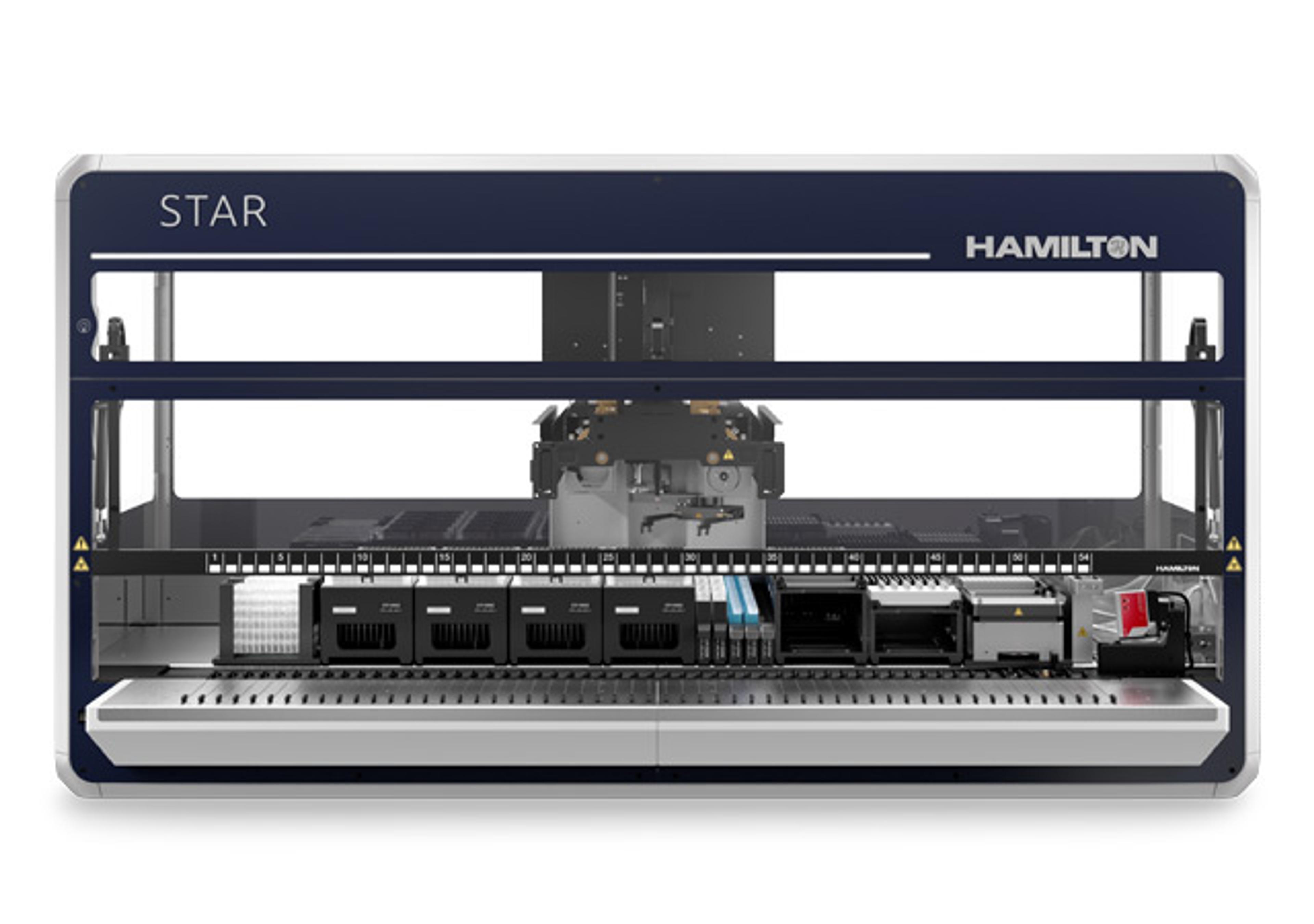
Hamilton Robotics announced today a successful collaboration with Madison, Wisconsin-based Promega Corporation to automate the CellTiter-Glo luminescent cell viability assay on Hamilton's MICROLAB® STAR liquid handling workstation. The two companies have developed an automated, tested and verified protocol for the fast and accurate dispensing of the Promega reagent in microplate format.

Cell viability assays are widely used in biotech, pharmaceutical and academic research, providing information on cell health, proliferation and toxicity. In addition to drug discovery, common applications include research on disease, environmental damage and implant rejection.

The Hamilton STAR 8-channel platform, with its unique air displacement pipetting technology, performs precise dispensing of the CellTiter-Glo reagent in 96- or 384-well plate formats and can process multiple plates per day for high-throughput labs. An integrated shaker effectively disrupts cells at 400 rpm in 96-well plate format.

"The Hamilton air displacement technology has a number of advantages and the software interface is unique and easy to use," comments Sarah Shultz, senior automation scientist for Promega. "The robot runs smoothly and this protocol is ideal for customers running multiple plates per day."

"This is the one of several automated solutions we are developing with Promega," commented Rick Luedke, product manager for Hamilton Robotics. "With the current rapid growth in cellular research, this is a key collaboration for Hamilton. Automation can deliver increased speed, accuracy and reproducibility to the setup and processing of cell-based assays."

*CellTiter-Glo is a registered trademark of Promega Corporation.

Microlab STAR

Hamilton

Experience Automation Your Way. The Microlab STAR Line automates liquid handling tasks from simple to complex with exceptional precision and flexibility so that you can increase throughput, reduce errors, and gain confidence in results.

(75)

Links

Tags

MicroplatesMicroplates are multi-well plates used to increase the throughput of biological investigations. The number of wells microplates contain can range from 6 to 3243 wells, with the 96-well format being the most commonly used. Microplates can come tailored for a range of applications including cell culture, PCR, filtration, storage, non-binding surface, protein crystallization, as well as pre-coated, deep well and normal Standard microplates. Additionally, options for microplate colors include clear , black, white or black with clear bottom and white with clear bottom for absorbance microplate reader applications. Find the best microplates for your lab in our peer-reviewed product directory: compare products, check customer reviews and receive pricing direct from manufacturers.Pipettes and DispensersPipettes and dispensers are essential lab equipment used to dispense measured volumes of liquid accurately. Explore a range of manual and electronic pipettes, including single and multichannel, serological and volumetric pipettes, as well as a range of pipette tips. Bottle-top dispensers are also available for simple and fast solvent dispensing. Find the best pipettes & dispensers in our peer-reviewed product directory: compare products, check customer reviews and receive pricing direct from manufacturers.Sample ManagementSample management systems include sample storage devices such as freezers and plate storers, sample environment enclosures and sample organization, retrieval and sorter systems. Useful system features include high-throughput, automation, robotic arms, automated liquid handling and associated database systems. Accessories in sample management include barcode scanners, heat sealers and tubes.Cell-Based AssaysCell-based assays are used to monitor the presence, quantity and activities of a desired cellular analyte including drug molecules or biomarkers. This can reveal information on cell health (apoptosis, cytotoxicity, viability and proliferation assays), cell metabolism, cell migration and cell signaling mechanisms. Find the best cell-based assay products, kits and equipment with our peer reviewed product directory: compare products, check customer reviews and receiving pricing direct from manufacturers.Robotic WorkstationsRobotic workstations are automated platforms enabling the user to perform high-throughput, multi-application processes, from sample preparation tasks such as PCR set-up, DNA purification and NGS library preparation, to integrated sample prep and analysis workstations. Automation makes processes consistent, fast, precise and fully walk-away. Find the best robotic workstations in our peer-reviewed product directory: compare products, check customer reviews and receive pricing direct from manufacturers.Software PlatformsSoftware platforms are useful for various stages of laboratory experiments from data collection to data storage and processing. For instance lab software is available for system control, data management, data analysis and qualification / validation.Automated Liquid HandlingAutomated liquid handling equipment is used to mix, dilute and dispense allotted volumes of liquid into microplates and other vessels automatically. The robotic, liquid handling arms can dispense from single channel to 3456 multichannel as well as operate nanoliter dispensing, enabling high throughput of samples. Find the best automated liquid handlers in our peer-reviewed product directory: compare products, check customer reviews and receive pricing direct from manufacturers.
Hamilton Robotics Automates the Promega CellTiter-Glo* Cell Viability Assay for High-Throughput Applications