From gene to genome: NGS workflow automation for homogeneity in sequencing

The head of molecular genetics at Munich Leukemia Lab highlights the benefits of sequencing automation to improve the success of leukemia therapy

15 Apr 2020

Cameron Smith-Craig
Cameron Smith-Craig
Pharma and Applied Sciences Editor

Expert insights

Dr. rer. nat. Manja Meggendorfer

In a SelectScience webinar now available to view on demand, Dr. rer. nat. Manja Meggendorfer, MBA, head of molecular genetics at the Munich Leukemia Laboratory, delivers a presentation on the challenges of NGS workflow automation and the key benefits of automated library preparation in diagnostic workflows, including reliability, safety, and precision.

Watch Webinar Now

Meggendorfer also details how the leukemia laboratory achieved uniform output and homogeneity within its sequencing process and how overnight automation reduces turnaround times, ensuring fast conveyance of information to physicians.

Read on for highlights from the live Q&A session or register to watch the webinar at any time that suits you.

Certificate of attendance
It’s not too late! All webinar participants are entitled to a certificate of attendance.

Highlights from the live Q&A session can be found below:

Q: With regard to automation of your NGS workflows, did you start with the three systems for research and routine diagnostics right away, or was it more a stepwise extension of your automation pipeline?

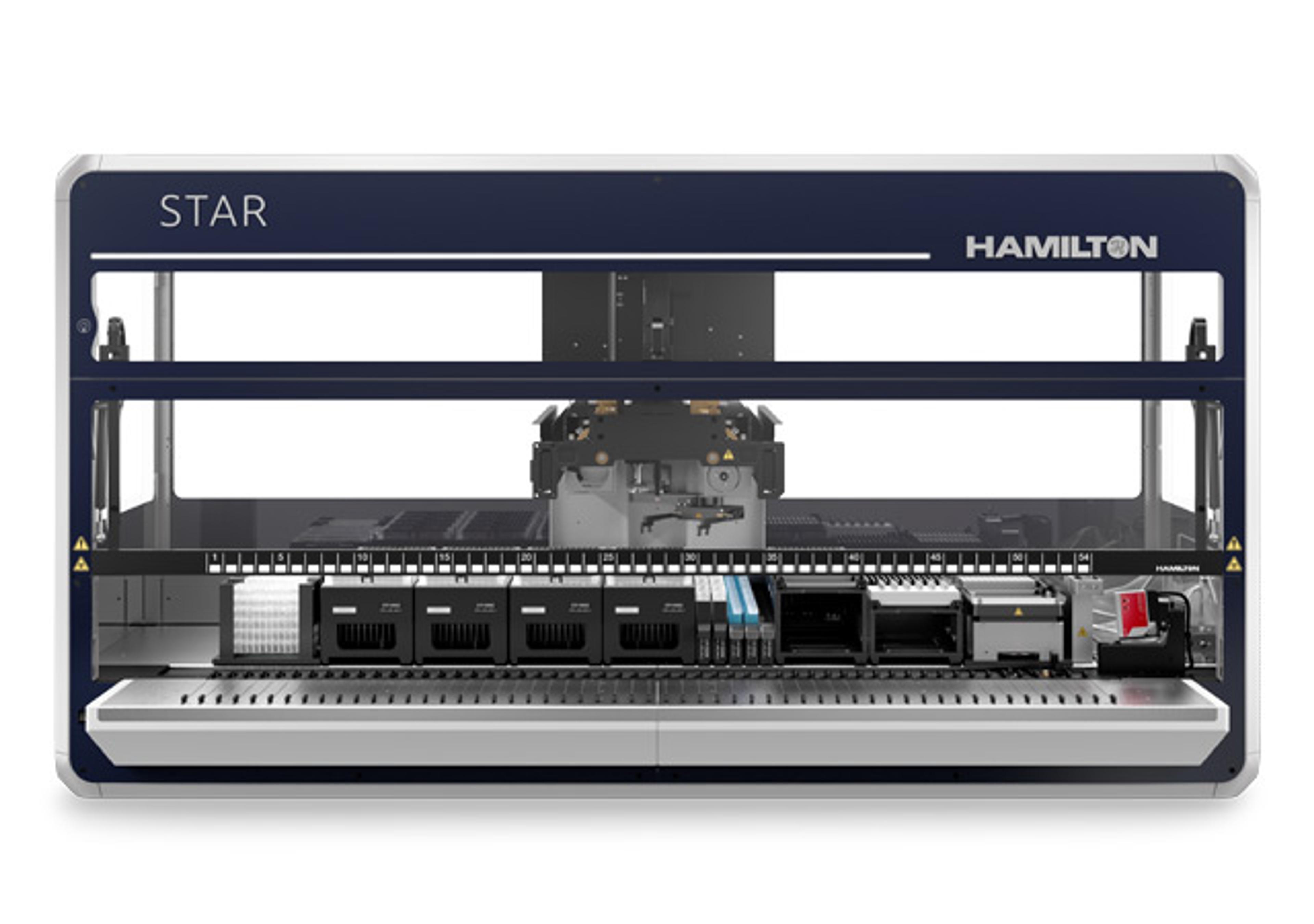
MM: In our lab, we try to automize as much as possible due to the increasing throughput of all our analysis. Mostly, we try to establish new workflows in the research setting and then release them to our routine diagnostic settings. We started, in this case, with the automation of the WGS and transcriptome workflows, and extended subsequently to the routine panel workflows. We started with one system, extended to two, then two or three, and finally a fourth one.

Q: Are there upfront workflow steps for NGS library preparation, such as DNA and RNA isolation, also automated in your Hamilton NGS STAR, or do you use separate workstations for this part of the workflow?

MM: For the DNA and RNA extraction, we currently use the MagNA Pure 96 system from Roche. We don't use an NGS STAR. However, for rare materials like FFPE and fixed DNA samples, we’re trying to establish an NGS STAR extraction method for next year. But currently, we use the 96 MagNA Pure systems.

Q: Have you separated pre- and post-PCR workflow steps in your lab, or do you use the systems as combined pre-post workstations for NGS library preparation?

MM: Due to our ISO accreditation, we try to split the workflows in pre- and post-PCR systems as much as possible. For independent workflows, we have two separate systems for the pre- and post-PCR steps of the library preparation and enrichment. However, for WGS and RNA-seq the library preparation is done on one system. Since this is a research setting, we combine the other pre- and post-PCR steps into one system. But, actually, we try to separate these two parts as far as possible.

SelectScience run multiple webinars a month covering various scientific topics, find our upcoming events here >>

Aliquot STAR Line

Hamilton

Hands-Off from Start to Finish. Rely on the Aliquot STAR Line to automate the tedious task of decapping and recapping of sample tubes, so you can focus on higher-value activities.

(3)

Links

Tags

Genome AnalysisGenomics, the study of genomes, includes functional genomics, evolutionary genomics and comparative genomics. There are many genomic technologies such as DNA sequencing of whole genomes, computational biology and bioinformatics. DNA and nucleic acids must be isolated and concentrated from cells for analysis with kits, automated analyzers and software. Other useful technologies for studying genomics include PCR, microarrays and electrophoresis.DNA SequencingDNA sequencing, such as sanger sequencing, is a biological technique that determines the precise order of nucleotide bases in a fragment or template of DNA. DNA sequencers and genetic analyzers are based on capillary electrophoresis, where labeled DNA fragments are electrophoretically separated by size as they migrate through a polymer. Find the best DNA sequencing products, including DNA sequencing kits, genomic libraries and genetic identity kits in our peer-reviewed product directory: compare products, check customer reviews and receive pricing direct from manufacturers.Automation Supplies / AccessoriesAutomated accessories and consumables make lab processes fast, efficient and reliable. Useful automation accessories include microplate sealers, label printers and reagent reservoirs.Next Generation SequencingNext-generation sequencing (NGS), also known as whole-genome sequencing, high-throughput sequencing and massive parallel sequencing, produces and analyses thousands to millions of nucleotide sequences at once. Sequencing systems operate via varying technologies depending on the manufacturer, including sequencing by synthesis, ligation, pyrosequencing, ion semiconductor and single-molecule real-time sequencing. For NGS, library preparation is paramount to successful sequencing. In this section, explore a range of library preparation kits, from targeted, amplicon-based or hybridization-based kits including epigenomic, transcriptomic and genomic workflows to fragmentation kits. Find the best next-generation sequencing products in our peer-reviewed product directory: compare products, check customer reviews and receive pricing direct from manufacturers.LeukemiaAutomationAutomation in laboratories and manufacturing processes enhances efficiency, precision, and scalability by reducing the need for manual intervention. It plays a critical role in improving productivity, minimizing human error, and accelerating workflows in fields like diagnostics, drug development, and industrial testing. Automation technologies include robotic systems, automated liquid handlers, and process control systems that streamline complex tasks and ensure consistent, reproducible results. Explore our peer-reviewed product directory to discover the best automation solutions, compare options, read user reviews, and get prices directly from manufacturers.NGS AutomationNGS automation streamlines next-generation sequencing workflows, increasing throughput, accuracy, and reproducibility. Automated solutions enhance productivity in genomic research, clinical diagnostics, and personalized medicine. Browse peer-reviewed tools to compare products, read reviews, and get pricing.Genome SequencingGenome sequencing involves determining the complete DNA sequence of an organism's genome. It provides crucial information about genetic variations, mutations, and diseases. Advances in sequencing technologies, such as next-generation sequencing (NGS), have accelerated research in genomics, diagnostics, and personalized medicine. Explore genome sequencing tools in our peer-reviewed product directory; compare products, check reviews, and get pricing directly from manufacturers.Webinar
From gene to genome: NGS workflow automation for homogeneity in sequencing