From explosives to COVID-19: Applying defense technology to diagnostics

Discover how an innovator in drug and explosives detection was able to adapt its portable technology to aid COVID-19 diagnostics

26 Jan 2022

Cameron Smith-Craig
Cameron Smith-Craig
Pharma and Applied Sciences Editor

Editorial article

Sci-Print VX2
"Automating where we can has helped save time for the whole team, which also means we can focus on other tasks outside of production."

The COVID-19 pandemic has brought with it an urgent need to ensure accessible diagnostics to monitor outbreaks and to protect as many people as possible. This need was recognized not only by existing medical manufacturers but also innovators in other industries, such as agriculture and defense, who could see the potential advantages of their approaches to rapid detection and so mobilized their resources.

In this exclusive interview, we speak with Chris Gaffney, developmental scientist at DetectaChem, Inc., a leader in mobile drug and explosive detection, to explore how its daughter company, MD-Bio, has been able to successfully adapt its MobileDetect platform to fit the needs of the medical industry, catering for rapid COVID-19 diagnostics with support for further pathogens in the pipeline.

How was MD-Bio formed and what is its mission in COVID-19 testing?

CG: DetectaChem, Inc., one of the front runners for drug and explosive detection using a mobile platform, is the parent company for MD-Bio. The company offers a phone app as well as a machine called the SEEKERe, a small handheld explosive detector. DetectaChem, Inc. works with almost every government entity, for example, the FBI, CIA, ATF, with virtually every warship in the naval fleet having a SEEKERe on it.

DetectaChem’s drug detection products work using a colorimetric spectrum and so, once COVID-19 hit, a couple of our engineers decided to see if it was possible to use a colorimetric loop-mediated isothermal amplification (LAMP) that worked in a similar way to how you use colorimetrics to run diagnostic tests. Based on this initial research, the company decided to pivot to making the first product for COVID-19 diagnostics, the BCC19. It received an emergency use authorization (EUA) from the FDA in September of 2020, and then shortly after, it decided to make MD-Bio a full-time separate company, hiring myself and a couple other scientists to spearhead this new venture.

Can you explain the principles of the technology used in your testing solutions?

CG: We have three different diagnostic platforms. We have colorimetric LAMP, fluorescence LAMP, and then qPCR-based probes. In colorimetric LAMP there are multiple sets of primers, unlike PCR where there's only the forward and the reverse. With LAMP, there is the F3, B3, the forward inner primer, the backwards inner primer, and the two loop primers. It's a total of six different primer sets.

What happens is the primers span different parts of the gene of interest, or the pathogen of interest, that it's trying to detect. With colorimetrics specifically, there is a phenol red dye that will shift from a pinkish color to yellow for a positive result, based on a pH change. Instead of using phenol red for colorimetric or fluorescence LAMP, we use intercalating dyes for detection. For our qPCR platform, we use TaqMan probes for a multiplexing-based detection.

We also have the MobileDetect app to read and log test results using a barcode system. For BCC19, the camera can pick up the change in color and provide diagnostic results. This system can also pair with a company’s existing logging system, meaning they can give out results to customers.

How have you automated your laboratory workflows when designing and manufacturing the test kits?
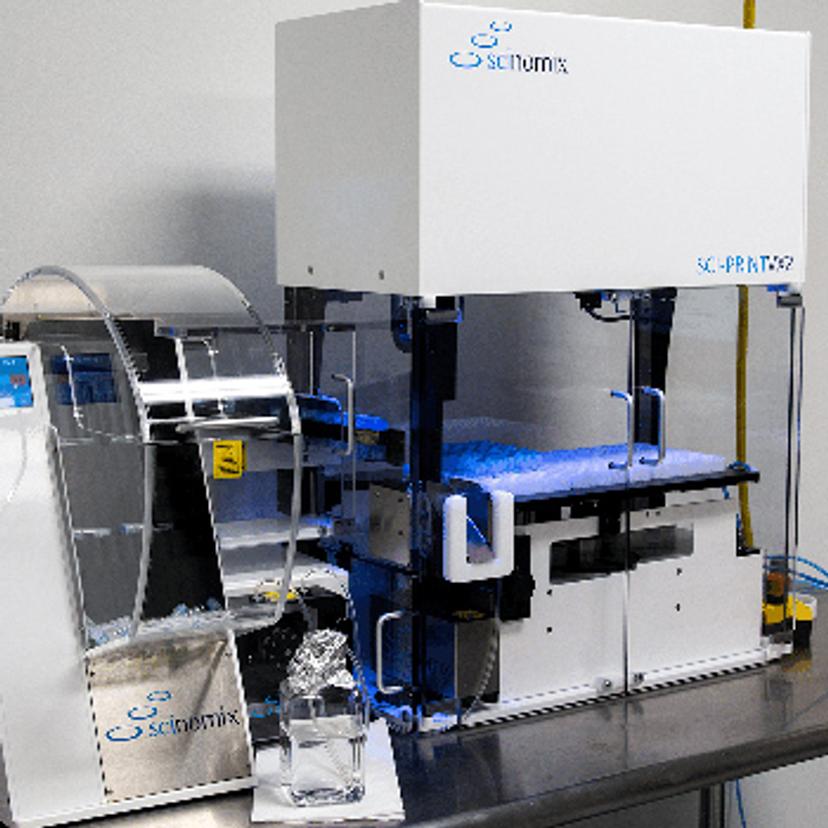
Scinomix VXQ
The Sci-Print VX2 coupled with the Scinomix VXQ bulk tube handler in the lab at MD-Bio

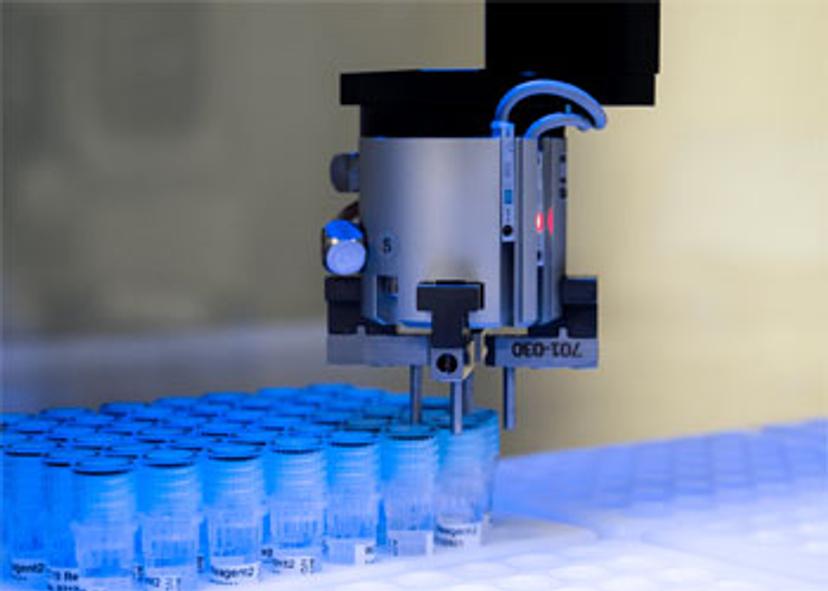
CG: In the laboratory setting, we try to use automation for the less meticulous or strenuous tasks, to reduce fatigue. For all our filling and labeling we use Sci-Print VX2 tube handling system combined with the VXQ bulk tube feeder and the Sci-Pump Peristaltic pump. We also have a couple of automated pipettes that we use. All our extraction is done through a machine-based approach and then, for any visualization of nucleic acids, we have a few qPCR and PCR machines.

Automating where we can has helped save time for the whole team, which also means we can focus on other tasks outside of production. Production can be a very time-consuming and tedious process because the samples have to be perfect, be delivered in the right amounts, be consistent, and you have to make sure there's no potential for contamination. We have to validate and pull samples to make sure they are free of anything that's going to inhibit or contaminate the reaction for our customers.

Do you receive support from the manufacturer?

CG: Scinomix has always been on hand to help. I like the personal one-on-one that the company is able to provide as it’s not a huge conglomerate like some of the other companies in the sector. Anytime I've had a problem, I've called one of its representatives. I've never really had a problem getting a hold of someone, and they are usually very, very patient and helpful.

Do you have any advice for other scientists who might be looking to purchase this equipment?

CG: I would recommend the Sci-Print VX2 tube handling system and the VXQ bulk tube feeder to anyone who is losing throughput in their production line. For example, we’re able to program it, validate that the fill volume is correct, then just leave the machine to run. We then grab the samples that we're going to validate and then we store the rest.

I think it would suit anyone who is trying to increase production of not only their assays or their kits, but also the development of other products. I think this is a very good piece of equipment, and there's not really too many like it for the price. The footprint of the Sci-Print VX2 tube handling system only takes up half of a benchtop, so we’re able to have other equipment on that station.

Is MD-Bio looking to expand its offering in the future? Will it be adding support for other pathogens?

CG: Yes, definitely. Right now, we have the EUA for colorimetric LAMP, but we’re also working on a multiplex assay for the flu and COVID-19. Instead of a large qPCR machine, we will be offering our own machine with a much smaller footprint. Alongside this, we're also looking at a point-of-care product using a multiplex assay. We have a couple of point-of-care fluorescence LAMP assays that we have just developed, but we’re just waiting on the EUA to come through.

That's what we're working on now, but we are also looking to work in the animal sector. My background is in animals, and so we have quite a few assays that we're working on involving livestock and small pets. To achieve this, we have partnered with a couple of universities to help develop certain assays that will help vet clinics as well as different feedlots or farmers. The goal is to empower them so they can perform rapid diagnostics on site. Similarly, we have also just spun into working within the food sector, trying to help develop rapid diagnostics for the key bacteria of concern such as E. coli, salmonella, and listeria.

Want the latest science news straight to your inbox? Become a SelectScience member for free today>>

Sci-Print VX2 Automated Tube Handler

Scinomix

The Sci-Print VX2 is a fully automated tube labeling system, capable of printing and applying labels to tubes ranging from 0.5 mL to 50 mL in size. The system can be used stand-alone or configured to sort racked tubes, receive bulk tubes, uncap/recap, fill and/or scan barcodes.

(20)

Scinomix VXQ Bulk Tube Feeder

Scinomix

The Scinomix VXQ is a bulk tube handler that eliminates hand loading of tubes into racks to provide even more time savings. The system is compatible with a range of tubes from 0.5 mL to 15 mL. When paired with the Sci-Print VX2 and VXL, the systems have a variety of functions including printing and labeling, filling, uncapping/recapping of screw top lids, and barcode scanning.

(1)

Links

Tags

PCR and Thermal CyclingPolymerase chain reaction (PCR) kits and thermal cyclers are used for the in vitro amplification of DNA permitting subsequent analysis and experimental procedures. Explore a range of high-quality polymerase, primers and nucleotides or simplify your workflow with a PCR mastermix. Find reverse transcription PCR (RT-PCR) and cDNA synthesis kits for RNA products and libraries. Quantitatively measure the amplification of DNA with real-time PCR (qPCR) and droplet digital PCR (ddPCR) kits and systems, and discover automated PCR setup solutions to increase throughput. Alternative DNA amplification methods also include recombinase polymerase amplification (RPA) kits. Find the best PCR kits and thermal cyclers and purification equipment in our peer-reviewed product directory: compare products, check customer reviews and receive pricing direct from manufacturers.Cell Lines Stem Cells and Primary CellsPrimary cell cultures, established cell lines and stem cells are vital for <i>in vitro</i> and <i>ex vivo</i> experimentation. High-quality cells, optimized for your applications, alongside optimized cell substrates, growth medium and supplements, are critical for experimental success. Explore a range of cells suitable for your applications, including isogenic cell lines, competent cells, induced pluripotent stem cell (iPSC)-derived cell lines, fungal/bacterial/mammalian cell lines, stem cells and cancer cell lines. Find the best cells for your research in our peer-reviewed product directory: compare products, check customer reviews and receive pricing direct from manufacturers.MicrobiologyMicrobiology is the study of microorganisms including protists, prokaryotes, fungi, and, often, viruses. Microorganisms are a useful research tool as genetic vectors and, in immunology, for antibiotic susceptibility testing, cellular biology and genetics. Microorganisms commonly grow readily in incubators with microbial culture media; this can contain chromogenic supplements to differentiate between cell lines. Estimate your culture’s density of microorganisms with colony counters, or screen and select colonies for desirable clones with automated colony pickers. Additionally, equipment is available to monitor environments for the presence of microbes and identify with microbial identification instruments. Find the best microbiology products in our peer-reviewed product directory: compare products, check customer reviews and receive pricing direct from manufacturers.Cell-Based AssaysCell-based assays are used to monitor the presence, quantity and activities of a desired cellular analyte including drug molecules or biomarkers. This can reveal information on cell health (apoptosis, cytotoxicity, viability and proliferation assays), cell metabolism, cell migration and cell signaling mechanisms. Find the best cell-based assay products, kits and equipment with our peer reviewed product directory: compare products, check customer reviews and receiving pricing direct from manufacturers.DNA SequencingDNA sequencing, such as sanger sequencing, is a biological technique that determines the precise order of nucleotide bases in a fragment or template of DNA. DNA sequencers and genetic analyzers are based on capillary electrophoresis, where labeled DNA fragments are electrophoretically separated by size as they migrate through a polymer. Find the best DNA sequencing products, including DNA sequencing kits, genomic libraries and genetic identity kits in our peer-reviewed product directory: compare products, check customer reviews and receive pricing direct from manufacturers.BiomarkersBiomarkers are biological markers which can be measured and evaluated to indicate a biological state. The use of biomarkers in research and diagnosis can indicate a normal or disease state or drug response of cells / tissues. Biomarkers include genetic markers, cell surface markers such as antigens, antibodies or receptors and secreted molecules such as cytokines. An assay system is required for identification of biomarkers. :Clinical MicrobiologyMicrobiology is the study of microorganisms including protists, prokaryotes, fungi, and, often, viruses. Microorganisms are a useful research tool as genetic vectors and, in immunology, for antibiotic susceptibility testing, cellular biology and genetics. Microorganisms commonly grow readily in incubators with microbial culture media; this can contain chromogenic supplements to differentiate between cell lines. Estimate your culture’s density of microorganisms with colony counters, or screen and select colonies for desirable clones with automated colony pickers. Additionally, equipment is available to monitor environments for the presence of microbes and identify with microbial identification instruments. Find the best microbiology products in our peer-reviewed product directory: compare products, check customer reviews and receive pricing direct from manufacturers.Next Generation SequencingNext-generation sequencing (NGS), also known as whole-genome sequencing, high-throughput sequencing and massive parallel sequencing, produces and analyses thousands to millions of nucleotide sequences at once. Sequencing systems operate via varying technologies depending on the manufacturer, including sequencing by synthesis, ligation, pyrosequencing, ion semiconductor and single-molecule real-time sequencing. For NGS, library preparation is paramount to successful sequencing. In this section, explore a range of library preparation kits, from targeted, amplicon-based or hybridization-based kits including epigenomic, transcriptomic and genomic workflows to fragmentation kits. Find the best next-generation sequencing products in our peer-reviewed product directory: compare products, check customer reviews and receive pricing direct from manufacturers.qPCRQuantitative PCR (qPCR) is a molecular biology technique used to amplify and measure the amount of a specific DNA or RNA target. It plays a crucial role in gene expression analysis, pathogen detection, and quantifying DNA or RNA in various applications. Real-time PCR provides precise, quantitative results and is widely used in research, diagnostics, and clinical studies. Browse our peer-reviewed product directory to find the best qPCR solutions; compare products, check reviews, and get pricing directly from manufacturers.DefenseMolecular DiagnosticsMolecular diagnostics use an individual’s genetic code and gene expression to diagnose and monitor diseases. The technique is used increasingly in the field of infectious diseases and oncology, as well as areas such as coagulation, HLA typing and pharmacogenomics. Molecular diagnostics plays a pivotal role in personalized medicine.CoronavirusCoronaviruses are a large family of viruses that can cause illnesses ranging from the common cold to more severe diseases like COVID-19. Research into the biology, transmission, and treatment of coronaviruses has become a global priority, particularly since the emergence of SARS-CoV-2. Understanding the virus�s structure and behavior is essential for developing vaccines, diagnostics, and antiviral treatments. Explore our peer-reviewed product directory to discover the latest research tools, diagnostic tests, vaccines, and treatments for coronavirus, compare products, read reviews, and receive pricing directly from manufacturers.Covid-19COVID-19, caused by the SARS-CoV-2 virus, has led to a global health crisis with profound impacts on societies and economies. Research into diagnostics, vaccines, treatments, and understanding viral mechanisms continues to evolve. The pandemic has accelerated innovations in healthcare and biopharmaceuticals, including novel vaccine platforms and rapid testing technologies. Browse our peer-reviewed product directory to find top COVID-19 testing kits, research tools, vaccines, and treatments, compare products, read reviews, and receive direct pricing from manufacturers.Infectious DiseasesInfectious diseases are caused by pathogens such as bacteria, viruses, and fungi. Effective detection, prevention, and treatment are crucial to control outbreaks and improve public health. Diagnostic tools, vaccines, and antimicrobial treatments are essential components of managing these diseases. Research into emerging pathogens and resistance patterns continues to evolve. Browse our peer-reviewed product directory to find the best diagnostic tools, prevention solutions, and treatment options; compare products, read customer reviews, and get pricing directly from manufacturers.