Free Webinar: Automate your ICP-OES Analysis with Powerful Software Tools

2 Oct 2017

Emily Adam
Publishing / Media

Expert insights

Would you like to streamline your ICP-OES method development and maximize your sample throughput? Then you won’t want to miss the forthcoming SelectScience webinar, featuring expert insights on ICP-OES analysis from Ross Ashdown, of Agilent Technologies.

Registration is now open for the event which will outline how automated tools and powerful software algorithms reduce the complexity of elemental analysis to the extent that ICP-OES analysis is simple, routine and reliable.

You will learn how to streamline their elemental analysis from instrument start-up to shutdown by using the latest tools included for use with ICP-OES instrumentation.

Analysis of complex matrices, such as brine, will be used to illustrate some of the tools that enable operators to:

  • Automate instrument performance checks
  • Streamline method development
  • Minimize/eliminate ICP torch blocking issues
  • Maximize sample throughput
  • Maximize instrument uptime

Register now for the event which will take place on October 17, 2017, 14:00 BST / 15:00 CEST or 08:00 PDT / 11:00 EDT. The event will be broadcast at two different times during the day, so you can choose the most convenient to attend. If you cannot attend either event time, please register to watch the webinar in your own time.

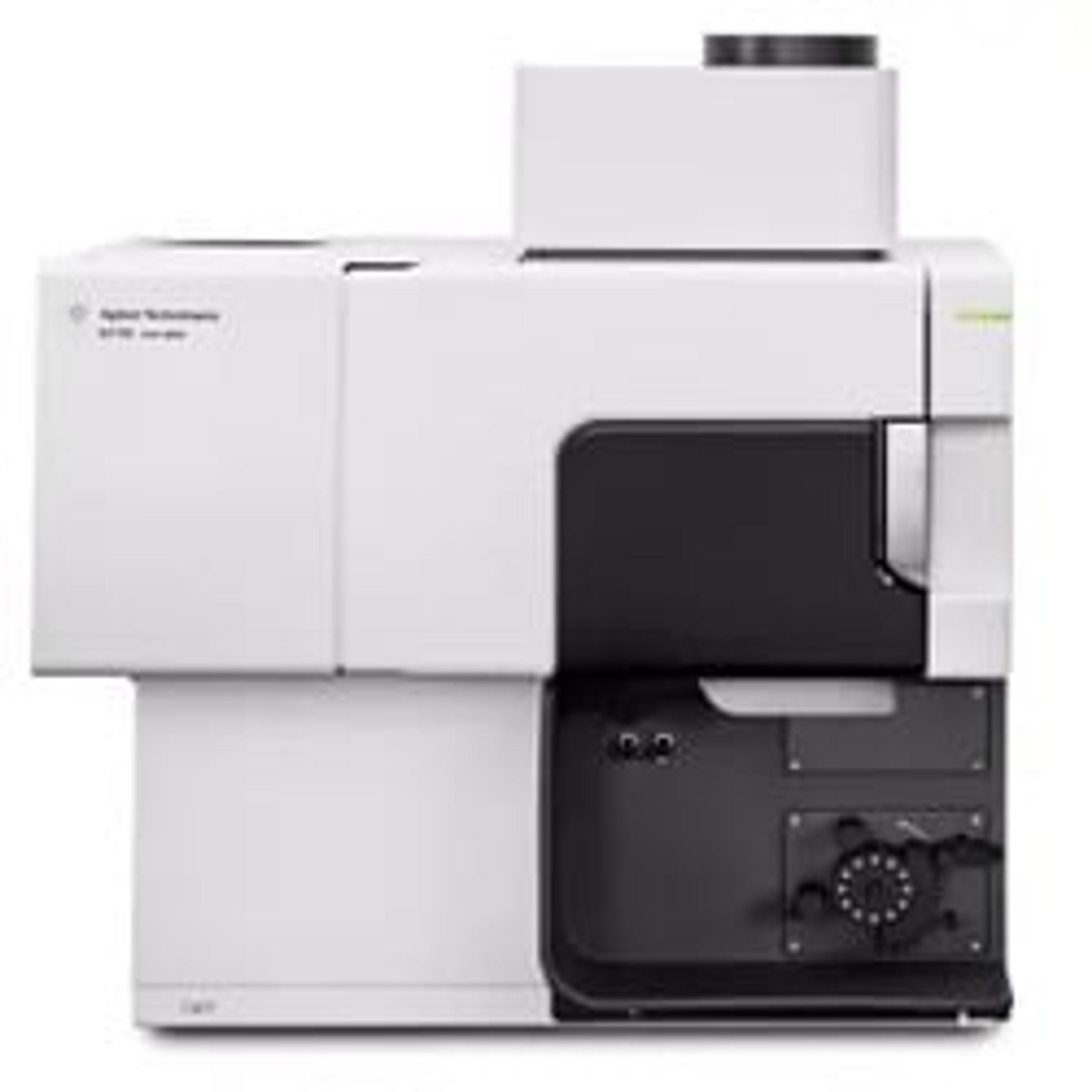
5110 ICP-OES

Agilent Technologies

The Agilent 5110 ICP-OES Instrument features unique Dichroic Spectral Combiner (DSC) technology that enables synchronous radial and axial measurements.

(18)

Links

Tags

Sample PreparationSample preparation can improve the quality and speed of separation techniques. Products to assist sample preparation include filtration equipment, evaporators, membranes and sieves.Atomic Absorption / Emission SpectroscopyAtomic absorption spectroscopy (AAS) and atomic emission spectroscopy (AES) — also called optical emission spectroscopy (OES) — are used to detect the elemental constituents in samples. Both techniques involve the atomization of a sample. Atomic absorption spectrometers may use a flame or furnace to create an atomic vapor of the sample before irradiation with spectral light. Optical emission spectrometers may use a flame, inductively coupled plasma (ICP), microwave plasma (MP) or spark arcs to atomize and excite the sample. At higher excitation energies, electrons can be emitted instead of photons, which can be useful for samples that can’t be atomized and for surface analysis. Explore electron spectroscopy equipment such as Auger spectrometers and photoelectron spectrometers for surface elemental analysis of samples. Find the best atomic absorption, photoelectron and optical emission spectrometers in our peer-reviewed product directory: compare products, check customer reviews and receive pricing direct from manufacturers.UV-Visible SpectroscopyUltraviolet-visible (UV-Vis) spectrophotometers are used to measure the interaction of UV and visible light with a sample, including transmission, reflectance & absorbance. The two major instrument classes are single-beam or double-beam spectrophotometers. More specialized equipment includes colorimeters, spectroradiometers and refractometers. Portable and microvolume spectrophotometers are also available. For the modular spectroscopy lab, explore a range of light sources for combination with a spectrograph/spectrometer and optics. Find the best UV-Vis spectroscopy products in our peer-reviewed product directory: compare products, check customer reviews and receive pricing direct from manufacturers.Software PlatformsSoftware platforms are useful for various stages of laboratory experiments from data collection to data storage and processing. For instance lab software is available for system control, data management, data analysis and qualification / validation.Software SolutionICP-MSInductively Coupled Plasma Mass Spectrometry (ICP-MS) is a powerful analytical technique used to determine the concentrations of elements and their isotopes in a variety of samples, including water, soil, and biological tissues. It involves ionizing elements in the samples with extremely high-temperature Argon (Ar) plasma and then using a mass spectrometer to measure the number of ions based on their mass-to-charge ratio (m/z). Explore ICP-MS systems in our peer-reviewed product directory; compare products, check reviews, and get pricing directly from manufacturers.Elemental AnalysisElemental analysis involves determining the elemental composition of a sample, often used in environmental, pharmaceutical, and material sciences. Techniques like ICP-MS, X-ray fluorescence, and atomic absorption spectroscopy allow precise quantification of elements such as metals and nonmetals in complex matrices. Browse our peer-reviewed product directory to find the best elemental analysis tools, compare products, check reviews, and get pricing directly from manufacturers.
Free Webinar: Automate your ICP-OES Analysis with Powerful Software Tools