Free Access to New Webinar Introducing Novel Large Volume Evaporation Technology

3 Nov 2010
Sarah Sarah
Marketing / Sales

Product news

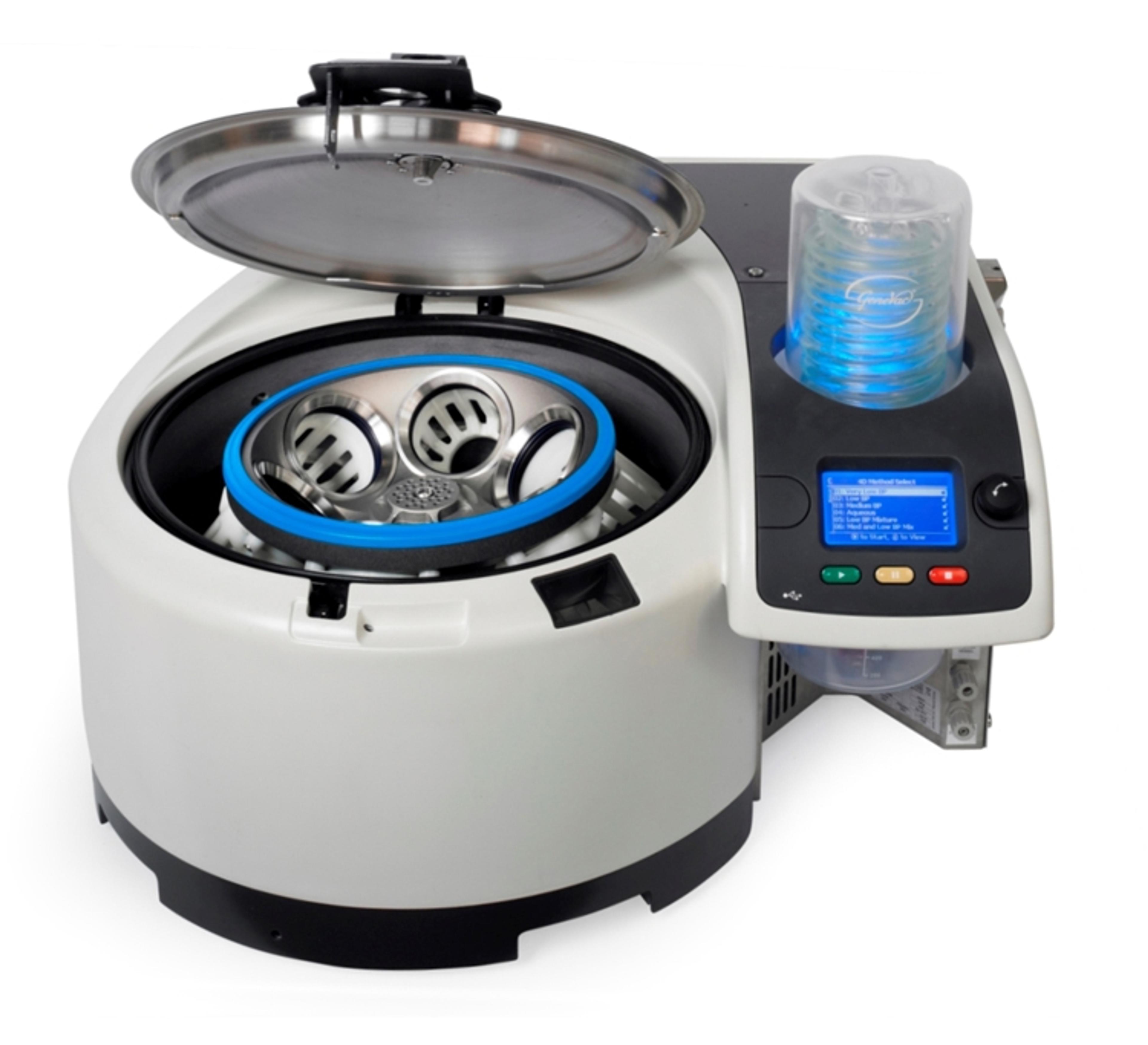
Genevac announces free access to a popular webinar that introduces the novel technology behind its ROCKET evaporator and describe how technological advances have addressed the shortfalls of traditional large volume sample evaporation techniques. The patented ROCKET technology is demonstrated using customer data showing highly efficient evaporation of environmental samples and HPLC fractions.

Fast, sample safe evaporative removal of large volumes of solvent is of considerable interest to many environmental, natural product, medicinal chemistry and chiral synthesis labs. Current techniques used for these applications have many shortfalls and there is no credible parallel sample evaporator for large volumes.

The Rocket Evaporator incorporates revolutionary new technology that enables it to dry or concentrate as many as six large volume flasks or up to 18 Accelerated Solvent Extractor (ASE®) tubes in a fraction of the time taken using conventional rotary evaporators.

Rocket Synergy Evaporator

Genevac

Rocket Evaporators use patented vacuum technology to evaporate solutions to dryness, or a concentrate, rapidly and safely. The latest Synergy series offers integrated, flexible solutions for processing a wide range of sample volumes. Interchangeable rotors will accommodate tubes, flasks and batch volumes of up to 100L. Rocket Synergy is designed primarily to quickly process larger volumes of solvent in parallel and without supervision. The Rocket Synergy Evaporator will accommodate six flasks, each containing up to 450ml of solvent, as well a variety of innovative Genevac sample holders such as the SampleGenie. The removable rotor may also be replaced with a 5L 316 stainless steel vessel for batch processing. Now you don't need to choose between flask or batch/feed evaporation. The Rocket and Rocket 4D Synergy evaporators will accommodate your process, whatever the volume. Each is capable of replacing several rotary evaporators and saving valuable bench space.

(3)

Links

Tags

UHPLC and HPLCHigh performance liquid chromatography (HPLC) and ultra high performance liquid chromatography (UHPLC), also known as UPLC, are analytical techniques used to separate, identify and quantitate components of complex mixtures including biological samples such as proteins and lipids as well as chemical mixtures of pesticides, drugs and oils. Both techniques are liquid chromatographic methods but differ by operating pressures (HPLC < 6000 psi < UHPLC ). Components of HPLC and UHPLC systems include columns, detectors, pumps, autosamplers and column heaters. Explore a range of UHPLC and HPLC columns for your specific sample needs including reverse phase, normal phase, ion exchange, HILIC, ion exclusion and size exclusion columns. For more specialized HPLC, explore FPLC, countercurrent LC and simulated moving bed systems. Find the best UHPLC and HPLC equipment in our peer reviewed product directory: compare products, check customer reviews and receive pricing direct from manufacturers.Sample PreparationSample preparation can improve the quality and speed of separation techniques. Products to assist sample preparation include filtration equipment, evaporators, membranes and sieves.IncubatorsLaboratory incubators are used to provide a stable environment to cultivate and store samples in, giving you optimal control of temperature, humidity, oxygen and CO<sub>2</sub> levels. Incubators are necessary equipment for cell culture and microbial research. Control temperature with heated or refrigerated incubators, or the levels of CO<sub>2</sub> and oxygen with CO<sub>2</sub> incubators. Using environmental chambers, create a humid climate for testing samples. Find the best incubators in our peer-reviewed product directory: compare products, check customer reviews and receive pricing direct from manufacturers.Environmental Monitoring and TestingEnvironmental monitoring and testing uses handheld portable analyzers, kits, spectrometers or chromatography systems for air, water, soil, food and other sample testing. Useful features of analyzers such as BOD and COD include portability, easy calibration, automation and sensitivity.  Environmental test kits for pH, water, moisture, etc, should be accurate, sensitive, reliable, fast and easy to use.Safety EquipmentLaboratory safety equipment is essential to the effective operation of all laboratories and is required to minimize the risk of harm during experiments. Safety equipment includes radiation safety, radioactive / hazardous waste disposal, alarms and personal safety.
Free Access to New Webinar Introducing Novel Large Volume Evaporation Technology