
Faster, Easier Quantification of Secreted IgG Antibodies
26 Jul 2007Product news
Guava Technologies, Inc. has launched a new and enhanced version Guava RapidQuant™ IgG Antibody Quantification Assays for mouse and human antibodies. Faster and easier than the average enzyme-linked immunosorbent assay (ELISA), the traditional approach for antibody quantification, RapidQuant Assays help users select of optimal clones from hybridoma screens.
According to David King, VP R&D and Operations, Guava Technologies, these mix-and-read, bead-based assays were developed with users in mind. “We wanted to give scientists an assay that almost ran itself,” said David. “The protocol is basically three simple steps; we eliminated the time-consuming sample preparation and washes common with many ELISAs.”
Users are quickly adopting the assays as critical tools for antibody research: “The RapidQuant IgG Assay expands our toolbox for differentiating monoclonal antibody cultures and is an essential tool when sub-cloning to obtain higher antibody secretors,” said Dr. John Kenney, President, Antibody Solutions, Mountain View, Calif.
Results from RapidQuant Assay are read on a plate-based benchtop flow cytometer, such as the Guava EasyCyte™ Plus System, and are equivalent to those obtained with traditional ELISAs.
Entirely new, the assay-specific RapidQuant Software gives users easy and complete data acquisition and analysis capabilities in a single program. Highly intuitive, it leads users directly to results while also offering customizable options for flexibility. And, assay processes are simplified with easy set-up, straightforward data acquisition, automatic analysis, and extensive data management options.
The end result is an ideal assay for hybridoma screening that combines the reliability of flow cytometry with the convenience of a microplate-based format.
To receive a special introductory offer, or simply learn more, contact Guava Technologies, Inc.
Related products
Request Quote for All Products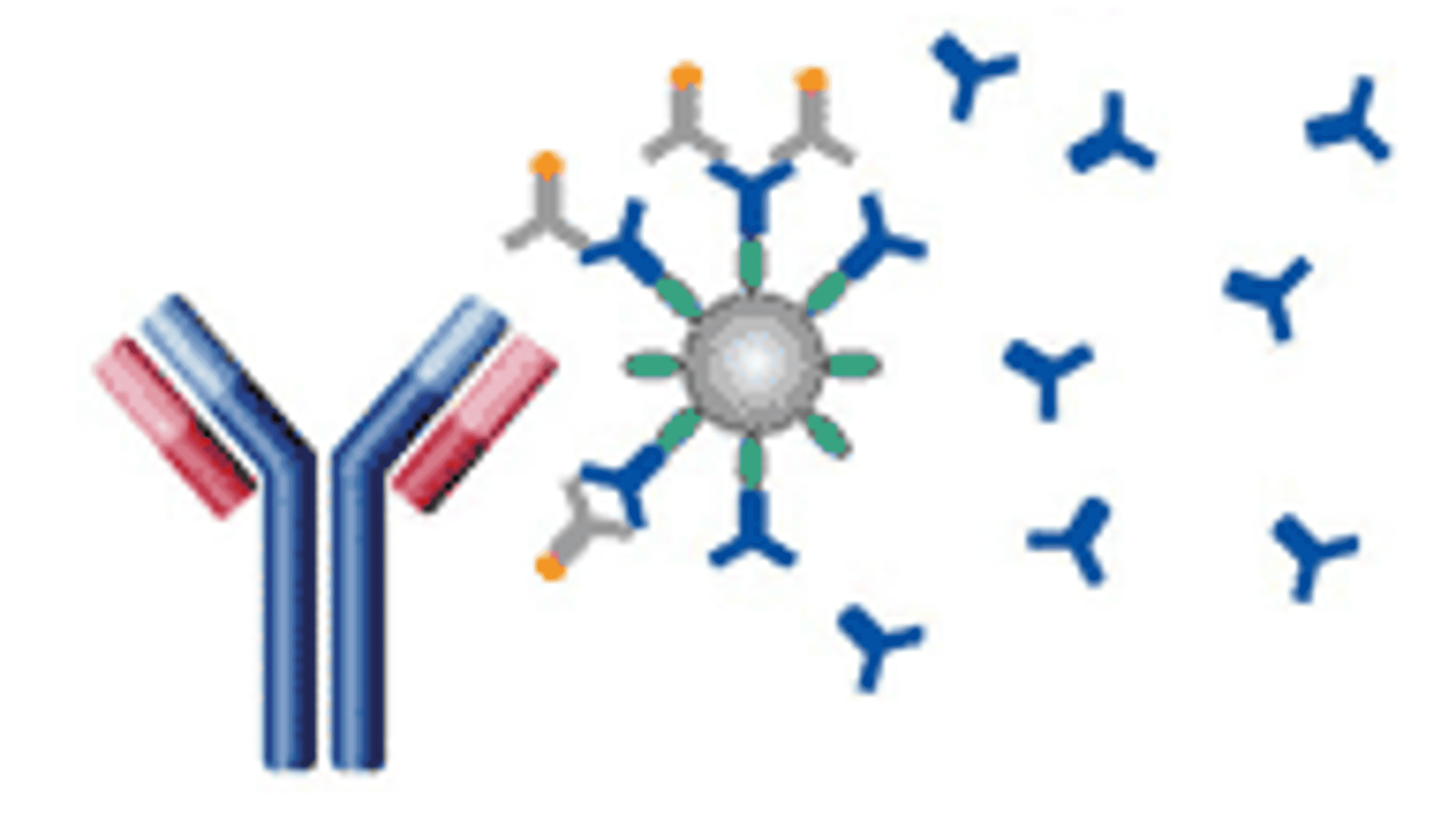
RapidQuant™ Mouse & Human IgG Antibody Quantification Assays
MerckQuick and Easy Antibody Quantitation:With its simplicity and ease of use, Guava’s new RapidQuantTM IgG Kits have raised the bar for IgG titering assays. Designed to be time-saving, labor-saving and money-saving, Guava’s RapidQuant kits eliminate the most tedious, laborious portions of antibody titering methods with Guava’s signature ease of use. • Robust, rapid and highly reproducible • Relevant quantitative range • Quantifies most IgG subtypes equivalently • Nearly twice as fast as typical ELISA assays • Ideal for use with robotic plate handler automation Guava RapidQuant kits are bead-based assays that rely on fluorescence for the quantitative measurements. The fluorescent intensity is proportional to the concentrations of antibody captured on the beads. The assay can be used to determine relative Ab production levels by different hybridoma clones or to determine absolute concentrations of antibody by comparison to a standard curve. Using fluorescence provides tremendous reliability and precision so you can have confidence in every result. RapidQuant assays have been tested extensively with both human and mouse antibodies of all IgG subtypes and in many types of hybridoma media and have performed well in all cases tested. RapidQuant IgG kits are extremely specific and will not be hindered by the presence of FBS or IgM in the media. RapidQuant kits also require very small volumes of sample for accurate determinations of antibody concentation so you can perform multiple analyses of each supernatant from a single 96-well plate. Unlike many current colorimetric immunoassays, the fluorescence readout allows multiple plates to be prepared, refrigerated and read hours or days later, without a loss of signal. This unprecedented stability and robustness makes the assay ideal for large scale screening on robotic systems where multiple plates are prepared prior to sampling.