Fast Filter Wheel for Fluorescence Microscopy

2 May 2016
Alex Waite
Editorial Assistant

Product news

Prior Scientific announces an addition to their range of microscope filter wheels and shutters.

The new HF110A/32 holds ten 32mm diameter filters and fits to the excitation ports of a range of popular microscopes from manufacturers including Leica, Nikon, Olympus and Zeiss.

Filtering of excitation and emission light is vital in fluorescence microscopy. The HF110A/32 filter wheel from Prior Scientific offers a way to quickly and precisely change the wavelengths of light that your sample is exposed to. The filter wheel takes less than 95 milliseconds to move between adjacent positions on the filter wheel, enabling the end user to quickly alter the fluorophore excited – ideal for multi-fluorophore applications where rapid imaging is essential.

If desired, it is also possible to mount (using an extensive range of adapters) the HA110A/32 filter wheel on the emission port of most microscopes. Magnetic covers on both sides of the HA110A/32 filter wheel allow quick and easy filter changing.

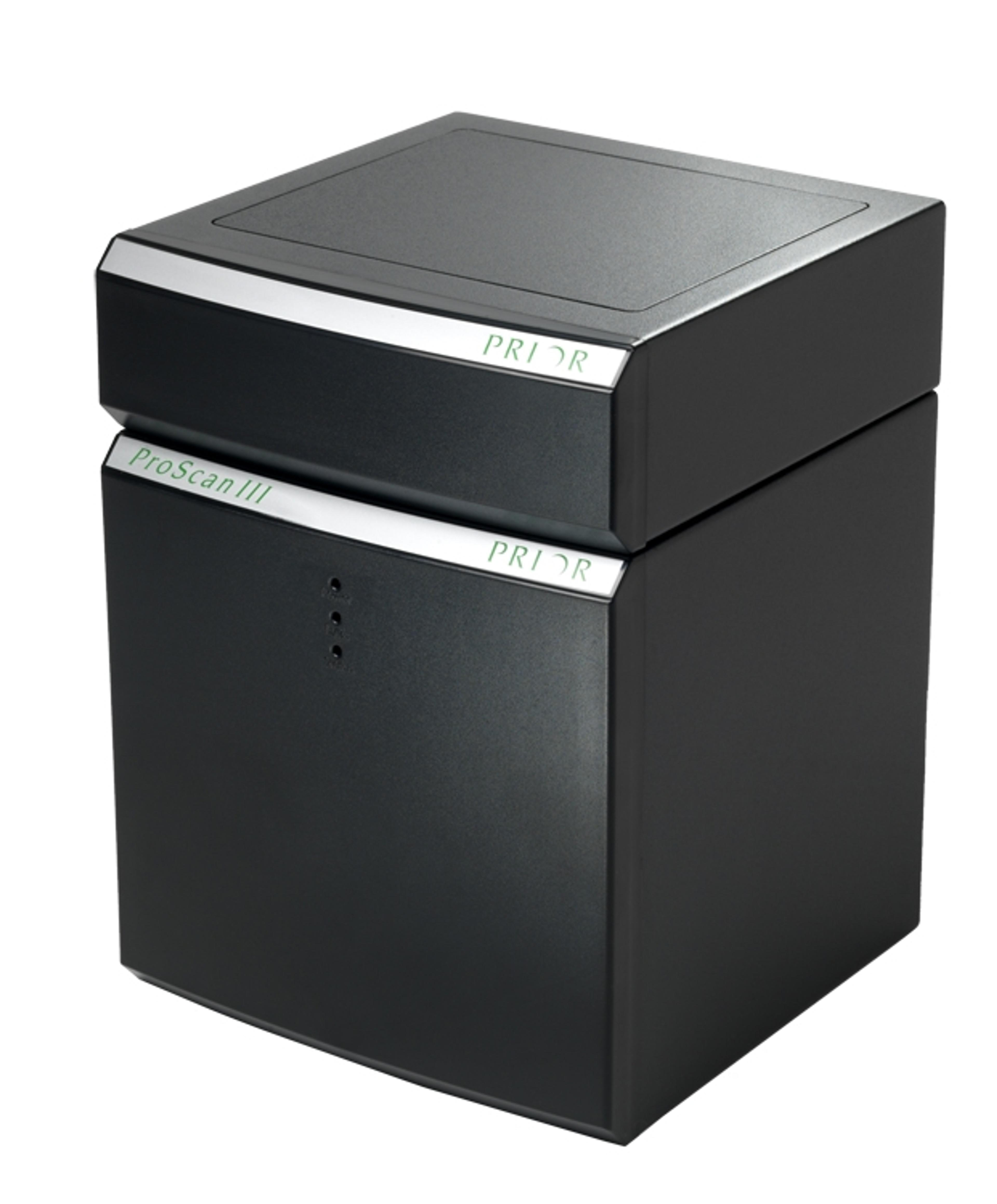
Both filter wheels and shutters can be easily controlled using the Prior Scientific ProScan® 3 control system, which is compatible with a wide range of microscope manufacturers imaging software packages. The end user can therefore control all aspects of their microscope system from a single point, allowing precise coordination of illumination, stage movement, focus movement, shutter and filter wheel operation and image capturing.

Filter Wheels

Prior Scientific

The filter wheels can fit to either the excitation or emission side of the imaging device. Magnetic covers over the filter load position on both sides of the filter wheel give easy access to allow filters to be changed quickly. Visible filter allocation numbers allow easy identification of filter positions, and a wide range of adapters for both illuminators and microscopes are available. In addition, Prior’s shutters can be mounted directly onto a filter wheel. The filter wheels are controlled via the ProScan® III control system.   FEATURES:   Easy to install and use 10 (for 25 mm filters), 8 or 6 (for 32 mm filters) position wheels available Compatible with almost all commonly used microscopes Controlled via Prior’s ProScan® III system. Adapters for a wide variety of microscopes and illumination devices available 55 ms change between adjacent positions on the filter wheel  

(0)

Links

Tags

Fluorescence SpectroscopyFluorometers and spectrofluorometers (also called fluorescence spectrometers) are used to measure the intensity and wavelength of fluorescent light emitted from a sample after excitation by illumination. Spectrofluorometers utilize monochromators to select the desired wavelengths, whereas filter fluorometers employ a set of filters. Spectrofluorometers for measuring steady-state fluorescence and lifetime fluorescence (or time-resolved fluorescence) are available, as well as fluorescence microscopes and microplate readers. Find the best fluorescence spectroscopy products in our peer-reviewed product directory: compare products, check customer reviews and receive pricing direct from manufacturers.FiltrationFiltration and microfiltration are used to separate solids, particulates or large molecules from fluids (liquid or gases) in order to purify the filtrate. Explore a range of filter formats, including filter paper, plates and membranes for your separation needs. While larger particulates may be separated by gravity filtration, smaller particulates may require additional force for timely separation. Microfiltration equipment includes vacuum filters, as well as positive pressure, crossflow and centrifugal filtration devices. Find the best filtration products in our peer-reviewed product directory: compare products, check customer reviews and receive pricing direct from manufacturers.Gel Doc / Image AnalysisGel documentation (gel doc) or gel imaging systems are used for the analysis of proteins, antibodies and nucleic acid immobilized in polyacrylamide or agarose gels, membranes or microarrays. Explore a range of a gel imaging systems, densitometers, scanners, transilluminators or UV lamp + CCD cameras for your image analysis solutions. Colorimetric, fluorescent and/or radioisotopic samples can be visualized and documented for further analysis. See gel doc / Image analysis software for quantitative 1D and 2D analysis of your samples. Find the best gel doc / image analysis products in our peer-reviewed product directory: compare products, check customer reviews and receive pricing direct from manufacturers.Software PlatformsSoftware platforms are useful for various stages of laboratory experiments from data collection to data storage and processing. For instance lab software is available for system control, data management, data analysis and qualification / validation.In Vivo Imaging Systems<i>In vivo</i> imaging systems, including pre-clinical imaging systems and medical imaging systems are used to non-invasively visualize and capture images of live animals and plants. Monitor the natural processes or diseases of your subjects using small-animal pre-clinical imaging systems, including single photon positron emission tomography (SPECT), positron emission tomography (PET), computed tomography (micro-CT), magnetic resonance imaging (MRI), X-ray radiography, ultrasound, fluorescence and bioluminescence imagers. Multimodal systems and software solutions are also available for correlative analysis of organ, tissue, cell, or molecular-level processes. Find the best in vivo imaging products in our peer-reviewed product directory: compare products, check customer reviews and receive pricing direct from manufacturers.Light MicroscopyLight microscopes or optical microscopes are used to visualize microscale objects under magnification, including cells, clinical specimens and materials. Lab equipment for light microscopy includes confocal microscopes, fluorescence microscopes, zoom and stereo microscopes. Microscope slides and imaging reagents are available for visualizing samples, as well as various microscope stages and incubators for large or temperature-sensitive samples. Find the best light microscopes in our peer-reviewed product directory: compare products, check customer reviews and receive pricing direct from manufacturers.Digital MicroscopyDigital microscopy involves using digital cameras and sensors to capture high-resolution images of samples for analysis. It offers enhanced imaging capabilities compared to traditional optical microscopy and is widely used in biological and material science research. Explore digital microscopy systems in our peer-reviewed product directory; compare products, check reviews, and get pricing directly from manufacturers.Fluorescence MicroscopyFluorescence microscopy has become an essential tool in biology, as well as in materials science. The application of many fluorochromes has made it possible to identify cells and sub-microscopic cellular components with a high degree of specificity. Using multiple fluorescence labels, different probes can simultaneously identify several target molecules.MicroscopyMicroscopy is a technique used to observe small objects in detail, from cells to materials, using light or electron microscopes. It enables researchers to examine structures with high resolution, aiding in fields such as biology, medicine, and materials science. With advanced microscopy techniques, scientists can gain insights into cellular processes, tissue structures, and material properties. Explore the best microscopy solutions in our peer-reviewed product directory, compare products, read customer reviews, and get pricing directly from manufacturers.Digital ImagingDigital imaging is a technique that captures images of biological and chemical samples in high resolution, often using advanced cameras and sensors. This technology is crucial in microscopy, diagnostics, and quality control. Explore digital imaging systems in our peer-reviewed product directory; compare products, check reviews, and get pricing directly from manufacturers.
Fast Filter Wheel for Fluorescence Microscopy