Extracting the Scents & Smells of Christmas

Genevac evaporator systems are widely used by researchers seeking to safely extract novel fragrance molecules from natural sources

8 Dec 2015
Weylan Kiam-Laine
Microbiologist

Product news

To obtain fragrances from natural products - chemists and perfumers often employ organic solvent extraction techniques to produce a large volume of crude extract. This technique is preferable to steam distillation as the higher temperatures are prone to denaturing the delicate fragrance molecules and some materials do not yield their characteristic aroma using steam.

Using a patented low temperature technology, the Genevac Rocket™ vacuum evaporator has become a defacto standard for safely concentrating crude extracts while preserving delicate fragrances. To isolate individual fragrance components from the concentrated extract, one or two dimensional chromatography is then often the technique of choice.

Rocket Evaporators use patented vacuum technology to evaporate solutions to dryness, or to concentrate, rapidly and safely. The latest Rocket Synergy evaporators offer integrated, flexible solutions for processing a wide range of sample volumes. Interchangeable rotors will accommodate tubes, flasks and batch volumes of up to 100 litres.

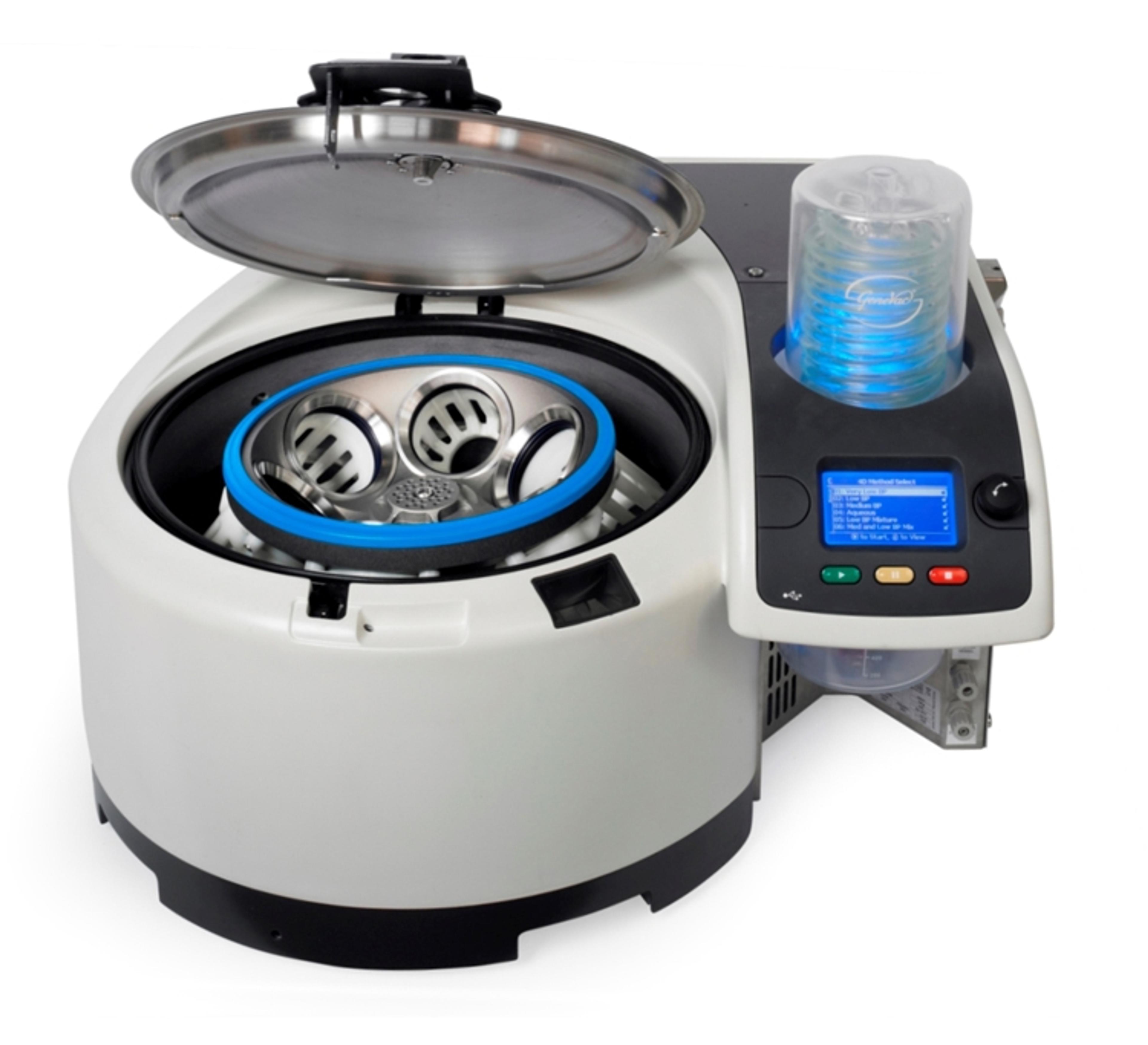
Rocket 4D Synergy Large Volume Evaporator

Genevac

Rocket 4D Synergy is designed primarily to evaporate large sample volumes, with autofeed if required, allowing automatic evaporation of volumes up to 100 litres. Rocket 4D Synergy provides fast, safe evaporation for solvents with a boiling point of up to 165°C (DMF) and can easily dry aqueous samples. The system feeds the solution for evaporation to the evaporation vessel, controls temperature and pressure, prevents bumping and foaming, drains the condenser, stops when dry or concentrated, and if required, redissolves the product in a small volume of solvent, unattended, and with no user intervention. The Rocket 4D Synergy can also be fitted with a removable flask rotor to accommodate the full range of Rocket Sample handling solutions such as flasks, tubes and SampleGenie. Now you don't need to choose between flask or batch/feed evaporation. The Rocket and Rocket 4D Synergy evaporators will accommodate your process, whatever the volume. Each is capable of replacing several rotary evaporators and saving valuable bench space.
(0)

Rocket Synergy Evaporator

Genevac

Rocket Evaporators use patented vacuum technology to evaporate solutions to dryness, or a concentrate, rapidly and safely. The latest Synergy series offers integrated, flexible solutions for processing a wide range of sample volumes. Interchangeable rotors will accommodate tubes, flasks and batch volumes of up to 100L. Rocket Synergy is designed primarily to quickly process larger volumes of solvent in parallel and without supervision. The Rocket Synergy Evaporator will accommodate six flasks, each containing up to 450ml of solvent, as well a variety of innovative Genevac sample holders such as the SampleGenie. The removable rotor may also be replaced with a 5L 316 stainless steel vessel for batch processing. Now you don't need to choose between flask or batch/feed evaporation. The Rocket and Rocket 4D Synergy evaporators will accommodate your process, whatever the volume. Each is capable of replacing several rotary evaporators and saving valuable bench space.

(3)

Links

Tags

Gas ChromatographyGas chromatography (GC) is an analytical technique used to separate and quantitate mixtures of small and volatile compounds. Gas chromatographs or GC systems include components such as GC columns, detectors, pumps and autosamplers. Choose from packed or capillary GC columns, flame ionization (FID), photoionization (PID) electron capture detectors and selective or non-selective detectors. Find the best gas chromatographs in our peer-reviewed product directory: compare products, check customer reviews and receive pricing direct from manufacturers.UHPLC and HPLCHigh performance liquid chromatography (HPLC) and ultra high performance liquid chromatography (UHPLC), also known as UPLC, are analytical techniques used to separate, identify and quantitate components of complex mixtures including biological samples such as proteins and lipids as well as chemical mixtures of pesticides, drugs and oils. Both techniques are liquid chromatographic methods but differ by operating pressures (HPLC < 6000 psi < UHPLC ). Components of HPLC and UHPLC systems include columns, detectors, pumps, autosamplers and column heaters. Explore a range of UHPLC and HPLC columns for your specific sample needs including reverse phase, normal phase, ion exchange, HILIC, ion exclusion and size exclusion columns. For more specialized HPLC, explore FPLC, countercurrent LC and simulated moving bed systems. Find the best UHPLC and HPLC equipment in our peer reviewed product directory: compare products, check customer reviews and receive pricing direct from manufacturers.Mass SpectrometryMass spectrometry (MS) is a powerful analytical technique used to identify and quantify molecules based on the mass-to-charge ratio of gas-phase ions. It provides detailed information about the structure, composition, and properties of compounds and is widely used across fields such as environmental monitoring, materials science, drug discovery and development, food and beverage testing, and wider chemical research. Key MS techniques include tandem mass spectrometry (MS/MS), liquid chromatography–mass spectrometry (LS-MS) and inductively coupled plasma (ICP-MS). Choosing from these wide range of techniques and technologies can be a daunting task, so keep up to date with scientific applications, performance expectations, and customer reviews here all in one place. Visit our product directory to receive quotes direct from the manufacturer. Solid-Phase ExtractionSolid-phase extraction (SPE) is used for clean-up, extraction and concentration of semi-volatile or non-volatile analytes from complex mixtures including blood, urine and food samples. Multiple formats are available for conducting SPE, including prepacked SPE cartridges, disks and microplates, as well as SPE sorbent powders for manual packing. SPE systems can be used to automate the process and extract multiple samples at once. Solid-phase microextraction (SPME) and supported liquid extraction (SLE) products are also available in the same formats. Find the best SPE, SLE and SPME equipment in our peer-reviewed product directory: compare products, check customer reviews and receive pricing direct from manufacturers.Temperature ControlTemperature controlled processes are experiments carried out using ovens, furnaces, incubators, hotplates, refrigeration and freezers.AutomationAutomation in laboratories and manufacturing processes enhances efficiency, precision, and scalability by reducing the need for manual intervention. It plays a critical role in improving productivity, minimizing human error, and accelerating workflows in fields like diagnostics, drug development, and industrial testing. Automation technologies include robotic systems, automated liquid handlers, and process control systems that streamline complex tasks and ensure consistent, reproducible results. Explore our peer-reviewed product directory to discover the best automation solutions, compare options, read user reviews, and get prices directly from manufacturers.ChromatographyChromatography is a powerful technique used to separate and analyze components of mixtures based on their chemical properties. It is widely used in fields like biochemistry, pharmaceuticals, and environmental analysis. By exploiting differences in the interaction of substances with a stationary phase and a mobile phase, chromatography enables precise purification and quantification of compounds. Whether you're working with complex biological samples or industrial chemicals, chromatography is essential for obtaining high-quality results. Browse our peer-reviewed product directory to find the best chromatography systems, compare products, read customer reviews, and get pricing directly from manufacturers.2D ChromatographyDistillationSolvent ExtractionVacuum