Extending possibilities for cell-based HCS in drug discovery

17 Mar 2008

Product news

At next month's SBS 2008 in St Louis, April 6-10, BIOSTATUS will be showcasing several new developments of its technologies for fluorescent imaging of cells. These are a direct result of the wide acceptance of its technologies into mainstream use for HCS in drug discovery.

DRAQ5™ for primary and genome-wide use:
New packaging formats for the far-red nuclear counterstain DRAQ5™ offer further economies in large-scale screening. These will be particularly suited to laboratories performing primary screening of compound libraries and genome-wide RNAi screens. Expect the same performance, simplicity and quality at improved cost per well.

DRAQ5™ proves a powerful tool for in vitro toxicology:
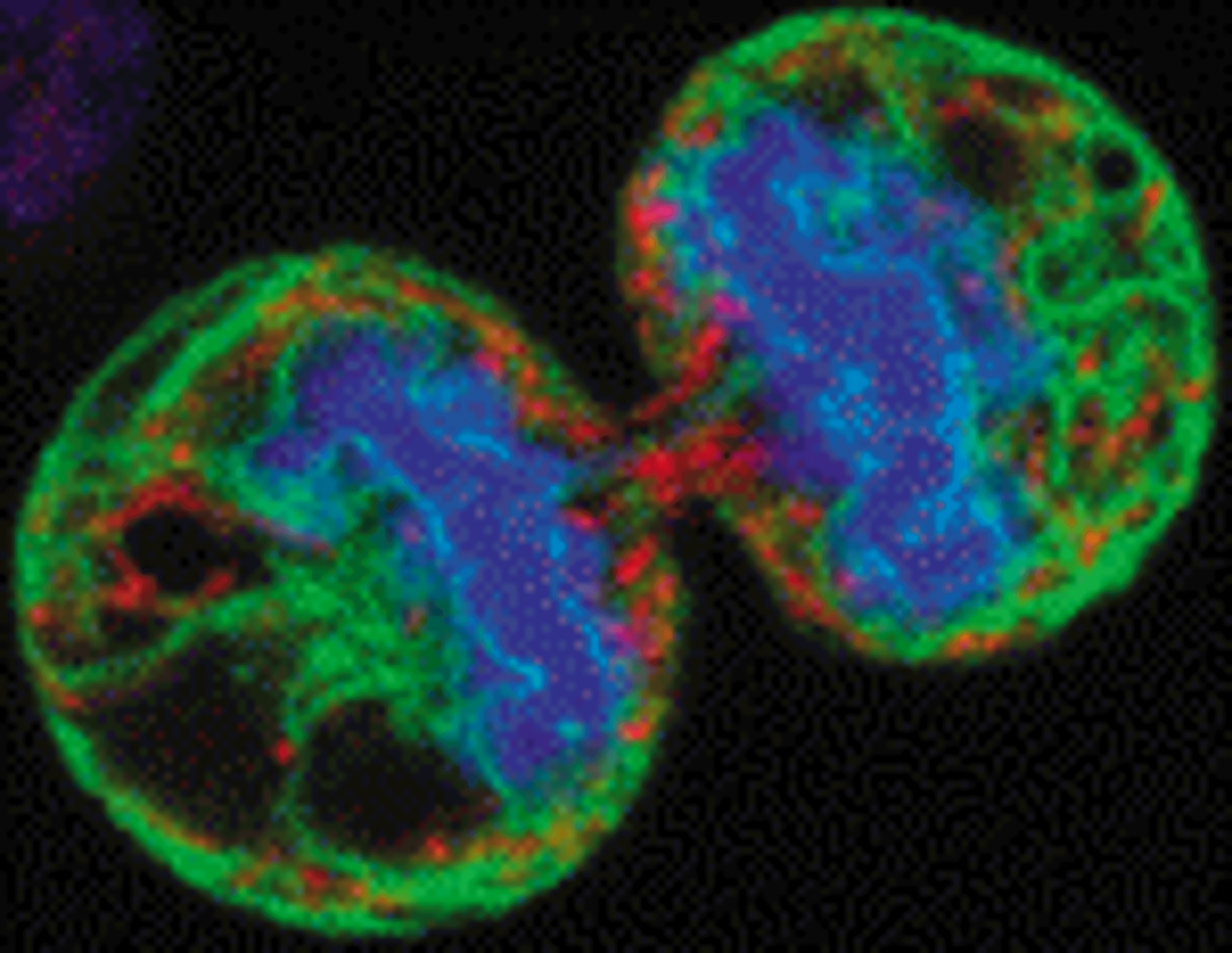
Presentations at recent HCS meetings have shown the fantastic added value of performing cell-based in vitro toxicology assays with DRAQ5™. Firstly, DRAQ5™ is the ideal choice of nuclear counterstain - the far-red emission means it leaves the visible range fully open for other parameters. From this, direct measurements on nuclear condensation, nuclear morphology, cell shape and size can be gathered. Exciting new data from scientists at Pfizer's laboratories in Cambridge, Mass. have shown that DRAQ5™ efficiently labels (phospho)lipid accumulation in the cytosol of primary human hepatocytes, one of the important early markers of hepatotoxicity.

Cell-based assays using non-adherent cells:
As we further develop our core technology CyGEL™ we want to know what it is that YOU want to do as a scientist leading the search for new druggable targets and compounds. CyGEL™ enables the imaging of LIVE non-adherent cells in HCS. This means that you can choose the right host cell type for a given biology and still get high resolution images since cells are gently held still in this thermo-reversible hydrogel. You can even recover the cells afterwards to investigate them in a further molecular analysis!

Come and see us at Booth 205 at SBS in St Louis!

DRAQ5

Biostatus Limited

The proven far-red probe for live or fixed cells, spectrally compatible with UV / Vis-range fluors.

(267)

Links

Tags

Genome AnalysisGenomics, the study of genomes, includes functional genomics, evolutionary genomics and comparative genomics. There are many genomic technologies such as DNA sequencing of whole genomes, computational biology and bioinformatics. DNA and nucleic acids must be isolated and concentrated from cells for analysis with kits, automated analyzers and software. Other useful technologies for studying genomics include PCR, microarrays and electrophoresis.ADME-ToxicologyADME-toxicology (ADME-Tox) studies are used in pharmacology and pharmacokinetics to assess the activity/toxicity of drugs <i>in vivo</i> or <i>in vitro</i>. Find bioassays for absorption, distribution, metabolism, and excretion of drug molecules including cytotoxicity, transporter/permeability, metabolism and activity assays as well as hepatocytes and cell lines for ADME. Find the best ADME-toxicology products in our peer-reviewed product directory: compare products, check customer reviews and receive pricing direct from manufacturers.Assay AssemblyAssay Assembly is technique used in drug discovery to develop assays to test the cytotoxicity, genotoxicity, or other activities of a compound on a cell. Assay assembly requires chip assembly, a delivery system and a detection and analysis method. Beneficial features of assay kits or automated systems include high-throughput, high speed and sensitivity and low signal to noise ratio.Compound LibrariesCompound libraries, or chemical libraries, are used in drug discovery for the identification of potential therapeutics compounds. Used in conjunction with high-throughput screening, the libraries of stored compounds are often generated for specific purposes as a drug target or disease model. Cheminformatics are commonly used when designing a compound library and software can be used to analyze the screening process.  Cell-Based AssaysCell-based assays are used to monitor the presence, quantity and activities of a desired cellular analyte including drug molecules or biomarkers. This can reveal information on cell health (apoptosis, cytotoxicity, viability and proliferation assays), cell metabolism, cell migration and cell signaling mechanisms. Find the best cell-based assay products, kits and equipment with our peer reviewed product directory: compare products, check customer reviews and receiving pricing direct from manufacturers.High-Content ScreeningHigh-content screening (HCS), also known as high-content analysis (HCA), is a high-throughput technique used in drug discovery to identify substances that alter the phenotype of cells. HCS uses fluorescent microscopic imaging and automated image analysis to investigate cellular events such as apoptosis, cell viability, GPCR activation, oxide production, neurite outgrowth, and cell signaling. Find the best fluorescent labeling reagents, cellular assays, and high-content imaging systems in our peer-reviewed product directory: compare products, check customer reviews and receive pricing direct from manufacturers.
Extending possibilities for cell-based HCS in drug discovery