
Eppendorf – Your Expert and Advisor All Around the Laboratory at BIOTECHNICA 2015
3 Sept 2015Industry news
Eppendorf AG will be presenting itself at BIOTECHNICA 2015 in two adjacent booths, on a total exhibition area of 260m² focusing on the topic “Take Good Care of Your Cells”. This year’s novel products include the Centrifuge 5920R, the ultra-deep freezer CryoCube F570, the Multipette E3/E3x (an electronic hand dispenser) as well as the BioFlo 320 from the area of Bioprocessing.
Visitors will be invited to join guided tours of the transparent laboratory three times daily (11:00 am, 2:00 pm and 4:00 pm), covering the main topic “Cell Biology”. For almost 70 years, innovative technologies and premium products by Eppendorf have contributed to improving work processes in laboratories and research facilities around the world. The product portfolio includes highly reliable, long-lasting instruments, matching consumables and tailored accessories to make the daily laboratory routine easier and at the same time more efficient and reproducible.
"We have gained a deep understanding of different laboratory workflows through our close and long-established relationship with the scientific community," says Dr. Tanja Musiol, Global Project Leader Workflows, Cell Handling Procedures and PhysioCare at Eppendorf AG. "To share this knowledge and deepen it further at the same time, we engage in a personal and application-oriented dialog with our customers on-site at the BIOTECHNICA 2015 and talk about their requirements regarding processes and the daily routine at the laboratory."
For this purpose, Eppendorf built a glass laboratory at the exhibition and offers guided laboratory tours. During these tours, the application experts explain typical applications and processes in the cell-biological / bioprocess laboratory. Day-to-day tasks are discussed with the customer directly on-site. During personal conversations, application-oriented approaches to gain reliable results are discussed with the experts.
This can mean an optimization of the entire laboratory process or small changes of the daily routine at the laboratory. Our experts give tips to avoid contaminations in the cell culture as well as advice on how to reach a homogeneous and reproducible cell growth. They also present intelligent solutions that reduce the complexity in the daily laboratory work are also presented.
This year, in addition to BIOTECHNICA, a new trade fair - LABVOLUTION - will simultaneously take place in the same exhibition hall. This event features a space which will be dedicated to the subject area smartLAB – the laboratory of the future. Eppendorf will also participate in this event with presentations and instruments, as well as with a small information area.
Related products
Request Quote for All Products
CryoCube® Freezers
EppendorfThe new CryoCube F570 and FC660 provide true reliability and energy efficiency in ultra-low temperature freezers. CryoCube upright and chest freezers are built with user comfort in mind. The CryoCube F570h and FC660h further improve energy efficiency. They combine all the power-saving technology of the F570 and FC660 with additional vacuum insulated panels. CryoCube ultra-low temperature freezers combine maximum sample security with improved functionality. New features decrease power consumption and make CryoCube freezers more comfortable to use. Eppendorf quality means years of trouble-free operation and dependable support. Features: New automatic vent port on front door improves energy consumption and uniformity while providing easier access New ergonomic handle requires less force and improves freezer access Magnetic closures on inner doors further increase ease‐of‐use New high‐efficiency fan, compressor, and condenser Additional vacuum insulated panels on the CryoCube F570h and FC660h further improve on energy efficiency
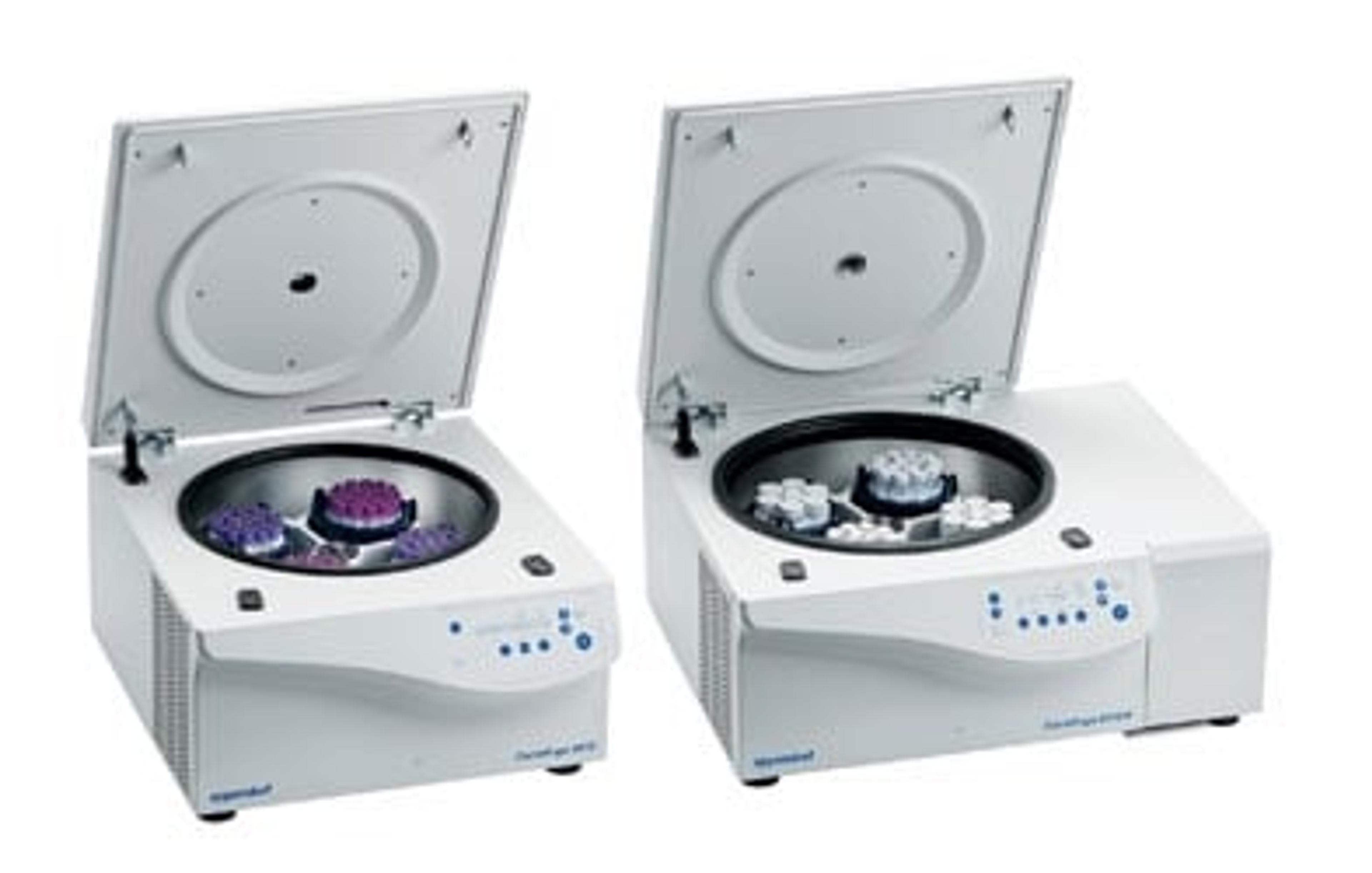
Centrifuge 5810 / 5810 R
EppendorfEppendorf Centrifuge 5810/ 5810 R with its renowned quality and reliability offers you the most cost efficient solution for your medium to high-throughput applications—now and in the future.The Centrifuge 5810/ 5810 R is designed to operate at low noise levels for a relaxing work environment. It features new aerosol-tight Eppendorf QuickLock® caps and lids as well as a low profile for easy loading and unloading of samples. The refrigerated model has unique features such as ECO shut-off function and dynamic compressor control for optimized cooling performance and energy savings.Centrifuge 5810/5810 R is a workhorse for medium to high-throughput laboratories. It combines extraordinary versatility and capacity for both tubes and plates with an extraordinary compact footprint. With the new rotor generation the capacity of Centrifuge 5810/ 5810 R increases to max. 4 x 750 mL (or max. 28 x 50 mL / 56 x 15 mL). Considering its small footprint, Centrifuge 5810/5810 R is the most compact 3 liter centrifuge currently available in the market.Features: Swing-bucket rotors and adapters accommodate tubes and bottles from 0.2 mL to 750 mL Plate rotors for centrifugation of all types of MTP, PCR, cell culture, or deepwell plates Fixed-angle rotors for high-speed molecular biology applications in tubes from 0.2 mL to 85 mL High centrifugation speed of up to 20,913 x g (14,000 rpm) Aerosol-tight Eppendorf QuickLock® caps and lids for easy, one-hand operation Centrifuge lid with soft-touch lid closure Low access height of 29 cm for easy loading and unloading of samples Quiet operation to improve your work environment Compact footprint saves valuable bench space Automatic rotor recognition and imbalance detection for maximum operational safety Special features for Centrifuge 5810 R: Temperature range from -9 °C to 40 °C FastTemp function for fast pre-cooling Standby cooling function holds temperature when centrifuge is not in use ECO shut-off engages after 8 hours of non-use to reduce energy consumption and to extend compressor life Dynamic compressor control (DCC) technology for optimized cooling performance
