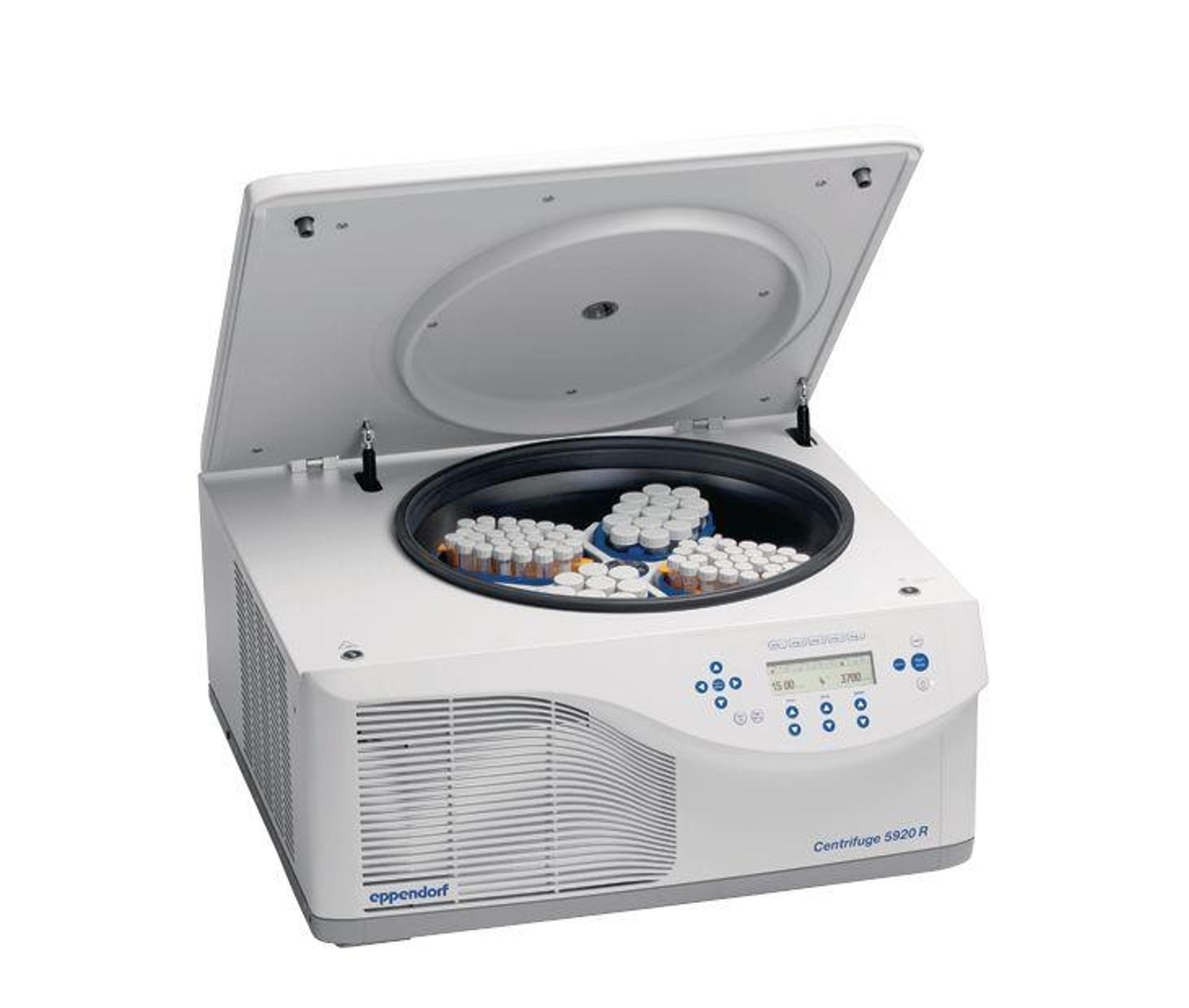
Eppendorf Centrifuge 5920 R: The New Benchmark in Capacity and Performance

The new refrigerated Eppendorf Centrifuge 5920 R combines extraordinary high capacity with enhanced temperature management in a very compact and ergonomic product design

15 Jun 2016
Weylan Kiam-Laine
Microbiologist

Product news

Centrifuge 5920 R can accommodate up to 4 x standard 1 Liter Nalgene® bottles, as well as up to 108 x 15mL conical tubes, and 52 x 50mL conical tubes, enabling researchers to spin large volumes at any one time, in applications such as bioprocessing or cell culture. Additionally, the universal rotor bucket design means researchers can spin both plates and tubes in the same bucket without the need to purchase separate plate buckets.

The Eppendorf Centrifuge 5920 R also offers a powerful state-of-the-art refrigeration system with advanced temperature management, meaning users can be confident that their temperature-sensitive samples are safe. Dynamic compressor control technology and a FastTemp pro® function also allows precise and automated pre-cooling based on a pre-programmable time and date.

Easy to use, the Centrifuge 5920 R features a multi-lingual menu with backlit display with 5 program keys enabling rapid access to routine programs, as well as an adjustable ECO shut-off function to save energy and increase compressor life. “With laboratories under increasing pressure to increase efficiencies and throughput we understand the challenges that researchers face in their work,” said Peter Schreiner, Global Product Manager Centrifugation at Eppendorf.

“The very large capacity and precise temperature management offered by the Centrifuge 5920 R means researchers can be assured that not only are their samples safe, but that they are saving time, money and energy with this system.”

Centrifuge 5920 R

Eppendorf

Centrifuge 5920 R features extraordinary high capacity and performance. Its capacity of up to 4 x 1,000 mL / 52 x 50 mL conical tubes makes it the ideal instrument for high-throughput applications.

(6)

Links

Tags

Refrigerators Freezers and CryogenicsRefrigerators, Freezers & Cryogenics can be used for preservation or experimental purposes. Types of freezers include deep freeze, -80C°C, ultra-low temperature, explosion proof, cryogenic and controlled rate freezers. Freezing is also used in freeze-drying equipment for dehydration processes. Feature to consider in freezers include temperature control and recorders, failure alarms and self-closing mechanisms.CentrifugesCentrifuges are used to separate particulates suspended in a liquid via the application of a centrifugal force including cells, macromolecules, nanoparticles and precipitates. Centrifuges come in three sizes: microcentrifuges, benchtop and floor-standing centrifuges, depending on the volume and number of samples that require separation. When choosing a centrifuge, consider its maximum separation power indicated by its relative centrifugal force (RCF) value. Low force centrifuges reach a maximum RCF of 8,000 g, high-force centrifuges can reach maximum RCF values of 80,000 g. For extremely high forces, consider ultracentrifuges (up to 800,000 g). Refrigerated and vacuum centrifuges also known as concentrators are available for more specialized applications. A range of volumes are available for centrifuge tubes and microfuge tubes, depending on sample sizes. Find the best centrifuges in our peer-reviewed product directory: compare products, check customer reviews and receive pricing direct from manufacturers.Sample PreparationSample preparation can improve the quality and speed of separation techniques. Products to assist sample preparation include filtration equipment, evaporators, membranes and sieves.Temperature ControlTemperature controlled processes are experiments carried out using ovens, furnaces, incubators, hotplates, refrigeration and freezers.AutomationAutomation in laboratories and manufacturing processes enhances efficiency, precision, and scalability by reducing the need for manual intervention. It plays a critical role in improving productivity, minimizing human error, and accelerating workflows in fields like diagnostics, drug development, and industrial testing. Automation technologies include robotic systems, automated liquid handlers, and process control systems that streamline complex tasks and ensure consistent, reproducible results. Explore our peer-reviewed product directory to discover the best automation solutions, compare options, read user reviews, and get prices directly from manufacturers.Centrifuge