
Enable quality and pace in your drug discovery workflow: Your questions answered
This on-demand webinar shows how cutting-edge liquid handling, automation, and detection technologies can increase speed and efficiency in your lab
21 Jul 2020
Expert insights

Accurate experimental design, together with flawless execution and integration of consistent data, are critical factors for ensuring the fidelity of high-quality decision-making in drug discovery. Issues with experimental reproducibility are not new, and confidence in the accuracy of research findings remains low. Coupled with the current levels of operational vulnerability caused by the COVID-19 pandemic, these factors have prompted a fundamental reassessment of strategic priorities.
In this on-demand SelectScience webinar, Daniel Thomas, Head of Discovery Biology at Arctoris, examines how these challenges can be overcome through the utilization of specialist outsourced capabilities and highlights how these can deliver the critical data sets to keep projects on time while ensuring the accuracy and precision required.
Read on for highlights from the live Q&A session or register to watch the webinar at any time that suits you.
Watch webinarQ: Workflow optimization, lab automation, and statistical monitoring will not address fundamentally flawed assumptions leading up to false hypotheses and claims – how would you address that problem?
DT: The real essence of high-quality data means we can test the hypothesis earlier and we can test it with greater confidence. It might be that we have set the wrong hypothesis, haven't tested it robustly enough or haven't been able to test it because of the quality of the data. That is what we are looking to provide. We want to say to those researchers: “You come to us with your hypothesis, we're not going to test the hypothesis validity per se, but we will provide you with data that can answer that question.” We will give advice if our experience allows us to. However, we can't be the custodians of hypothesis validation, unless we generate that data. There’s only 13 of us at the moment, but we look forward to helping to debunk some of those false hypotheses and claims.
Q: Have you seen a decrease in assay development time using an automated liquid handler such as the dragonfly®?
DT: Yes. After using the dragonfly® discovery automated liquid handler, we've seen a decrease in time to validate an assay from about 24 hours to less than 10 hours. I believe we can reduce it further but before we had that capability in hand, it was taking us about three to four working days to do the same work. The automated analytical pipelines will help with that. We should be able to analyze data in real time, refine critical parameters, enter them into the design software on the dragonfly in format design, implement the outcomes and compress as much of that whitespace as possible. It won't eliminate all of it, but it should shorten it to 5-6 hours. That won’t be the case every single time, so we're highlighting what is possible. It is not necessarily going to be the average; hence we have to accept there will be a range of timelines in there depending upon the assay, the reagent, and what's being requested.
Q: How would you assess a novel assay when the positive and negative controls are lacking?
DT: As a small company, we offer access to non-completely novel experimentation. The challenge we have is assay development, which is fraught with difficulty. Novel assays not having positive controls or standards can be a real challenge. In the short term, we have tried to minimize our risk to taking on large assay development projects. However, what we can do is look to work with any researcher to help design the most statistically well-powered experiments. By leaving out elements of biology, we can look to interrogate what works and what doesn't, but in a certain time frame. That means that data won't take days, if not weeks to generate. Thus, we can accelerate the arrival at these outcomes and hopefully, arrive at a better endpoint.
Q: In terms of instruments, why did you choose to use the dragonfly when there are so many on the market?
DT: There are hundreds of different liquid dispensers out there, they all do a similar set of things which is to move fluids from point A to point B. For me, there are two equally important reasons for buying or for recommending things like the dragonfly and the D300. One is the quality of the output, which is of paramount importance. Secondly, is its ease of use. If it's a pain to use and not intuitive where you need weeks of training to get up to speed, then it's going to cost a lot more time than it saves. Furthermore, it's got to be reliable. You must trust it to perform consistently and deliver the expected results. What we've learned from working with SPT is to choose collaborative vendors who understand the problem. What they have done is evaluate the marketplace and developed an instrument that fills a niche rather than another generic product. Any piece of kit that is going to stand the test of time has got to be easy to use and easy to learn and that, coupled with the quality of output, are the two primary factors in why I've chosen these pieces of kit.
Q: What is the typical potency resolution that you see?
DT: For those who come from a profiling background, we look to routinely quote both standard, non-outlier excluded and robust quality control. The industry standard is around about a half level unit or three-folds as a discriminatory difference. Our typical standard discriminatory differences range from about 0.3 to 0.4 level unit, so two to three-fold. That's equivalent when we turn that into a robust discriminatory difference of about 0.2 to 0.3, so it goes down by about 1.5 to two-folds. We can get resolution sub-two-folds between independent tests. Since our sample size and the number of assays that we've got is low, we're building a QC data set. However, I've set a benchmark, which is a threshold performance of primers greater than 0.7 to be considered robust enough to be put into production. So, we must protect any downtime that we would have from assay troubleshooting. We can always relax it but it's much harder to increase stringency than it is to reduce it. For the assays we've currently got on our deck, the mean robust prime is currently between 0.85 and 0.9. This is what underpins our ability to get that type of resolution, between 0.2 and 0.3 of a whole unit.
Q: Do you investigate polyvinyl alcohol as a material for drugs and packaging?
DT: The simple answer is no. Largely, that's a very specific niche example. We're much more geared towards the early discovery. We're looking at molecules and their vehicles, as well as what they're dosed in. Hence, that is probably outside of the remit of the deck. I never say that we won't do something for anybody. If it's not on our deck today, I won't promise that I can offer it, but I will certainly engage with you to understand the value that it can provide. What we're really looking at is democratization and to serve the broadest possible cross-section of the research community.
This webinar is part of the SelectScience Webinar Series: Drug Discovery and Complex Biology
SelectScience runs 3-4 webinars a month across various scientific topics, discover more of our upcoming webinars>>
Related products
Request Quote for All Products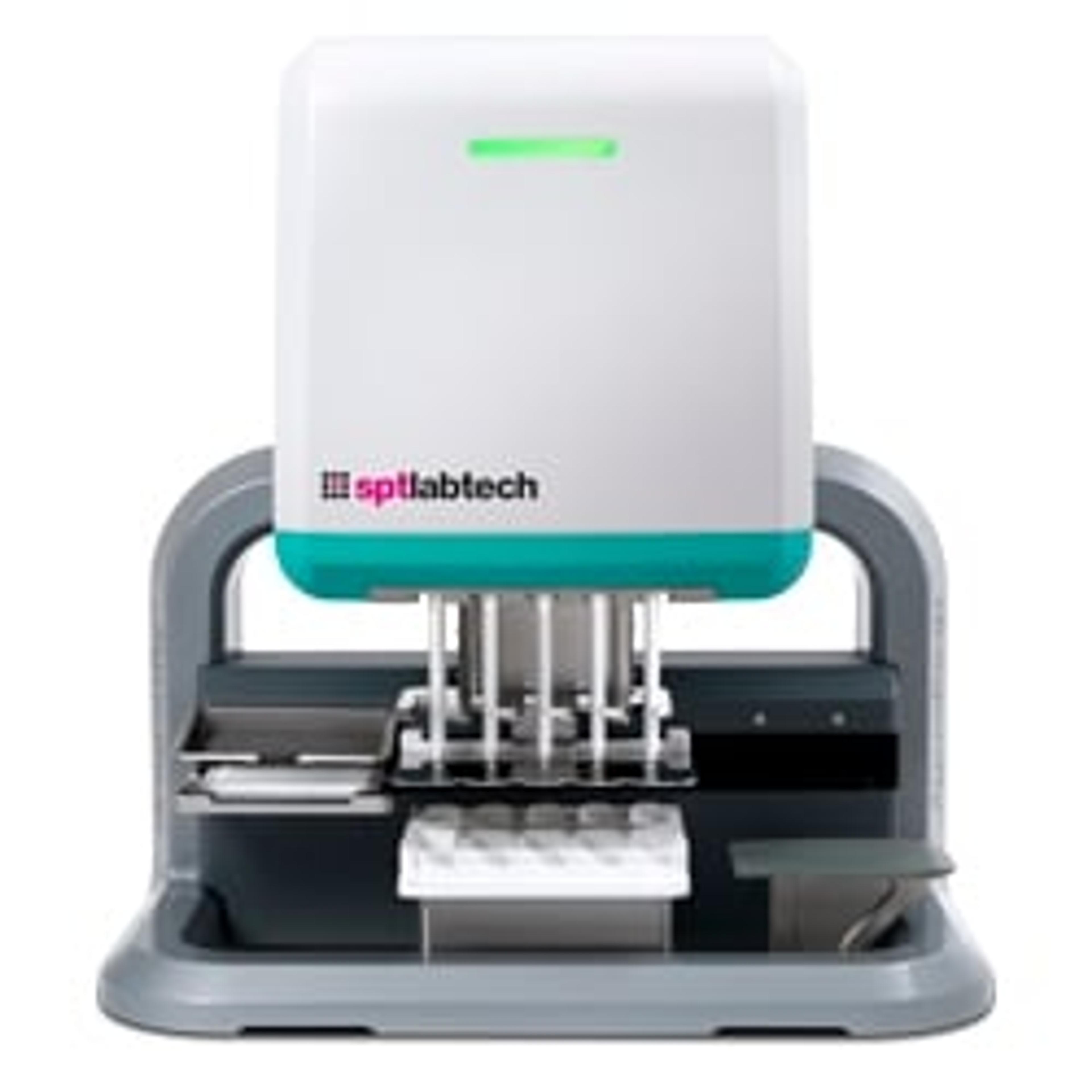
dragonfly® discovery
SPT Labtechdragonfly discovery enables innovative, low volume liquid dispensing that is compatible with a wide range of applications including molecular biology and genomics, biochemical assays, as well as cell- and bead-based assays.

dragonfly® crystal
SPT LabtechHarnessing innovative positive displacement pipetting to simplify protein crystal optimization