EKF Secures FDA Clearance for DiaSpect Tm POC Hemoglobin Analyzer

30 Apr 2018
Han Yin
Administrator / Office Personnel

Product news

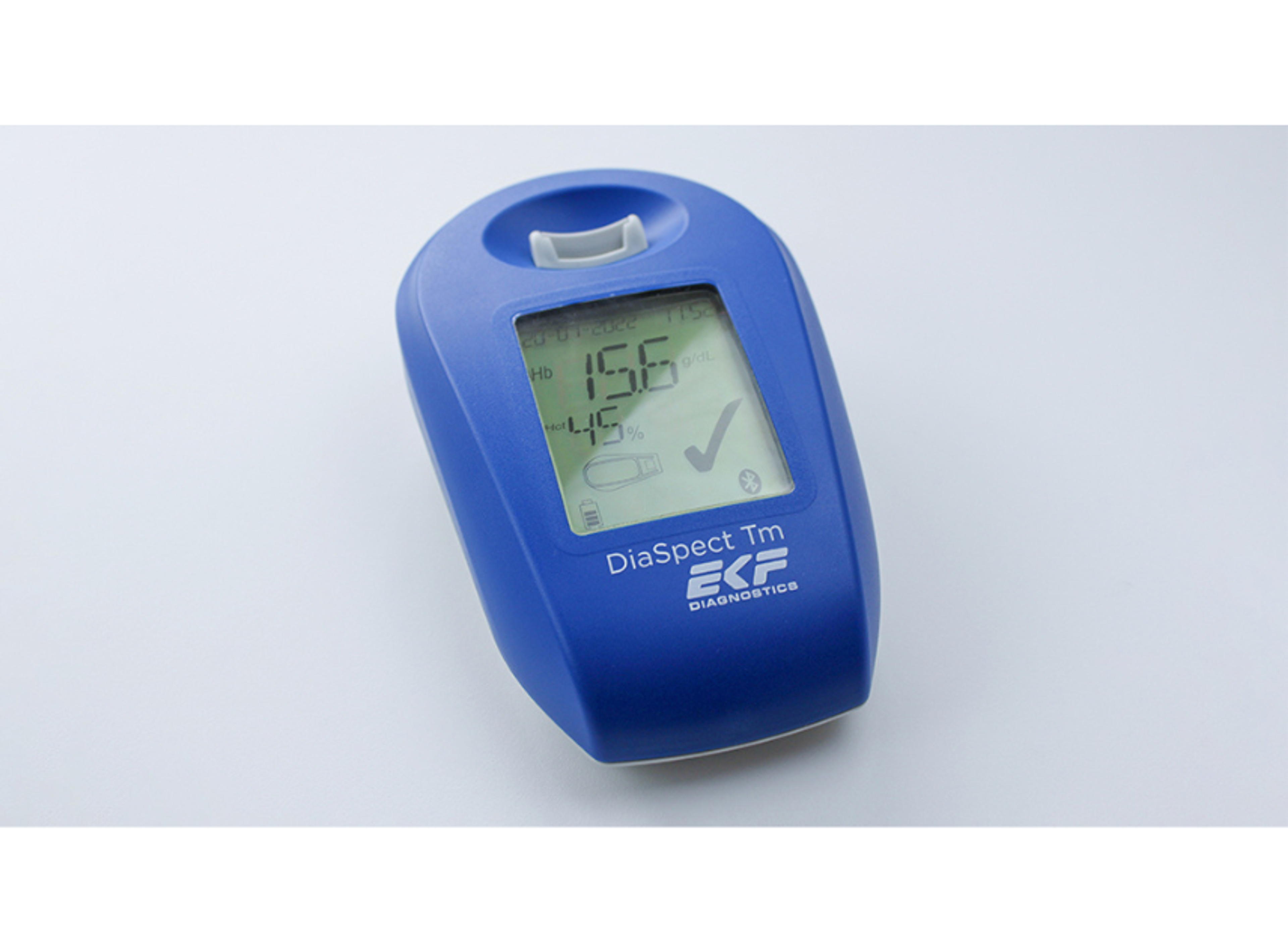
EKF Diagnostics, the global in vitro diagnostics company, has announced U.S. Food and Drug Administration (FDA) 510(k) clearance and CLIA waiver for the Company’s hand-held, reagent-free hemoglobin analyzer, the DiaSpect Tm. The device is cleared for use in point of care (POC) and Certificate of Waiver settings, such as physicians’ offices, clinics and other non-traditional laboratory locations.

The DiaSpect Tm provides users with accurate hemoglobin measurements (precision: CV ≤1%) within two seconds of its whole blood-filled cuvette being inserted for analysis. This ensures immediate and robust hemoglobin results for patient health checks and anemia screening at the point of care.

Based on its FDA categorization, DiaSpect Tm can be used in a variety of settings, as well as by a wide range of health care personnel. Essential for this, it is highly user-friendly requiring minimal training. The user simply collects a capillary or venous blood sample of 10 µL in the cuvette before inserting straight into the analyzer. Also making it simple for POCT use, DiaSpect Tm is factory calibrated against the HiCN reference method in accordance with ICSH. It is ‘always on’ and ready to use with no re-calibration or maintenance necessary.

Receive the latest clinical diagnostic news by visiting our Clinical Diagnostics Community >>

Commenting, Julian Baines, CEO of EKF Diagnostics, said: “The FDA clearance of DiaSpect Tm is part of our overall strategy to widen the range of regulatory approvals for our existing product range and to drive sales growth for these products across additional geographies. The US market is a key target for our DiaSpect Tm product, where we see a significant need for an easy to use, accurate and portable hemoglobin measurement system that can deliver laboratory quality results to patients in the clinic within seconds.”

FDA clearance is also a mark of the quality and reliability of a device which is recognized and trusted around the world. Lightweight and palm-sized, DiaSpect Tm is ideal for POCT in remote situations, not only due to its portability and unmatched measurement speed, but also through its rechargeable internal battery. This provides up to 40 days/10,000 tests continuous use, giving the flexibility of not needing a power source for weeks at a time.

DiaSpect’s reagent-free cuvettes have up to 2.5 years shelf life, even after opening, and are unaffected by temperature or humidity. These disposable cuvettes can be stored from 0 to 50°C, meaning temperature-controlled storage is not necessary - short term storage is even possible at -30°C to 70°C for 24 hours. This all makes the device highly suited for hemoglobin testing in a range of locations, environments and climatic conditions.

Do you use DiaSpect Tm from EKF Diagnostics at your workplace? Write a review today for your chance to win a $400 Amazon voucher.

Links

Tags

HematologyIn Haematology / Hematology, complete blood cell counts (or full blood counts) are obtained using automated blood count analyzers to enumerate blood cell types.  Hematology also encompasses haemostasis and coagulation, thrombophilia and hemophilia, plasma viscosity and ESR analysis, hemoglobinopathies, cell morphology and haematinic measurement.Point-of-CarePoint-of-Care Testing (POCT) or Near Patient Testing (NPT) products are available for urine, blood and other clinical chemistry analyses. POCT includes: blood glucose testing, blood gas and electrolytes analysis, rapid coagulation testing (PT / INR), rapid cardiac markers diagnostics, drugs of abuse screening, urine strips testing, pregnancy testing, fecal occult blood analysis, food pathogens screening, hemoglobin diagnostics, infectious disease testing and cholesterol screening.BiomarkersBiomarkers are biological markers which can be measured and evaluated to indicate a biological state. The use of biomarkers in research and diagnosis can indicate a normal or disease state or drug response of cells / tissues. Biomarkers include genetic markers, cell surface markers such as antigens, antibodies or receptors and secreted molecules such as cytokines. An assay system is required for identification of biomarkers. :Clinical ChemistryBiochemistry (or clinical chemistry) involves the analysis of bodily fluids using chemical tests. Techniques used include HPLC, chromatography, spectroscopy, mass spectrometry, immunochemical, electrophoresis, turbidometric / spectrophotometric assay, MRI and ISE analysis. Tests are often carried out on plasma or serum but urine (urinalysis) and fecal specimens are also processed.RegulatoryPharmaceutical regulations impact on all areas of drug development, manufacture and control and supply. Services are provided from the early stages of drug development and clinical trials through to dossier submission, approval and marketing. Regulatory also includes submission of analytical studies from the pharmaceutical product and safety. BiosensorsBiosensors are devices used to detect an analyte using biological molecules specific to the analyte coupled to a detector. Biosensor instruments may be photometric, typically using surface plasma resonance (SPR), electrochemical or QCM (quartz crystal microbalance) biosensors. Biosensors should be selective, portable, robust and sensitive and have a fast response time. Systems may be manual or automated and usually have associated software.Companion DiagnosticsCompanion diagnostics are tests, often <i>in vitro</i>, that are used to determine whether a therapeutic product will be safe and effective for use on an individual. They also identify which patients will benefit most from them. Companion diagnostic tests are often developed in conjunction with the pharmaceutical industry.FDAThe Food and Drug Association (FDA) is an agency within the U.S. Department of Health and Human Services. Among other things, it is responsible for ensuring the safety, effectiveness and quality of drugs, vaccines and other biological products, and medical devices. Molecular DiagnosticsMolecular diagnostics use an individual’s genetic code and gene expression to diagnose and monitor diseases. The technique is used increasingly in the field of infectious diseases and oncology, as well as areas such as coagulation, HLA typing and pharmacogenomics. Molecular diagnostics plays a pivotal role in personalized medicine.
EKF Secures FDA Clearance for DiaSpect Tm POC Hemoglobin Analyzer