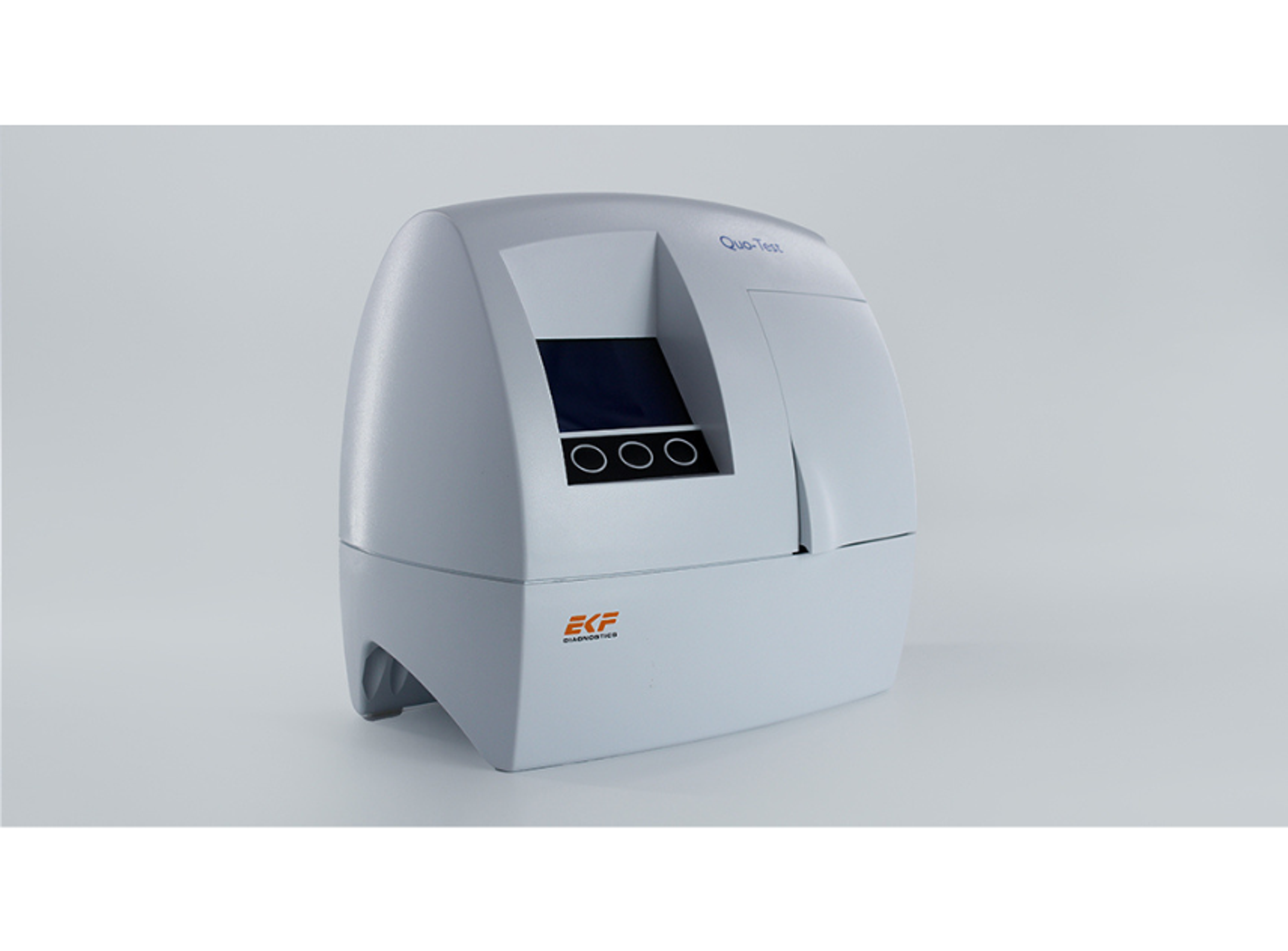
EKF Diagnostics’ Quo-Test HbA1c Analyzer Achieves Class Leading Level of Performance

11 Jul 2016
Alex Waite
Editorial Assistant

Product news

EKF Diagnostics, the global in-vitro diagnostics company, announces the release of a significant critical evaluation of the Quo-Test analyzer carried out by the European Reference Laboratory for Gylcohemoglobin.

This new evaluation represents the culmination of several years’ cooperation between EKF Diagnostics and the European Reference Laboratory to produce a world class Point-of-Care-Testing (POCT) HbA1c analyzer.

Following CLSI (Clinical & Laboratory Standards Institute) guidelines and NGSP (National Glycohemoglobin Standardization Program) criteria for precision the Quo-Test HbA1c analyzer was found to have class-leading level of performance for precision with a CV (coefficient of variation) of 2.2% at 6.6% DCCT. According to the IFCC (International Federation of Clinical Chemistry and Laboratory Medicine) and the NGSP an HbA1c value of 6.5% DCCT indicates a patient can be considered to be diabetic.

This new evaluation also demonstrates that the unique boronate affinity fluorescence quenching technology employed by the Quo-Test helps to keep results consistent by minimising the effect of hemoglobin variants, showing very little difference compared to the market-leading HPLC lab systems. The Quo-Test showed no interference of the common Hb-variants HbAS, HbAC, HbAD, HbAE, HbAJ, elevated A2 (­thallasemia) and HbF <8.6%.

“We are very happy with the results of this evaluation” said Global Diabetes Product Manager, Gavin Jones. “Following several disappointing evaluations produced by the European Reference Laboratory we decided to listen carefully to the advice they had to offer and incorporate that advice into our product development programme. What you are seeing in this evaluation is the result of that programme and we feel that we now have one of the most robust, accurate and precise POCT HbA1c analyzers on the market.”

The Quo-Test HbA1c analyzer has been designed for easy and reliable HbA1c measurement for the monitoring and management of diabetes in a point of care setting such as diabetes clinics and doctors’ surgeries.

The Quo-Test HbA1c is a fully automated hemoglobin A1c analyzer that uses patented boronate fluorescence quenching technology to measure glycated hemoglobin from a 4 μl sample taken from a finger prick or venous whole blood.

Quo-Test®: Lab-accurate HbA1c results

EKF Diagnostics

The Quo-Test® is a fully automated desktop point-of-care HbA1c analyzer. It will give easy and reliable HbA1c measurement for the monitoring and management of diabetes in a point-of-care setting, such as diabetes clinics and doctors’ surgeries.

(1)

Links

Tags

AutosamplersAutosamplers are automated sample loaders used with a number of separation and analytical techniques. HPLC autosamplers use automated partial or full-loop injection systems and place samples in vials or microplates for analysis. Autosamplers can also be used for elemental analysis. Features to consider include repeatability, syringe capacity, footprint and temperature controls.  Sample PreparationSample preparation can improve the quality and speed of separation techniques. Products to assist sample preparation include filtration equipment, evaporators, membranes and sieves.Preparative ChromatographyPreparative chromatography equipment is used for purification purposes, separating and collecting compounds eluted from a mixture which can then be subsequently used for further purposes. This can be done in large quantities or small. Preparative chromatography systems are usually low to medium pressure liquid chromatographs that are semi-automated. Explore a range of preparative columns and fraction collectors. Find the best preparative chromatography equipment in our peer-reviewed product directory: compare products, check customer reviews and receive pricing direct from manufacturers.HematologyIn Haematology / Hematology, complete blood cell counts (or full blood counts) are obtained using automated blood count analyzers to enumerate blood cell types.  Hematology also encompasses haemostasis and coagulation, thrombophilia and hemophilia, plasma viscosity and ESR analysis, hemoglobinopathies, cell morphology and haematinic measurement.Cell-Based AssaysCell-based assays are used to monitor the presence, quantity and activities of a desired cellular analyte including drug molecules or biomarkers. This can reveal information on cell health (apoptosis, cytotoxicity, viability and proliferation assays), cell metabolism, cell migration and cell signaling mechanisms. Find the best cell-based assay products, kits and equipment with our peer reviewed product directory: compare products, check customer reviews and receiving pricing direct from manufacturers.Point-of-CarePoint-of-Care Testing (POCT) or Near Patient Testing (NPT) products are available for urine, blood and other clinical chemistry analyses. POCT includes: blood glucose testing, blood gas and electrolytes analysis, rapid coagulation testing (PT / INR), rapid cardiac markers diagnostics, drugs of abuse screening, urine strips testing, pregnancy testing, fecal occult blood analysis, food pathogens screening, hemoglobin diagnostics, infectious disease testing and cholesterol screening.Clinical ChemistryBiochemistry (or clinical chemistry) involves the analysis of bodily fluids using chemical tests. Techniques used include HPLC, chromatography, spectroscopy, mass spectrometry, immunochemical, electrophoresis, turbidometric / spectrophotometric assay, MRI and ISE analysis. Tests are often carried out on plasma or serum but urine (urinalysis) and fecal specimens are also processed.Hematology Point of CareDiabetesDiabetes is a metabolic disorder characterized by high blood sugar levels, either due to insufficient insulin production or resistance to its effects. Ongoing diabetes innovation focuses on developing better diagnostic tools, treatments, and preventive measures. Browse our peer-reviewed product directory to find the best diabetes diagnostic tools, compare products, check reviews, and get pricing directly from manufacturers.HBA1CIn Vitro DiagnosticsIn vitro diagnostics (IVD) involve testing samples outside the body, typically in a laboratory, to diagnose diseases or conditions. IVD technologies include blood tests, molecular assays, and other bodily fluid tests, enabling accurate diagnosis and monitoring of diseases. These tests are essential for guiding treatment decisions in clinical settings. Browse our peer-reviewed product directory to find the best IVD solutions; compare products, check reviews, and get pricing directly from manufacturers.Blood AnalysisThe analysis of blood is vital for many areas of life sciences and forensic investigations. Blood samples can be tested for a number of different reasons such as diagnosis, glucose levels, cholesterol and drug testing.
EKF Diagnostics’ Quo-Test HbA1c Analyzer Achieves Class Leading Level of Performance