
Drastic Reduction in CRISPR Off-Target Effects by IDT’s New Cas9 Enzyme
Reduction of CRISPR off-target effects without significant loss of on-target activity
1 Aug 2017
Product news
Integrated DNA Technologies (IDT) has announced the launch of the first Cas9 enzyme variant that extensively reduces off-target effects in CRISPR genome editing without compromising on-target activity. The Alt-R® S.p. HiFi Cas9 Nuclease 3NLS enzyme is a recombinant S. pyogenes Cas9 mutant that improves specificity while maintaining a high editing efficiency similar to wild-type Cas9. The launch represents a major step towards therapeutic use of CRISPR, which has previously borne the risk of the unwanted off-target editing events observed with wild-type Cas9. Earlier Cas9 mutants that offer improved specificity suffer from a moderate to severe loss of on-target activity when used as an RNP complex.
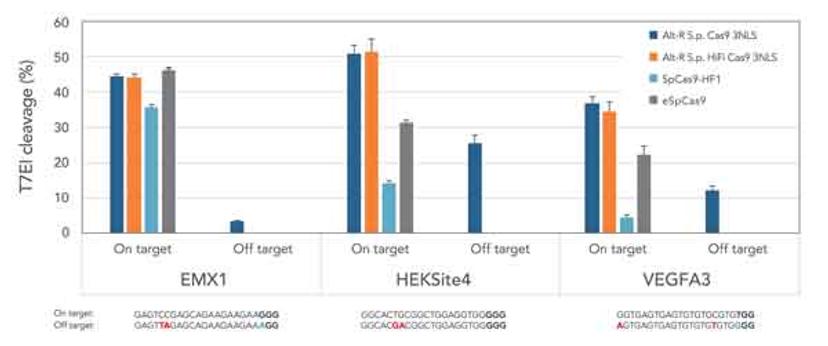
CRISPR-Cas9 genome editing has revolutionized life science research, but concern about unwanted off-target editing events has been a stumbling block for researchers considering therapeutic applications. The largely preferred method of delivering genome editing reagents as RNP complexes reduces, but does not eliminate, the risk of off-target editing. However, recent attempts at rational design of Cas9 mutants with reduced off-target activity traded on-target activity for improved specificity, and produced mutants generally unsuitable for use in RNP delivery.
In order to successfully provide a Cas9 mutant with radically reduced off-target effects while maintaining high on-target activity, IDT screened more than 250,000 mutants in two rounds of selection. The resulting rigorously tested enzyme, Alt-R S.p. HiFi Cas9 Nuclease 3NLS, is further enhanced with three nuclear localization signals (NLS) for optimal migration to the target DNA.
The new enzyme has been tested at a number of prominent laboratories conducting translational research into various diseases - with results that have exceeded all expectations. Matt Porteus, MD, PhD, at Stanford University’s Division of Stem Cell Transplantation and Regenerative Medicine, said, “We performed an unbiased evaluation of several versions of high fidelity Cas9 enzyme in primary human stem cells. We have been very impressed with the characteristics of this new IDT enzyme. Unlike other versions, this version consistently gives us high on-target editing activity while having low off-target activity. Because of the retained excellent on-target activity and improved specificity profile, we are excited to use this version in our future experiments focused on developing novel genome editing based therapies for severe diseases with unmet medical needs.”
Jacob Corn, PhD, Director of the Innovative Genomics Initiative at the University of California Berkeley, said, “The IDT high fidelity Cas9 performed admirably in primary human hematopoietic stem cells. On-target editing was just as good as wild-type Cas9 and off-target events were greatly reduced”.
Mark Behlke, Chief Scientific Officer at IDT, said, “Previous attempts to make improved specificity Cas9 mutants focused on plasmid-based methods, which greatly overexpress the Cas9 protein and maximize unwanted side effects. To achieve reduced off-targeting in the face of sustained overexpression, this first generation of Cas9 variants relied on mutations that compromised activity, which in turn led to poor function when used in RNP format. IDT specifically developed a mutant that performs well when used with the lower levels of protein employed with RNP delivery, maximizing safety and further reducing unwanted side effects.”
IDT’s new Alt-R S.p. HiFi Cas9 Nuclease 3NLS enzyme is the latest addition to the popular Alt-R CRISPR-Cas9 system. Along with high potency and safety, the system saves time by providing easy, ready-to-use RNA reagents.