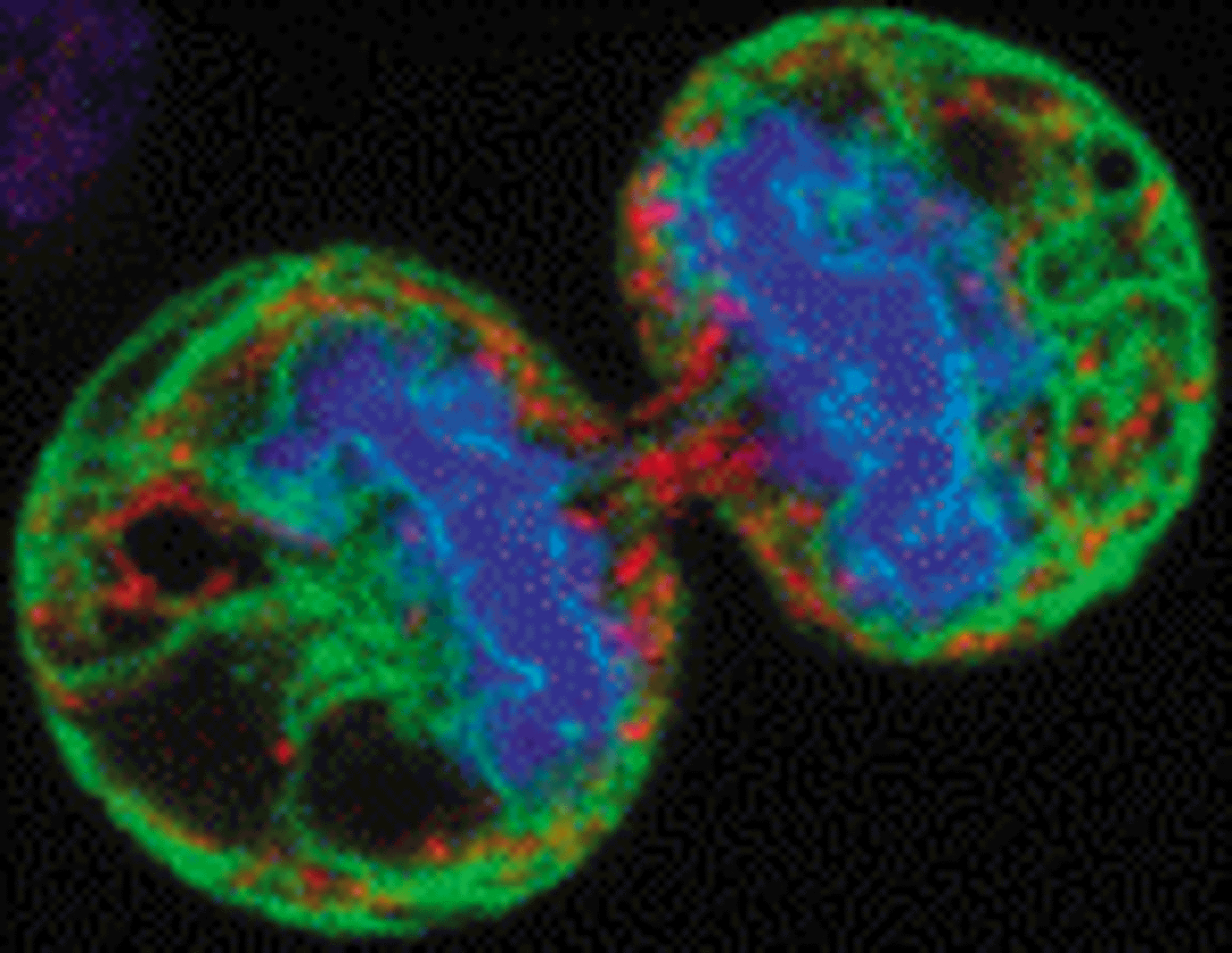
DRAQ5 is an ideal DNA dye for fixed cell preparations in fluorescence microscopy

20 Nov 2007

Product news

The far-red fluorescing nuclear counterstain DRAQ5, widely used for live cell imaging and flow cytometry, has also been validated by many recent publications for a wide range of fixatives, frozen and paraffin-embedded preparations.

Due to remarkable spectral properties DRAQ5 is compatible with the widest range of visible range fluorophores allowing simultaneous and multi-parametric imaging. One striking example is the combination of a constitutively-expressed GFP-tagged protein in female donor cells, a Y-chromosome FISH Cy3-probe for male recipient cells and DRAQ5 to demark the nuclei of all cells in mouse cardiac tissue sections (Visconti, 2006).

Usefully, DRAQ5 works with a full range of fixatives including methanol, acetone, PFA, and PLP and has been shown to stain efficiently both before (Schweitzer, 2005) and more typically after fixation (Grimm, 2004).

DRAQ5 penetrates deep into tissue sections: staining of 50 um-thick fixed sections from rat kidney samples (Toyokawa, 2006) permitted multiple confocal sections and 3-D reconstruction for a movie of three parameters.

DRAQ5 is compatible with wide-field, epifluorescent and confocal microscopes and all available HCS imaging platforms making it a perfect choice for broad application in immunohistochemistry.

DRAQ5

Biostatus Limited

The proven far-red probe for live or fixed cells, spectrally compatible with UV / Vis-range fluors.

(267)

Links

Tags

Gel Doc / Image AnalysisGel documentation (gel doc) or gel imaging systems are used for the analysis of proteins, antibodies and nucleic acid immobilized in polyacrylamide or agarose gels, membranes or microarrays. Explore a range of a gel imaging systems, densitometers, scanners, transilluminators or UV lamp + CCD cameras for your image analysis solutions. Colorimetric, fluorescent and/or radioisotopic samples can be visualized and documented for further analysis. See gel doc / Image analysis software for quantitative 1D and 2D analysis of your samples. Find the best gel doc / image analysis products in our peer-reviewed product directory: compare products, check customer reviews and receive pricing direct from manufacturers.Flow Cytometry / Cell CountingFlow cytometers are used to count, sort and examine multiple characteristics of cells. Other cell analysis equipment includes image cytometers, cell counters, fluorescence-activated cell sorters (FACS), magnetic-activated cell sorters (MACS), and a range of flow cytometry assay kits. Flow cytometers can reveal information on cell viability, cell proliferation, apoptosis and cell cycle progression, as well as identify cell populations and intracellular or cell-surface molecules. Additionally, some flow cytometers, known as FACS, have an additional sorting function after analysis. Cell counters and image cytometers count live and dead cell populations and can also conduct cell proliferation assays. Find the best flow cytometers, cell counters and cell sorters in our peer-reviewed product directory: compare products, check customer reviews and receive pricing direct from manufacturers.Cell-Based AssaysCell-based assays are used to monitor the presence, quantity and activities of a desired cellular analyte including drug molecules or biomarkers. This can reveal information on cell health (apoptosis, cytotoxicity, viability and proliferation assays), cell metabolism, cell migration and cell signaling mechanisms. Find the best cell-based assay products, kits and equipment with our peer reviewed product directory: compare products, check customer reviews and receiving pricing direct from manufacturers.High-Content ScreeningHigh-content screening (HCS), also known as high-content analysis (HCA), is a high-throughput technique used in drug discovery to identify substances that alter the phenotype of cells. HCS uses fluorescent microscopic imaging and automated image analysis to investigate cellular events such as apoptosis, cell viability, GPCR activation, oxide production, neurite outgrowth, and cell signaling. Find the best fluorescent labeling reagents, cellular assays, and high-content imaging systems in our peer-reviewed product directory: compare products, check customer reviews and receive pricing direct from manufacturers.Light MicroscopyLight microscopes or optical microscopes are used to visualize microscale objects under magnification, including cells, clinical specimens and materials. Lab equipment for light microscopy includes confocal microscopes, fluorescence microscopes, zoom and stereo microscopes. Microscope slides and imaging reagents are available for visualizing samples, as well as various microscope stages and incubators for large or temperature-sensitive samples. Find the best light microscopes in our peer-reviewed product directory: compare products, check customer reviews and receive pricing direct from manufacturers.