Discovering Digitization at the Forefront of Scientific Innovation: analytica 2018 Highlights

Digital solutions, food safety & security and sustainability all high on the agenda at 50th anniversary of analytical conference

3 May 2018

Emily Adam
Publishing / Media

Editorial article

Eager scientists from around the world descended on Munich, Germany, for an exciting four days of high-impact science and technology at analytica 2018. Now in its 26th iteration, this biennial exhibition has grown to over 35,000 visitors and over 1,000 exhibitors, who come together to focus on the latest innovations and breakthroughs.

Eager scientists arrive at analytica 2018. Image courtesy of Messe München GmbH

From basic research to application-based studies, analytica featured an impressive array of both exhibitors and supporting forums focused on areas including material analysis, bioanalysis, food analysis and pharmaceutical analysis. There were also many key identifiable trends across the conference floor, ranging from digitization to sustainability.

The importance of digitization in the laboratory

Digitization was a recurrent theme throughout analytica, and with 90% of conference attendees indicating that laboratory digitization is one of the key challenges they will need to overcome in the next few years, exhibitors were keen to show off their digital expertise and offerings. Encompassing both in-lab and office-based innovations, the solutions found across the conference were as varied as the scientists using them.

The announcement of key digitized solutions was a highlight of the show. Thermo Fisher Scientific announced the launch of its first cloud-enabled biological safety cabinet, the Thermo Scientific HeraSafe 2030i BSC, which brings with it the addition of cloud-technology enabling seamless workflow connectivity. Peter Huber Kältemaschinenbau AG meanwhile highlighted its Pilot ONE Controller System. By utilizing one core system which is compatible with a full range of products, Huber has successfully managed to cut down on training time and made its products even easier to use.

The importance of food security and analysis
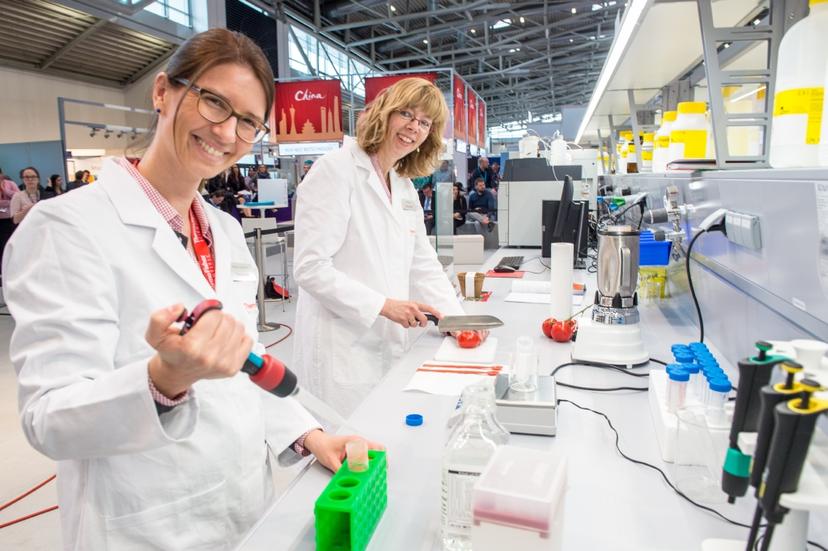
The importance of food analysis was highlighted at analytica 2018. Image courtesy of Messe München GmbH

In a increasingly connected world, the safety of our food has never been more important. Analytica therefore hosted a Live Lab on food analysis, exploring the top techniques for analyzing the quality of our food, as well as for detecting toxic compounds. The showcase highlighted the interdisciplinary nature of food analysis, as well as some exciting equipment systems and methods.

The NMR FoodScreener from Bruker Biospin continues to be one of the key pieces of technology for research around Europe, having been selected by the Hungarian government for use in its wine profiling initiative, which aims to map the quality and authenticity of all the wine produced in the country.

The sustainability transformation and innovation across the industry

Sustainability is already transforming the world we live in, but with laboratories consuming more energy than other work spaces such as hospitals or office buildings, the need for solutions is critical. Agilent Technologies has been focusing on its role in sustainability and highlighted some fantastic innovations during the conference. These included a drive to create smarter packaging and reduce water and energy consumption, as well as to cut the amount of hazardous waste produced.

The issue of plastics in the environment was also a key consideration throughout the conference, with microplastics — the small plastic particles formed when plastics are discarded in the environment — being of particular concern. An enlightening presentation during the conference highlighted new techniques for the analysis of microplastics in water using FTIR, Raman and pyrolysis-GC-MS methods.

The impact of biotechnology on clinical diagnostics and laboratory medicine

Over the past few decades biotechnology has revolutionized diagnostic, medical and clinical chemistry. From start-ups to leading manufacturers, there were exhibitors across the conference focusing on this exciting area of research. One such manufacturer, SCIEX, had recently announced the launch of a high-performance mass spectrometry technology that brings ultimate sensitivity and speed to clinical diagnostics laboratories. The SCIEX Citrine™ MS/MS medical device provides clinical labs with one solution to tackle today’s difficult assays, and the versatility to address tomorrow’s precision medicine and wellness testing.

A time for celebration

Overall, analytica 2018 had an atmosphere of celebration, with the conference itself marking its 50th anniversary, an impressive feat indicating the conference organizers' commitment to developing a strong and relevant program. It was also heartening to see that several manufacturers were also celebrating key anniversaries, including Huber Kältemaschinenbau AG and Julabo. SelectScience, meanwhile, marked its 20th anniversary with a special party and the launch of the new European Scientists’ Choice Awards, which served to reinforce the event’s sense of shared success.

For updates from across the conferences check out the analytica 2018 special feature >>

Links

Tags

Flash ChromatographyFlash chromatography is a fast-preparative column chromatography technique used for separation and purification of liquid analytes. Flash chromatography systems use small silica gel particles for separation and a pressurized gas for driving the solvent through the column or pre-packed cartridge. Find the best flash chromatography equipment in our peer-reviewed product directory: compare products, check customer reviews and receive pricing direct from manufacturers.Gas ChromatographyGas chromatography (GC) is an analytical technique used to separate and quantitate mixtures of small and volatile compounds. Gas chromatographs or GC systems include components such as GC columns, detectors, pumps and autosamplers. Choose from packed or capillary GC columns, flame ionization (FID), photoionization (PID) electron capture detectors and selective or non-selective detectors. Find the best gas chromatographs in our peer-reviewed product directory: compare products, check customer reviews and receive pricing direct from manufacturers.UHPLC and HPLCHigh performance liquid chromatography (HPLC) and ultra high performance liquid chromatography (UHPLC), also known as UPLC, are analytical techniques used to separate, identify and quantitate components of complex mixtures including biological samples such as proteins and lipids as well as chemical mixtures of pesticides, drugs and oils. Both techniques are liquid chromatographic methods but differ by operating pressures (HPLC < 6000 psi < UHPLC ). Components of HPLC and UHPLC systems include columns, detectors, pumps, autosamplers and column heaters. Explore a range of UHPLC and HPLC columns for your specific sample needs including reverse phase, normal phase, ion exchange, HILIC, ion exclusion and size exclusion columns. For more specialized HPLC, explore FPLC, countercurrent LC and simulated moving bed systems. Find the best UHPLC and HPLC equipment in our peer reviewed product directory: compare products, check customer reviews and receive pricing direct from manufacturers.Sample PreparationSample preparation can improve the quality and speed of separation techniques. Products to assist sample preparation include filtration equipment, evaporators, membranes and sieves.Atomic Absorption / Emission SpectroscopyAtomic absorption spectroscopy (AAS) and atomic emission spectroscopy (AES) — also called optical emission spectroscopy (OES) — are used to detect the elemental constituents in samples. Both techniques involve the atomization of a sample. Atomic absorption spectrometers may use a flame or furnace to create an atomic vapor of the sample before irradiation with spectral light. Optical emission spectrometers may use a flame, inductively coupled plasma (ICP), microwave plasma (MP) or spark arcs to atomize and excite the sample. At higher excitation energies, electrons can be emitted instead of photons, which can be useful for samples that can’t be atomized and for surface analysis. Explore electron spectroscopy equipment such as Auger spectrometers and photoelectron spectrometers for surface elemental analysis of samples. Find the best atomic absorption, photoelectron and optical emission spectrometers in our peer-reviewed product directory: compare products, check customer reviews and receive pricing direct from manufacturers.LC-MSLC-MS (liquid chromatography-mass spectrometry) systems and equipment are used for separation and quantitative analysis of complex mixtures, combining liquid chromatography and mass spectrometry. Quantify proteins, contaminants, pesticides or screen for drug metabolites with a high level of sensitivity. LC-MS systems and equipment include reverse phase, normal phase and specialized columns integrated with various MS detectors such as time-of-flight (TOF), quadrupole, orbitrap or ion trap mass analyzers. LC-MS/MS instruments equipped with a qTOF or triple quadrupole analyzer give greater sensitivity and resolving power to your analysis. Find the best LC-MS equipment in our peer-reviewed product directory: compare products, check customer reviews and receive pricing direct from manufacturers.Mass SpectrometryMass spectrometry (MS) is a powerful analytical technique used to identify and quantify molecules based on the mass-to-charge ratio of gas-phase ions. It provides detailed information about the structure, composition, and properties of compounds and is widely used across fields such as environmental monitoring, materials science, drug discovery and development, food and beverage testing, and wider chemical research. Key MS techniques include tandem mass spectrometry (MS/MS), liquid chromatography–mass spectrometry (LS-MS) and inductively coupled plasma (ICP-MS). Choosing from these wide range of techniques and technologies can be a daunting task, so keep up to date with scientific applications, performance expectations, and customer reviews here all in one place. Visit our product directory to receive quotes direct from the manufacturer. NanoLCNano LC is a nano scale liquid chromatography technique typically used for proteomic applications. The nano refers to the very low flow rate of the mobile phase in the system. The advantage of nanoLC is its high sensitivity. Often the system is integrated with a mass spectrometer in nano LC-MS or nano LC-MS/MS. When using nanoLC equipment consider column choice, software and accurate and precise flow rate control.Environmental Monitoring and TestingEnvironmental monitoring and testing uses handheld portable analyzers, kits, spectrometers or chromatography systems for air, water, soil, food and other sample testing. Useful features of analyzers such as BOD and COD include portability, easy calibration, automation and sensitivity.  Environmental test kits for pH, water, moisture, etc, should be accurate, sensitive, reliable, fast and easy to use.Light MicroscopyLight microscopes or optical microscopes are used to visualize microscale objects under magnification, including cells, clinical specimens and materials. Lab equipment for light microscopy includes confocal microscopes, fluorescence microscopes, zoom and stereo microscopes. Microscope slides and imaging reagents are available for visualizing samples, as well as various microscope stages and incubators for large or temperature-sensitive samples. Find the best light microscopes in our peer-reviewed product directory: compare products, check customer reviews and receive pricing direct from manufacturers.GC-MS GC-MS (gas chromatography-mass spectrometry) instruments and equipment are used to separate, quantify and identify mixtures of small and volatile compounds, such as polycyclic aromatics, fatty acids and alcohols. Often used in drug detection, forensic investigation and environmental analysis for pesticides and contaminants, GC-MS is a powerful addition to your lab’s analytical capabilities. GC-MS/MS instruments equipped with a qTOF or triple quadrupole analyzers can give greater sensitivity and resolution to your analysis. Find the best GC-MS instruments and equipment in our peer-reviewed product directory: compare products, check customer reviews and receive pricing direct from manufacturers.Homogenizers and BlendersHomogenizers and blenders are used to homogenize various types of material, including tissue, cells, plants, food, soil, biological and chemical samples for subsequent analysis. Lab equipment for sample homogenization includes handheld and benchtop homogenizers, bead mill, ultrasonic and multiple sample homogenizers, high shear homogenizers and blenders. Homogenizer bead and probe multipacks are available to avoid cross contamination of samples, as well as cooling systems for homogenizing temperature-sensitive samples. Homogenizers are often used in the first step of extraction of DNA, RNA and proteins from tissue and cell samples. Find the best homogenizers and blenders in our peer-reviewed product directory: compare products, check customer reviews and receive pricing direct from manufacturers.NMR and EPR SpectroscopyNuclear magnetic resonance (NMR) spectroscopy is used to resolve the local chemical environment of atomic nuclei with spin, revealing information on molecular structure, dynamic processes and chemical reactions of organic molecules, from proteins to synthetics. Electron paramagnetic resonance (EPR) also known as electron spin resonance (ESR) spectroscopy is used to detect and quantify paramagnetic species in a sample, including free radicals as transition metal ions. By immersing the sample in a strong magnetic field, both NMR and EPR spectrometers probe the sample with either radio waves or microwaves respectively. A range of benchtop, solid-state and time domain NMR spectrometers & EPR spectrometers are available, as well as NMR tubes, NMR solvents, software, coils, and magnets. Find the best NMR & EPR equipment in our peer-reviewed product directory: compare products, check customer reviews and receive pricing direct from manufacturers.analyticaAnalytica is a leading international trade fair for laboratory technology, analysis, and biotechnology, showcasing innovations and solutions in the scientific community. Stay updated with the latest trends and products in the industry. Wine
Discovering Digitization at the Forefront of Scientific Innovation: analytica 2018 Highlights