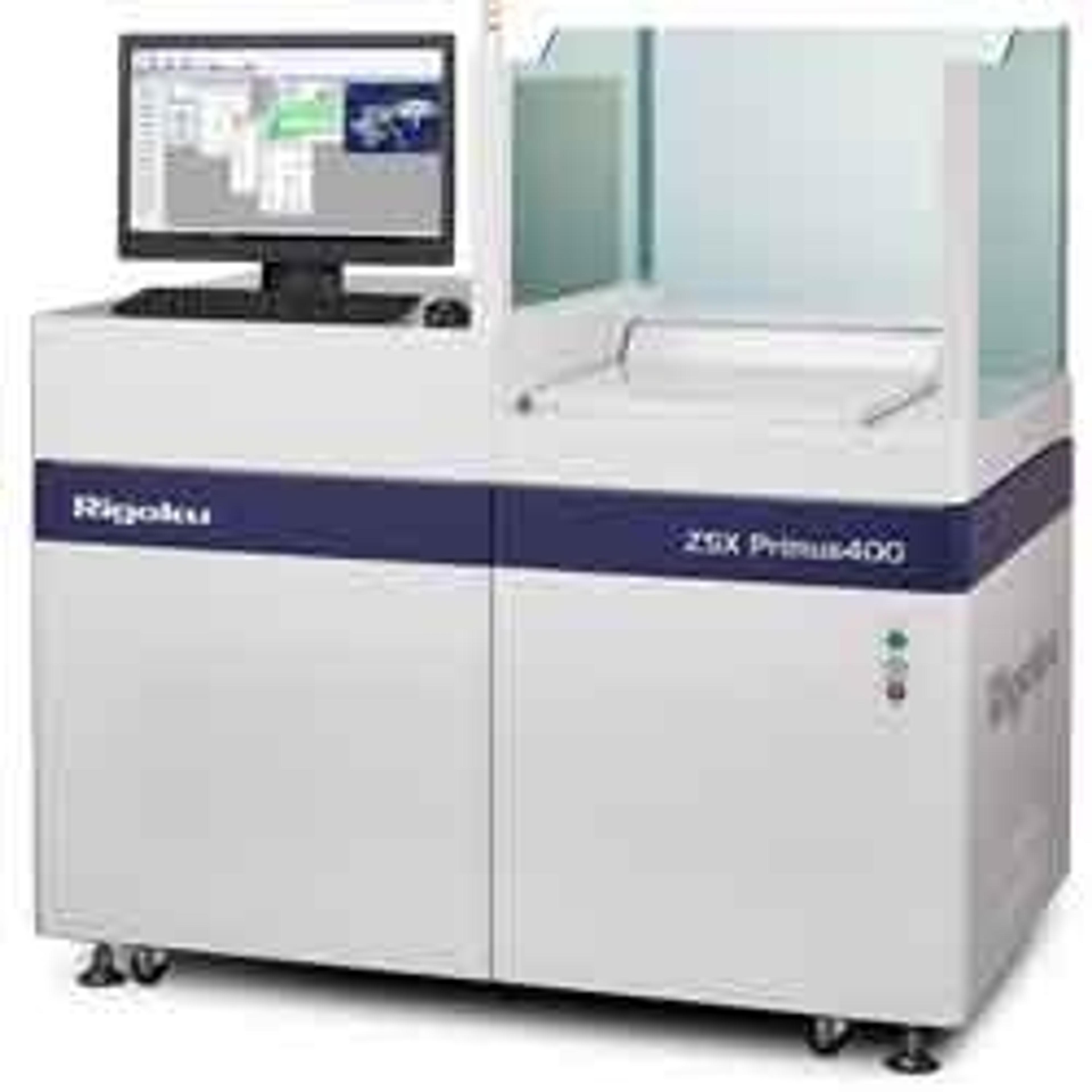
Discover the New Spectrometer Designed for Large and Heavy Samples from Rigaku

New WDXRF spectrometer from Rigaku enables elemental analysis of large objects by WDXRF spectroscopy with micro-mapping

31 Jul 2017

Finn Price
Administrator / Office Personnel

Product news

Rigaku Corporation is pleased to announce the introduction of the new Rigaku ZSX Primus 400 sequential wavelength dispersive X- ray fluorescence (WDXRF) spectrometer. The new instrument was conceived specifically to handle very large and/or heavy samples and offers micro-mapping capabilities.

WDXRF analyzers are notable for high sensitivity and spectral resolution for non-destructive elemental analysis. The ZSX Primus 400 spectrometer was designed to adapt to varying, specific sample types and analysis needs. Accepting samples up to 400 mm diameter, 50 mm thick and 30 kg mass, the new system is ideally suited for analyzing sputtering targets, magnetic disks, or for multilayer film metrology or elemental analysis of large samples.

All analytical capabilities of a traditional instrument are retained in this "large sample" variant, including measurement of beryllium (Be) through uranium (U) with high-resolution and precise WDXRF spectroscopic examination of samples from solids to liquids and powders to thin films.

For added flexibility, the new instrument offers a customized sample adapter system. With a variable measurement spot (30 mm to 0.5 mm diameter with 5-step automatic selection) and mapping capability with multi-point measurements to check for sample uniformity, this uniquely versatile instrument was engineered to dramatically streamline quality control processes.

An available real-time camera allows the analysis point to be viewed on-screen, offering the operator complete certainty as to what is being measured.

The ZSX Primus 400 Windows® based software is user-friendly, yet powerful enough for the most complex analysis. Based on the Rigaku easy-to-use flow bar interface, the ZSX Guidance software walks the user through the steps required to set up an empirical or fundamental parameters application.

Links

Tags

Fluorescence SpectroscopyFluorometers and spectrofluorometers (also called fluorescence spectrometers) are used to measure the intensity and wavelength of fluorescent light emitted from a sample after excitation by illumination. Spectrofluorometers utilize monochromators to select the desired wavelengths, whereas filter fluorometers employ a set of filters. Spectrofluorometers for measuring steady-state fluorescence and lifetime fluorescence (or time-resolved fluorescence) are available, as well as fluorescence microscopes and microplate readers. Find the best fluorescence spectroscopy products in our peer-reviewed product directory: compare products, check customer reviews and receive pricing direct from manufacturers.X-Ray Diffraction and SpectroscopyX-Ray diffraction & spectroscopy are used in material characterization to discern the structure and elemental composition of a sample. X-Ray diffractometers (XRD) are superior instruments in elucidating the dimensional atomic structure of crystalline materials, including powders, thin films and single crystals. For large unit cells or ordered macromolecules, consider small-angle X-ray scattering (SAXS). X-ray spectroscopic techniques include X-ray fluorescence (XRF) and X-ray photoelectron spectroscopy (XPS), both providing simple and accurate methods for determining the elemental composition of a material. Energy dispersive (EDXRF) and wavelength dispersive (WDXRF) XRF spectrometers are available, as well as handheld/portable devices. High-resolution, 3D microstructure characterization of materials can be achieved with X-ray microscopes combining sub-micron resolution imaging with 3D computed tomography. Find the best XRD and XRF spectrometers in our peer-reviewed product directory: compare products, check customer reviews and receive pricing direct from manufacturers.Software PlatformsSoftware platforms are useful for various stages of laboratory experiments from data collection to data storage and processing. For instance lab software is available for system control, data management, data analysis and qualification / validation.Particle CharacterizationParticle characterization instruments are used to determine particle size distribution, shape, surface area, zeta potential, density and porosity of particles and materials. Multiple tecchniques are available for determining particle size, shape and count including dynamic light scattering (DLS), laser diffraction, electrozone (Coulter technique), imaging particle analysis and single particle optical sensing. Determine the density of your material with a gas pycnometer or examine its surface area and porosity with gas adsorption analyzers and mercury porosimeters. Find the best particle characterization instruments in our peer-reviewed product directory: compare products, check customer reviews and receive pricing direct from manufacturers.Surface Mapping
Discover the New Spectrometer Designed for Large and Heavy Samples from Rigaku