
Discover How Roche Applied Science Drives Success in Cancer Research
5 Apr 2009Product news
Join Roche Applied Science at AACR 2009 in Denver, April 19-22. Stop by Booth 819 to discover how we’re helping cancer researchers succeed.
Do some business….
• Design your own qPCR assay in less than one minute with the Universal ProbeLibrary — and take it with you.
• Search our database to see if your cell line has been successfully transfected with FuGENE® HD Transfection Reagent.
• Request a FREE sample of Complete Protease Inhibitor Cocktail Tablets, PhosSTOP Phosphatase Inhibitor Cocktail Tablets, FastStart Universal Probe Master (Rox), or FastStart Universal SYBR Master (Rox).
• Sign up for e-news subscriptions.
…. and have some fun!*
• Play Guitar Hero.
• Check out the new xCELLigence Rock Video.
• Register for a chance to win a Nintendo Wii game console with dual Guitar Hero bundle.
• Complete a survey and get a Cell Death Tour T-Shirt.
• Play the Gene Expression Rave Game.
Roche Applied Science provides a broad range of instruments and reagents for oncology research, including innovative technologies for real-time cellular analysis, nucleic acid isolation, gene expression analysis, real-time PCR, genome sequencing, and microarray analysis.
Visit the company article website to learn more about these and other products that enable discovery.
*All offers valid while supplies last, and only at AACR 2009, Booth 819, April 19-22.
For life science research only.
COMPLETE, FASTSTART, PHOSTOP, and XCELLIGENCE are trademarks of Roche.
FUGENE is a registered trademark of Fugent, L.L.C., USA.
PROBELIBRARY is a registered trademark of Exiqon A/S, Vedbaek, Denmark.
Nintendo is a registered trademark and Wii is a trademark of Nintendo of America, Inc.
Guitar Hero is a registered trademark of Activision Publishing, Inc.
Related products
Request Quote for All Products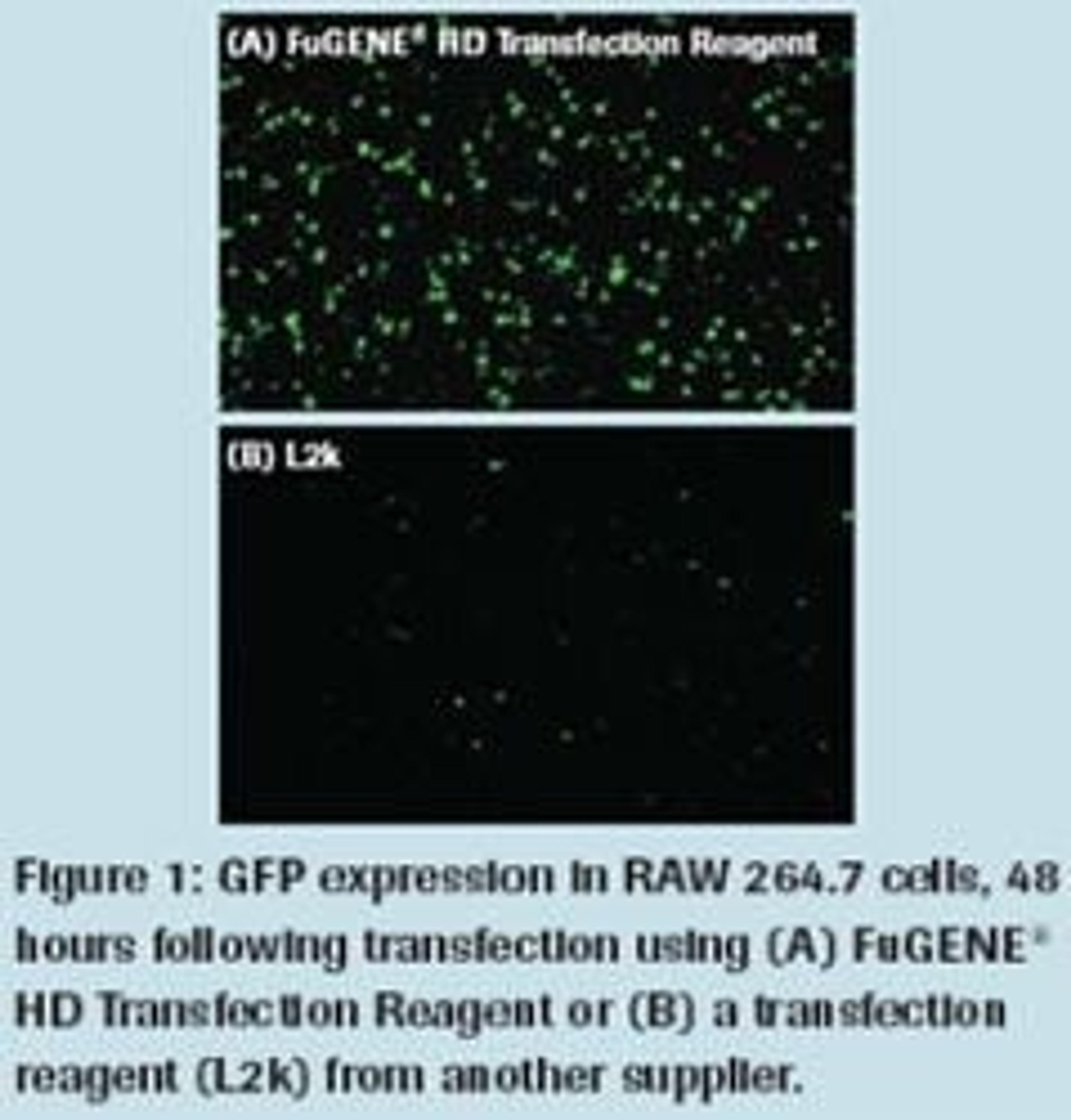
FuGENE® HD Transfection Reagent
Roche FuGENE HD Transfection Reagent is a next-generation transfection reagent, free of animal-derived components. Roche FuGENE HD Transfection Reagent is designed to transfect a wide range of eukaryotic cells, including insect cells and many tumor cell lines not transfected well by other reagents (e.g., MCF7, Hep G2, PC-3, HeLa, MA-10, Hep G2, SH-SY5Y, A7r5, STO, SCC-61, SQ20B, T98G, STSAR-90, A375, A549, and others). In addition, embryonic stem cells are effectively transfected with FuGENE® HD Transfection Reagent.Roche FuGENE HD Transfection Reagent can be successfully used in a variety of applications, such as gene expression analysis and protein production using transiently transfected cells, generation of stable cell lines, generation of retroviruses and lentiviruses, expression of shRNA for Gene Knockdown studies, in drug discovery programs, and for target validation. Features of Roche FuGENE® HD Transfection Reagent: Achieve new levels of transfection efficiency in difficult-to-transfect cell lines, such as RAW 264.7 and many tumor cell lines that are not transfected well by other reagents. Select FuGENE® HD Transfection Reagent for the transfection of stem cells and obtain superior results, as demonstrated in a publication (Biochemica, 4, 2006; 24 – 26) where the reagent was compared with a pool of 37 other transfection reagents. Generate physiologically relevant data you can trust by using a reagent that has exceptionally low cytotoxicity, as measured through the amount of off-target effects and cell proliferation. Obtain higher expression levels of proteins in many adherent and suspension-adapted eukaryotic cell lines (HEK-293, CHO-S, CHO-K1, COS-7) and insect cell lines such as High Five and Sf9, over extended periods with scalability that other reagents cannot provide. Accelerate the move to development by using this unique non-liposomal reagent that is free of animal-derived components, stable at room temperature, sterile (0.1 µm filtered), and active in up to 100% serum. The ability to transfect cells in up to 100% serum provides a good model to mimic biological conditions. Increase experimental throughput and enable target validation by using a stable reagent with a simple, consistent, and fast protocol across a wide range of cell types.
PhosSTOP
Phosphatase Inhibitor Cocktail Tablets supplied in EASYpacks Application When isolating or detecting phosphorylated proteins, benefit from the ultimate in convenience to protect your proteins against phosphatase activity. PhosSTOP Phosphatase Inhibitor Cocktail Tablets eliminate the time-consuming search for just the right phosphatase inhibitor mix. PhosSTOP is a proprietary blend of phosphatase inhibitors, formulated as a ready-to-use tablet which dissolves quickly in aqueous solutions (buffers), including buffers containing formalin (for formalin fixation). Achieve effective and convenient inhibition of a broad spectrum of phosphatases across a wide range of sample materials (e.g., mammalian, plant, yeast, and bacterial) with non-toxic PhosSTOP Phosphatase Inhibitor Cocktail Tablets. They are well suited for the purification and detection of phoshorylated proteins. PhosSTOP Tablets can also be used in combination with the Complete Protease Inhibitor Cocktail Tablets to simultaneously protect proteins against dephosphorylation and proteolytic degradation; both inhibitor tablets maintain their activity when used together. Benefits Complete protection.Protect your proteins against a broad range of phosphatases. Inhibits acid and alkaline phosphatases, as well as serine/threonine (PP1, PP2A, and PP2B) and tyrosine protein phosphatases (PTP). Safe. Dissolve the non-toxic PhosSTOP Tablets in aqueous solutions and avoid organic solvents (e.g., DMSO). Flexible. Use PhosSTOP Tablets in extracts from almost any tissue or cell, including animals, bacteria, plant, or yeast cells. Suitable for formalin fixation. Maintain phosphorylation status of proteins in histological sections; PhosSTOP phosphatase inhibitors are compatible with buffers containing formalin (for formalin fixation). Convenient. Eliminate the time-consuming search for just the right phosphatase inhibitor. Easy to use. Simply drop a quick-dissolving tablet into your buffer; no weighing or mixing of different inhibitors is necessary. Compatible with Complete Protease Inhibitor Cocktail Tablets. Obtain complete phosphatase inhibitor and protease inhibitor activity when used in combination with Complete Tablets.
FastStart Universal SYBR Green Master (Rox)
FastStart Universal SYBR Green Master (Rox) includes a novel reference dye, which enables its use without modifications or adjustments to the specific instrument or protocol on all real-time PCR instruments requiring normalization with ROX. This ready-to-use, 2x-concentrated master mix contains all reagents (except primers and template) needed for running quantitative, real-time DNA detection assays, including qPCR and two-step qRT-PCR, in the SYBR Green I detection format. FastStart Universal SYBR Green Master (Rox) generates excellent results on instruments such as the Applied Biosystems 7900 HT Fast Real-Time PCR System or the Applied Biosystems 7500 Real-Time PCR System. Benefits Use this master mix on all real-time instruments that require normalization: Benefit from the new, specially developed universal reference dye included in the master mix for robust performance with a variety of instrument platforms. Improve PCR sensitivity and specificity: Rely on this mix’s FastStart Taq DNA Polymerase to minimize the formation of nonspecific amplification products through hot start PCR. Avoid over-estimation of qPCR results: Eliminate nonspecific amplification products and primer-dimers that would increase the amount of bound quantified SYBR Green I. Amplify and detect a broad range of DNA or cDNA targets: Amplify fragments up to 500 bp long, including those that are GC- or AT-rich. Save time and effort in qPCR preparation: Rely on this easy-to use, 2x master mix to eliminate the need to mix components, titrate MgCl2, or perform other time-consuming optimization steps. Prevent false positives resulting from carryover contamination: The mix contains dUTP, so that it may be used with Uracil-DNA Glycosylase to eliminate contaminating DNA carried over from previous PCR reactions.