
Discover How Multiplex Assays are Advancing Biomedical Research
Top tips to optimize your analyses
9 May 2016
Editorial article
Top tips to help you optimize your multiplex assays
Sonali Nayak, Senior Manager for North America Life Science Technical Services at MilliporeSigma, spoke to SelectScience® about the advantages and applications of multiplex assays. Read on to discover the latest technological developments and top tips for setting up your multiplex assays.
Q: Please tell us about your role at MilliporeSigma.
A: As the manager for protein detection, cell analysis and sample preparation, I support the products and tools developed for biomedical research, including the first commercially available multiplexed cytokine assay for the Luminex® platform. I also collaborate in data analysis software development for multiplexed assays. My experience encompasses many areas across drug discovery and development with an emphasis on research diagnostics.
Q: What are the benefits of multiplex assays?
A: Multiple biomarkers may need to be measured for research or diagnostic purposes and conventional methodologies, such as RIAs, ELISAs or Western blotting are constrained due to:
- sample volumes required
- costs
- time for standardization, validation & assay runs
- data reliability of running multiple assays on one sample
Multiplex assays address all these issues. Luminex’s xMAP® technology coupled with MILLIPLEX® Immunoassay kits, enables simultaneous measurement of multiple analytes, in low sample volumes, using one assay run. Fluorescent detection also provides a wider dynamic range for higher assay sensitivity. Costs are reduced as fewer assay runs are required.
Q: What are the most important applications of multiplex assays?
A: These assay formats have been used in several aspects of preclinical research and are now used in diagnostics. In drug development, multiplex assays can be applied at the discovery stage during screening, for biomarker profiling in preclinical tests, for final ADME studies and in phase IV clinical trials. In new-born screening, only one capillary tube of blood is sufficient to generate data across multiple parameters. Dried blood spots, collected worldwide, have been tested for biomarker research and epidemiology studies.
Multiplex assays, such as MILLIPLEX® MAP, are facilitating drug discovery screening, by reducing the time and resources necessary to develop a commercially viable drug.
Q: What are your top tips to get the best multiplex assay results?
A: Several factors should be considered for optimum results:
- Cross Reactivity
The antibody pairs used in a multiplexed panel should have negligible cross reactivity to the other analytes in the panel.
- Sample Dilution / Treatment
The sample values for the chosen assays should fall within the dynamic range of the standard curves. For example, high abundant proteins may require a sample dilution, in which case they cannot be plexed with low abundant protein assays. Similarly, analytes that require sample extraction (by either acidification, column separation etc.) may need to be plexed separately.
- Matrix Compatibility
Some sample types may have interfering matrix effects that reduce the recovery of the analyte in the assay. The use of a compatible matrix in the standard curve and /or buffers can compensate for these interferences. However, as the effect is different for each assay, only those assays, that give similar accuracy and linearity can be plexed.
- Assay Format
Some applications only require a qualitative response, i.e. presence, absence or change in analyte concentration. These assays may need to be run separately from quantitative assay, for example cell signaling studies versus cytokine profiling.
Q: What developments could benefit multiplex assays in the future?
A: We have the tools to generate data from genomic and proteomic microarrays separately but the ability to combine these parallel resources would greatly enhance research. Development of more sophisticated software, capable of quickly analyzing and interpreting the large volumes of data that can be generated from just one sample would also improve data management.
Do you use MILLIPLEX Immunoassay Kits? Tell us your opinion, leave a review today.
Image: diamant24/Shutterstock
Related products
Request Quote for All Products
MILLIPLEX MAP Human Complement Panel 1 - Immunology Multiplex Assay
MerckEMD Millipore’s MILLIPLEX® MAP Complement Panel 1 Magnetic Bead Panel is an 8-plex kit to be used for the simultaneous quantification of any or all of the following analytes in serum, plasma or culture supernatant samples: Complement 2, Complement C4B, Complement C5, Complement C5a, Complement C9, Adipson/Complement Factor D, Mannose-Binding Lecting (MBL) and Complement Factor I. MILLIPLEX® MAP offers the broadest selection of analytes across a wide range of disease states and species. Once the analytes of interest have been identified, you can rely on the quality that we build into each kit to produce results you can trust. In addition to the assay characteristics listed in the protocol, other performance criteria evaluated during the validation process include: cross-reactivity, dilution linearity, kit stability, and sample behavior(e.g. detectability and stability). Each panel and kit meets stringent manufacturing criteria to ensure batch-to-batch reproducibility. Each MILLIPLEX® MAP panel and kit includes: Quality controls (QCs) provided to qualify assay performance Comparison of standard (calibrator) and QC lots to a reference lot to ensure lot-to-lot consistency Optimized serum matrix to mimic native analyte environment Detection antibody cocktails designed to yield consistent analyte profiles within panel EMD Millipore’s MILLIPLEX® MAP Complement Panel 1 Magnetic Bead Panel is part of the most versatile system available for complement factor research. From our single to multiplex biomarker solutions, we partner with you to design, develop, analytically validate and build the most comprehensive library available for protein detection and quantitation.
MILLIPLEX MAP Human Stem Cell Pluripotency Magnetic Bead Panel 2 - Stem Cell Multiplex Assay
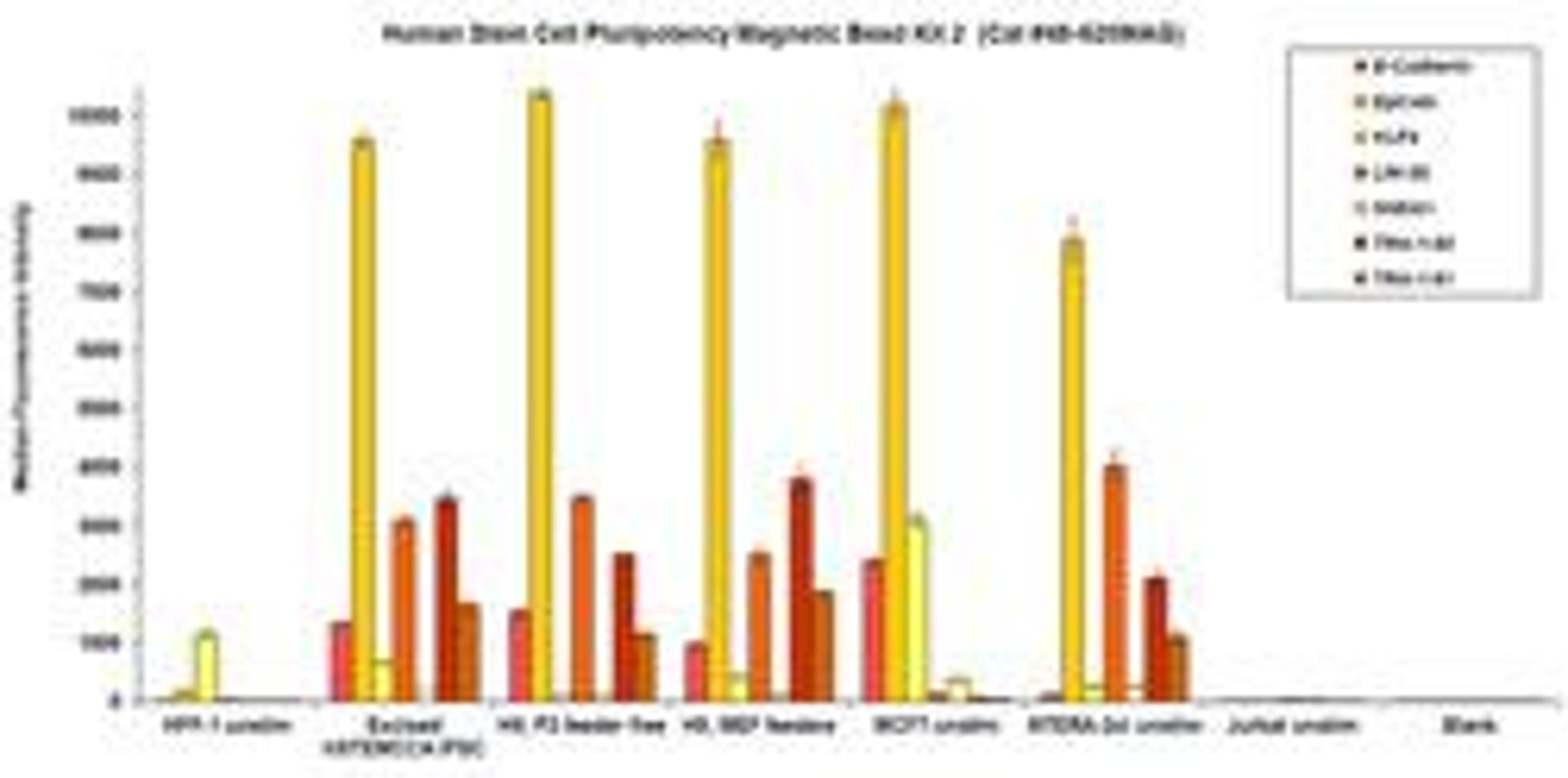
MerckProduct Overview: The MILLIPLEX® Human Stem Cell Pluripotency Magnetic Bead Kit 2 (Cat. No. 48-620MAG) is a premixed kit to be used for the simultaneous quantification of the following 7 analytes in cell lysates: E-Cadherin, EpCam, KLF4, LIN-28, and the glycostructures TRA-1-60, TRA-1-81 and SSEA1. The detection assay is a rapid, convenient alternative to Western Blotting and immunoprecipitation procedures. Each kit has sufficient reagents for one 96-well plate assay. Background Information: The expression of transcription factors, translational regulators and trans-membrane proteins, as well as cell surface glycostructures, play critical roles in the maintenance of pluripotency and self renewal in stem cells and can serve as markers of cell status. Applications: This MILLIPLEX® MAP Human Stem Cell Pluripotency Magnetic Bead Panel 2 is a Stem Cell Characterization multiplex assay. The analytes available for this multiplex kit are: E-Cadherin, EpCam, KLF4, LIN-28, SSEA1, TRA-1-60, TRA-1-81.

MILLIPLEX MAP Human Stem Cell Pluripotency Magnetic Bead Panel 1 - Stem Cell Multiplex Assay
MerckProduct Overview: The MILLIPLEX® Human Stem Cell Pluripotency Magnetic Bead Panel 1 (Cat. No. 48-617MAG) is a premixed panel to be used for the simultaneous quantification of the following 4 analytes in cell lysates: c-Myc, Nanog, Oct 3/4, and Sox2. The detection assay is a rapid, convenient alternative to Western Blotting and immunoprecipitation procedures. Each kit has sufficient reagents for one 96-well plate assay. Background Information: The expression of the transcription factors Oct 3/4, Sox2 and Nanog play a critical role in the maintenance of pluripotency and self renewal in stem cells. c-Myc, a member of the helix-loop-helix-leucine zipper family, is a transcription factor that regulates the expression of multiple genes involved in apoptosis, cell differentiation and cell proliferation. In stem cells it seems to control the balance between stem cell self-renewal and differentiation. Thus the presence of the four proteins Oct-3/4, Sox2, Nanog and c-Myc are indicators for the pluripotency of iPS cells and human embryonic stem cells. Applications: This MILLIPLEX® MAP Human Stem Cell Pluripotency Magnetic Bead Panel 1 is a Stem Cell Characterization multiplex assay. The analytes available for this multiplex kit are: c-Myc, Nanog, Oct 3/4, Sox2.