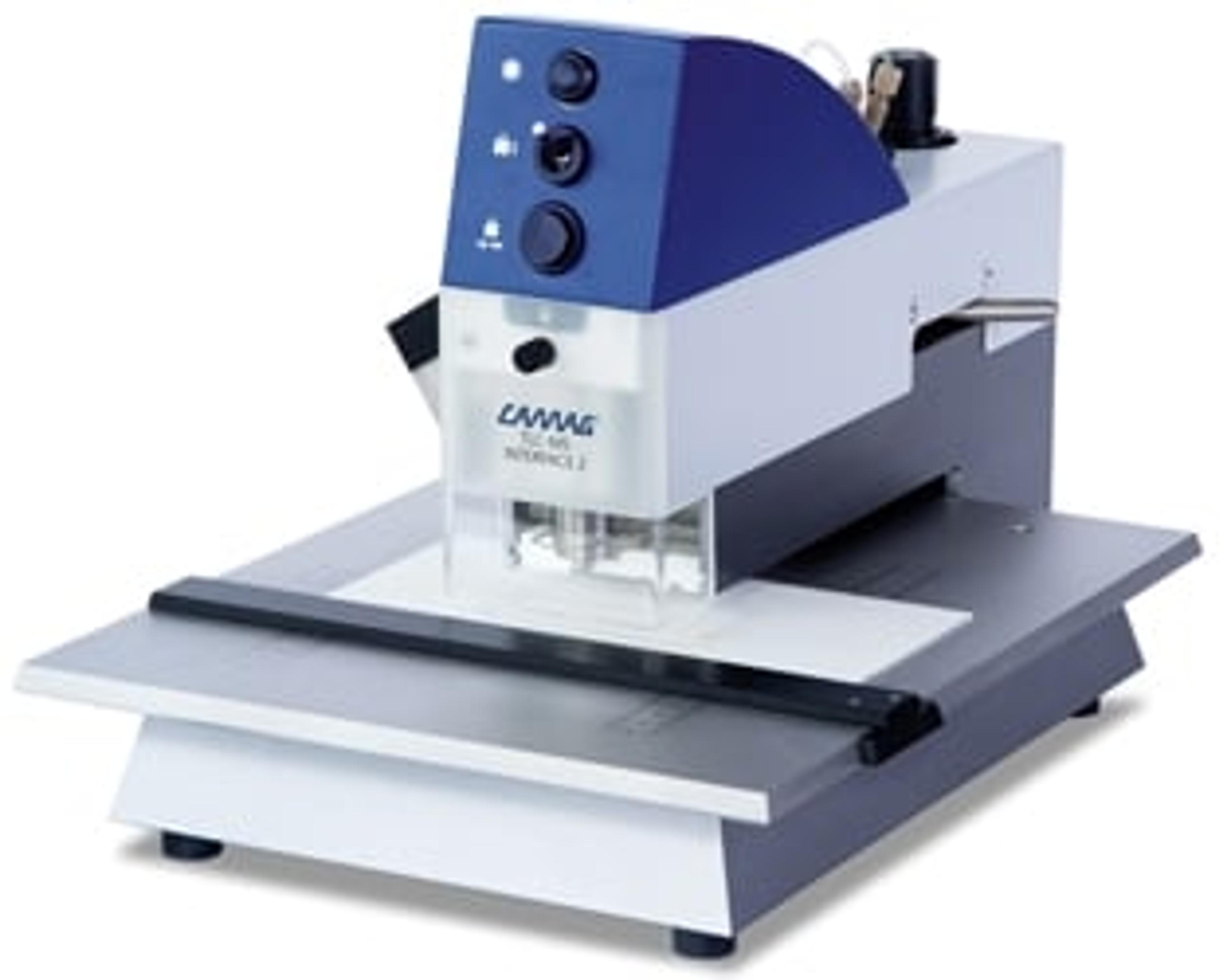
Direct extraction of compounds from TLC/HPTLC layers into MS:

1 Jun 2009
Lukas Frommenwiler
Marketing / Sales

Product news

When doing TLC or HPTLC analyses we often want to know more about a certain substance. We then usually would scrape off the silica, extract the unknown substance zones with an appropriate solvent, filter the solutions and finally inject them into a mass spectrometer.

A tedious procedure, isn’t it?

Now the new CAMAG TLC-MS Interface is available for the rapid and convenient extraction of compounds into APCI-MS, APPI-MS or ESI-MS. The instrument semi-automatically extracts zones of interest and directs them online into a HPLC-MS system for substance identification or structure elucidation.

Easily linked, simple handling
The universal CAMAG TLC-MS Interface is conveniently connected (by two fittings) to any brand of LC-coupled mass spectrometer without adjustments or MS modifications:
• Connect solvent capillary to the HPLC pump
• Connect the outlet capillary to the MS
• Place the zone of interest under the piston
• Start the extraction with TLC-MS Interface
and the MS registration.

How it works
TLC-MS Interface extracts circular zones of 4 mm diameter from the TLC/HPTLC layer, e.g. with methanol or another appropriate solvent by using the standard flow speed of the HPLC-MS system. The semi-automatic instrument features automatic piston movement for pressure seal of the TLC/HPLTC zone on glass plates and aluminium foils, automatic cleaning of the piston, but manual positioning and switching for flexibility.

Conclusion
The methodology of coupling HPTLC and MS can be very helpful because the identification
of unknown compounds can be performed in very short time. Within a minute the mass spectrum of the substance of interest is obtained by direct extraction into HPLC-MS.

TLC-MS Interface 2

CAMAG

The TLC-MS Interface 2 enables users to directly analyze zones from TLC and HPTLC plates by mass spectrometry. A substance confirmation can be obtained in less than a minute.

(1)

Links

Tags

LC-MSLC-MS (liquid chromatography-mass spectrometry) systems and equipment are used for separation and quantitative analysis of complex mixtures, combining liquid chromatography and mass spectrometry. Quantify proteins, contaminants, pesticides or screen for drug metabolites with a high level of sensitivity. LC-MS systems and equipment include reverse phase, normal phase and specialized columns integrated with various MS detectors such as time-of-flight (TOF), quadrupole, orbitrap or ion trap mass analyzers. LC-MS/MS instruments equipped with a qTOF or triple quadrupole analyzer give greater sensitivity and resolving power to your analysis. Find the best LC-MS equipment in our peer-reviewed product directory: compare products, check customer reviews and receive pricing direct from manufacturers.Mass SpectrometryMass spectrometry (MS) is a powerful analytical technique used to identify and quantify molecules based on the mass-to-charge ratio of gas-phase ions. It provides detailed information about the structure, composition, and properties of compounds and is widely used across fields such as environmental monitoring, materials science, drug discovery and development, food and beverage testing, and wider chemical research. Key MS techniques include tandem mass spectrometry (MS/MS), liquid chromatography–mass spectrometry (LS-MS) and inductively coupled plasma (ICP-MS). Choosing from these wide range of techniques and technologies can be a daunting task, so keep up to date with scientific applications, performance expectations, and customer reviews here all in one place. Visit our product directory to receive quotes direct from the manufacturer. Preparative ChromatographyPreparative chromatography equipment is used for purification purposes, separating and collecting compounds eluted from a mixture which can then be subsequently used for further purposes. This can be done in large quantities or small. Preparative chromatography systems are usually low to medium pressure liquid chromatographs that are semi-automated. Explore a range of preparative columns and fraction collectors. Find the best preparative chromatography equipment in our peer-reviewed product directory: compare products, check customer reviews and receive pricing direct from manufacturers.Thin Layer ChromatographyThin-layer chromatography (TLC), also called planar chromatography, is an inexpensive and simple liquid chromatographic technique used to separate and identify small amounts of compound in a mixture, monitor progress of a reaction or determine purity of substance. TLC plates come in multiple sizes with common adsorbent layers being silica, aluminum oxide or cellulose and high-performance (HP-TLC) plates are also available for increased sensitivity. Other equipment needed includes TLC developing chambers, applicators, TLC sprayers and visualizing devices, such as a viewing cabinet and UV lamp. Find the best TLC products in our peer-reviewed product directory: compare products, check customer reviews and receive pricing direct from manufacturers.