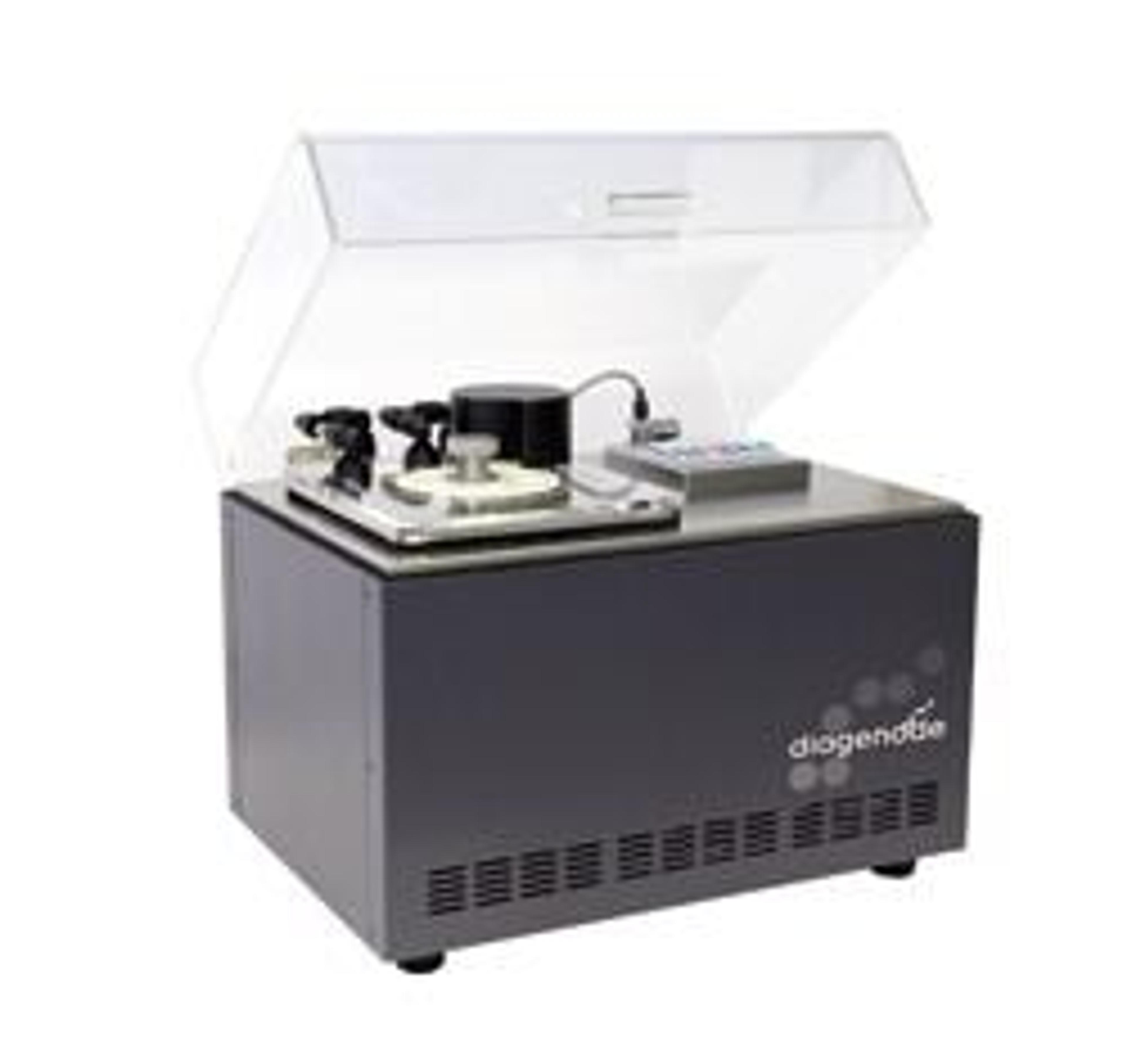
Diagenode Introduces Innovative Bioruptor® Pico for Micro-Volume Chromatin and DNA Shearing

14 May 2013

Product news

Diagenode, Inc., a leading global provider of complete solutions for epigenetics research, has announced the launch of the Bioruptor® Pico, an innovative “all-in-one” sonication device for chromatin and DNA shearing. Diagenode’s Bioruptor® sonication devices use Adaptive Cavitation Technology (ACT) to create gentle, focused mechanical stress to shear biological samples in a temperature controlled environment, highly effective for chromatin shearing, DNA & RNA shearing, cell lysis and tissue homogenization. The Bioruptor® is the most cited line of sonication devices with over 700 peer-reviewed publications.

The new Bioruptor® Pico represents a new breakthrough as an all-in-one shearing system optimized for shearing micro-volumes of 5 μl to larger volumes of up to 2 ml. This wide range enables a large variety of applications such as DNA shearing for next generation sequencing library preparation, RNA shearing, and chromatin shearing. It has been widely noted that shearing is a critical step in a number of applications. For example, the data accuracy from applications such as next generation sequencing library preparation, chromatin immunoprecipitation, and ChIP-seq depends on high-quality sample shearing and fragmentation.

"The Diagenode Bioruptor® Pico has been designed to provide the consistency, yields, and best range of fragment sizes, aspects that are critical for optimal sequencing library preparation such as in ChIP-seq and chromatin shearing” said Didier Allaer, CEO of Diagenode, “We remain committed to the epigenetics market, providing unique epigenetic solutions and innovating our line of shearing devices as the market requires increasingly smaller volumes for shearing.” In addition, the new instrument allows cost-effective shearing with sample multiplexing and simultaneous sonication of 6 to12 samples."

Manuela Saathoff, Ph.D., Product Manager for Bioruptor® stated, "The new system is smaller, lighter, and much faster than our previous models. Also the Bioruptor® Pico offers researchers flexibility for their shearing needs. Now, with just one device, you can shear chromatin and DNA in both small and large volumes.”

Regarding next generation sequencing, she also added, “for next generation sequencing library preparation, the Bioruptor® Pico achieves optimal fragmentation with the desired narrow size distribution and high quality and yields of double-stranded DNA crucial for sequencing accuracy and success.”

Diagenode has released data that can viewed here that exemplify the performance of the instrument for chromatin and DNA shearing. The company also offers a number of epigenetics products that can be used downstream in the ChIP and ChIP-seq workflow after shearing with the Bioruptor® Pico. These include highly-validated ChIP-seq antibodies, ChIP-seq kits for only 10,000 cells, and the IP-Star Compact, a unique epigenetics automation platform.

Bioruptor® Pico

Diagenode

The Bioruptor® Pico is the new next-generation all-in-one shearing device, highly optimized for DNA shearing for next-generation sequencing, chromatin shearing for ChIP-seq applications, RNA shearing, protein extraction, and cell/tissue lysis. The Pico is the shearing device of choice for sequencing applications, providing optimal yields, lengths, and consistency and excels in shearing different fragment size ranges, which are frequently required for downstream applications (e.g. bridge amplification) for sequencing. Moreover, the Pico provides flexibility in other applications saving the need to buy additional equipment. Unlike competing systems, the Pico has high throughput capabilities and can process up to 12 samples at once. The only ultrasonicator you’ll ever need, optimized for: Next-Generation Sequencing (5 - 100 µl) Chromatin shearing (10 µl - 2 ml) RNA shearing Protein extraction Tissue and cell lysis Simultaneous sonication of 12 samples Small and light  

(19)

Links

Tags

Genome AnalysisGenomics, the study of genomes, includes functional genomics, evolutionary genomics and comparative genomics. There are many genomic technologies such as DNA sequencing of whole genomes, computational biology and bioinformatics. DNA and nucleic acids must be isolated and concentrated from cells for analysis with kits, automated analyzers and software. Other useful technologies for studying genomics include PCR, microarrays and electrophoresis.DNA / RNA Extraction and PurificationPurified DNA and RNA are required for numerous downstream molecular biology applications. Consequently, the importance of high-quality DNA/RNA extraction and purification equipment cannot be underestimated. Many purification kits are available and are typically optimized for nucleic acid type and source, including plasmid DNA, genomic DNA, mRNA, RNA and viral nucleic acid purification kits. Automated extraction and purification of nucleic acids can be implemented with magnetic bead separator instruments or high-throughput purification workstations. Find the best DNA/RNA extraction and purification equipment in our peer-reviewed product directory: compare products, check customer reviews and receive pricing direct from manufacturers.DNA SequencingDNA sequencing, such as sanger sequencing, is a biological technique that determines the precise order of nucleotide bases in a fragment or template of DNA. DNA sequencers and genetic analyzers are based on capillary electrophoresis, where labeled DNA fragments are electrophoretically separated by size as they migrate through a polymer. Find the best DNA sequencing products, including DNA sequencing kits, genomic libraries and genetic identity kits in our peer-reviewed product directory: compare products, check customer reviews and receive pricing direct from manufacturers.Next Generation SequencingNext-generation sequencing (NGS), also known as whole-genome sequencing, high-throughput sequencing and massive parallel sequencing, produces and analyses thousands to millions of nucleotide sequences at once. Sequencing systems operate via varying technologies depending on the manufacturer, including sequencing by synthesis, ligation, pyrosequencing, ion semiconductor and single-molecule real-time sequencing. For NGS, library preparation is paramount to successful sequencing. In this section, explore a range of library preparation kits, from targeted, amplicon-based or hybridization-based kits including epigenomic, transcriptomic and genomic workflows to fragmentation kits. Find the best next-generation sequencing products in our peer-reviewed product directory: compare products, check customer reviews and receive pricing direct from manufacturers.Homogenizers and BlendersHomogenizers and blenders are used to homogenize various types of material, including tissue, cells, plants, food, soil, biological and chemical samples for subsequent analysis. Lab equipment for sample homogenization includes handheld and benchtop homogenizers, bead mill, ultrasonic and multiple sample homogenizers, high shear homogenizers and blenders. Homogenizer bead and probe multipacks are available to avoid cross contamination of samples, as well as cooling systems for homogenizing temperature-sensitive samples. Homogenizers are often used in the first step of extraction of DNA, RNA and proteins from tissue and cell samples. Find the best homogenizers and blenders in our peer-reviewed product directory: compare products, check customer reviews and receive pricing direct from manufacturers.ChIP-SequencingLibrary GenerationLibrary generation refers to the construction of NGS libraries from RNA and DNA sources.DNA ShearingEpigeneticsEpigenetics refers to heritable changes in gene expression. These changes are not caused by alterations to the DNA sequence. Three of the main systems responsible for the initiation of epigenetic change are DNA methylation, histone modification and non-coding RNA-associated gene silencing.Library PreparationLibrary preparation is a critical step in sequencing workflows, where DNA or RNA samples are converted into libraries for high-throughput, next generation sequencing. This step ensures accurate results and minimizes biases. Explore library preparation kits in our peer-reviewed product directory; compare products, check reviews, and get pricing directly from manufacturers.ChromatinNGS AutomationNGS automation streamlines next-generation sequencing workflows, increasing throughput, accuracy, and reproducibility. Automated solutions enhance productivity in genomic research, clinical diagnostics, and personalized medicine. Browse peer-reviewed tools to compare products, read reviews, and get pricing.
Diagenode Introduces Innovative Bioruptor® Pico for Micro-Volume Chromatin and DNA Shearing