
Detection and Removal of Estrogen Contamination from Drinking Water
SelectScience® studies recent research by the U.S. Environmental Protection Agency (EPA) into the prevalence of estrogenic compounds in the water supply
12 Jun 2016
Editorial article

SelectScience® studies recent research by the U.S. Environmental Protection Agency (EPA) into the prevalence of estrogenic compounds in the water supplyUnited States Environmental Protection Agency (EPA) The United States Environmental Protection Agency is an agency of the U.S. federal government which was created for the purpose of protecting human health and the environment.
Estrogen is a naturally occurring hormone, found in mammals and responsible for the development and regulation of female sexual characteristics. Synthetic forms of these hormones are used clinically, for example in birth control pills or in hormone replacement therapy. However, there is an emerging class of chemicals associated with plastics, pesticides, household and industrial products and heavy metals, that mimic estrogen.
Although the natural forms of these hormones are short lived, staying in the bloodstream for no more than a few hours before being metabolized, the synthetic compounds can bioaccumulate in fatty tissues and remain intact in the environment. They can cause feminization and reproductive dysfunction in male fish, and have been associated with a higher risk of some cancers1.
Existing water treatment
Water destined for drinking goes through various stages of treatment before reaching our taps2. Coagulation and flocculation are usually the first steps, removing dirt and dissolved particles. Sand, gravel and charcoal filters are then used to remove parasites, bacteria, viruses, and chemicals. Finally, a strong disinfectant is used to kill any remaining pathogens, and safeguard the water as it’s piped from the treatment plant to business and homes.
However, does this rigorous treatment remove these hardy synthetic compounds? Estrogenic compounds have been found in environmental samples, leading to concerns that they could make their way into drinking water3. Recent work by Mash et al, at the EPA set out to compare the estrogenic activity of pre-treated and treated water using in vitro bioassays2,4.
Treated vs pre-treated samples
Over 60% of samples tested displayed some levels of estrogenic activity, mainly estrone, which is found naturally in postmenopausal women and oxidized from estradiol. The main source of estrone in water is through waste5. Treatment of water with coagulation alone resulted in no significant removal of estrogen, and the use of charcoal filtration resulted in 20-80% removals of estrogenic compounds. However, treatment of water combining coagulation, charcoal filtration and chlorinated disinfection effectively removed estrogenic compounds, with no samples demonstrating estrogenity ‘above liquid chromatography-Fourier transform mass spectrometry (LC-FTMS) quantification limits’, giving approximately a 98% reduction in the estrogenic activity of the water.
LC-FTMS couples microcapillary HPLC columns with Fourier transform ion cyclotron resonance mass spectrometer, such as the Thermo Scientific LTQ Orbitrap Discovery. This allows scientists to acquire several mass spectral scans across a chromatographic peak, obtaining high resolution spectra with very accurate MS/MS6.
With tighter controls on the disposal of industrial compounds and pharmaceutical waste, as well as careful treatment of the water destined for drinking, the danger from estrogenic compounds and their mimics becoming less.
Find out more about other environmental contaminants, such as brominated compounds, here.
References
P Lemieux, S Fuqua, The role of the estrogen receptor in tumor progression,” J. of Steroid Biochem. and Mol. Bio. Vol. 56, No. 87−91, 1996.
Centers for Disease Control and Prevention (2015). Community Water Treatment. Retrieved 31/03/16 from http://www.cdc.gov/healthywater/drinking/public/water_treatment.html
K Schenck, L Rosenblum, T E Wiese, L Wymer, N Dugan, D Williams, H Mash, B Merriman, T Speth. Removal of estrogens and estrogenicity through drinking water treatment. Journal of Water and Health. 2012, 10 (1) 43-55; DOI: 10.2166/wh.2011.135
JM Conley, N Evans, H Mash, L Rosenblum, K Schenck, S Glassmeyer, ET Furlong, DW Kolpin, VS Wilson. Comparison of in vitro estrogenic activity and estrogen concentrations in source and treated waters from 25 U.S. drinking water treatment plants. Sci. of The Total Environment. doi:10.1016/j.scitotenv.2016.02.093
G Ying, RS Kookana, YJ Ru. Occurrence and fate of hormone steroids in the environment. Environ Int. 2002 Dec;28(6):545-51
JN Sutton, M Athanas, T Richmond, X Shi, R Gerszten, M Lopez, L Bonilla. P36-T Characterization of the Analytical Performance of an FT-MS-Based Label-Free Platform for Biomarker Discovery in Human Plasma: Standards, Precision, Accuracy, and Directed Feature Investigation Using SIEVE. Journal of Biomolecular Techniques. 2007;18(1):13.
Related products
Request Quote for All Products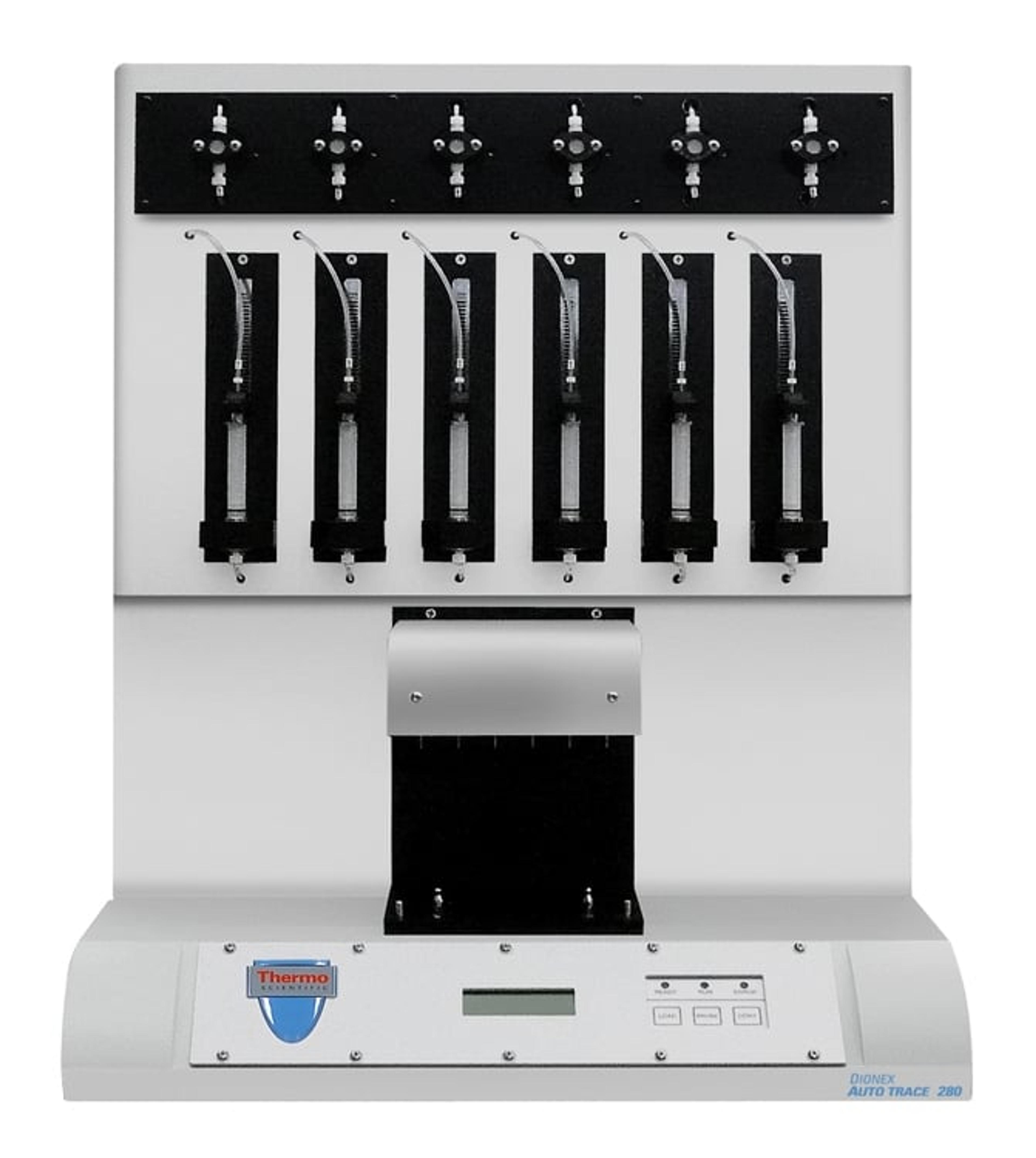
Thermo Scientific™ Dionex™ AutoTrace™ 280 Solid-Phase Extraction Instrument
Thermo Fisher ScientificThe Thermo Scientific™ Dionex™ AutoTrace™ 280 Solid-Phase Extraction (SPE) instrument is a powerful, high-throughput workstation dedicated specifically for automating SPE. The Dionex AutoTrace 280 instrument automates the cartridge or disk conditioning, sample loading, rinsing, and eluting steps for large volume aqueous solution extractions (20 mL to 20 L).The unit can process up to six samples in parallel, automatically conditioning, washing, and eluting SPE cartridges or disks with a choice of up to five reagents. The unit also segregates aqueous and solvent waste using separate waste lines for efficient, cost effective waste handling.AutoTrace 280 Solid-Phase Extraction Instrument Features: Use SPE technology for liquid-liquid extraction Automated sample loading of liquids onto SPE cartridges Automated eluting of SPE cartridges with organic solvent Closed systems with a fan to vent solvent vapors Positive pressure loading and elution of samples and solvents Benefits: Reduced solvent usage and elimination of glassware Does not require technician involvement to maintain a reservoir of liquid in the SPE cartridge Does not require technician involvement to control the flow of organics solvent through the SPE cartridge No hood required Provides constant flow of liquids through SPE cartridges
Thermo Scientific™ Chromeleon™ 7.3.2 Chromatography Data System (CDS)
Thermo Fisher ScientificBuilt for Stability. Built for Performance. Why Compromise? Deliver efficiency, assurance and compliance with one software platform that integrates seamlessly with your laboratory's IT infrastructure now and the future.