CytoSMART Technologies announces the launch of its first fluorescence live-cell imager Lux3 FL

4 Nov 2020
Tom Casburn
Associate Editor

Product news

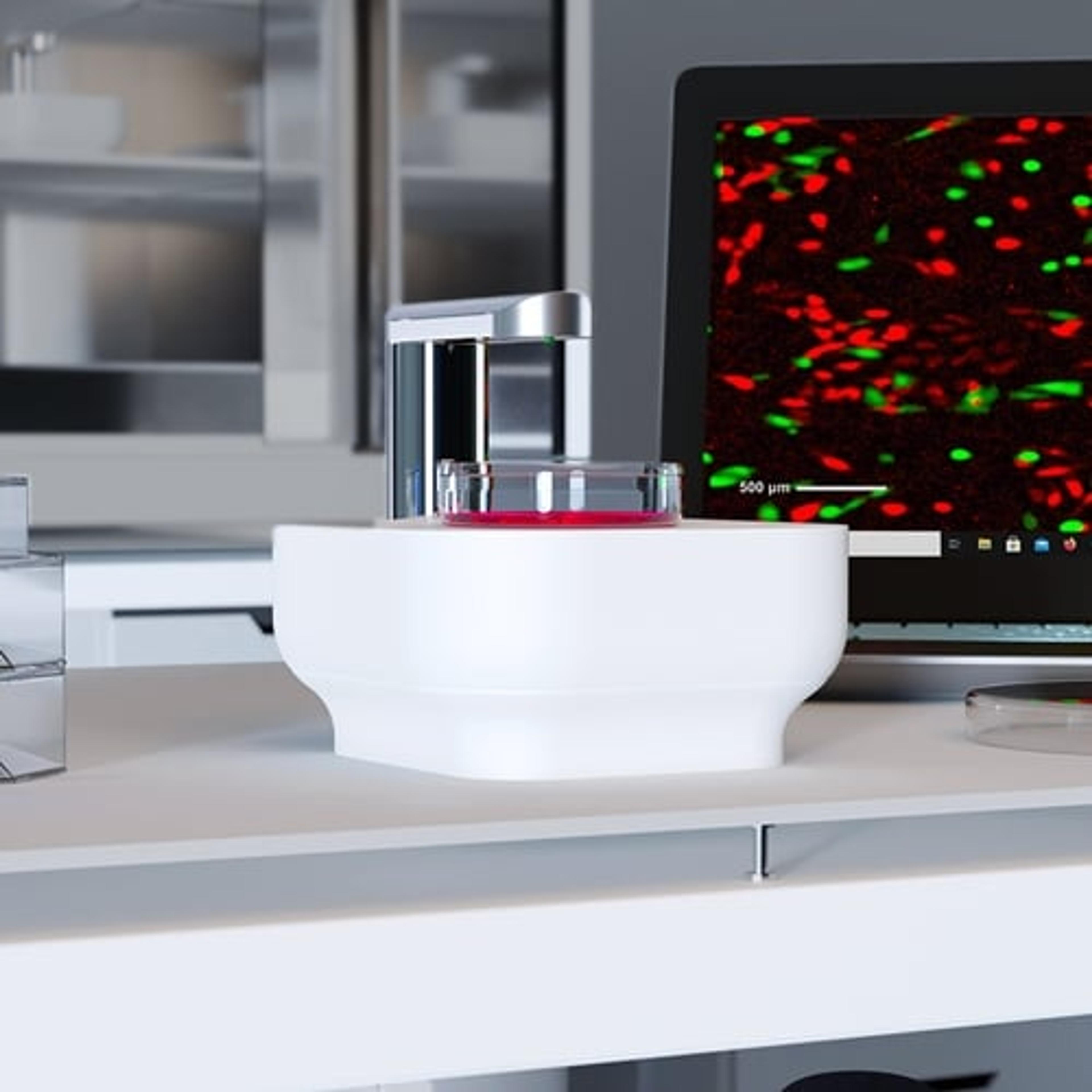
CytoSMART Technologies has announced its first fluorescence live-cell imager. The CytoSMART Lux3 FL is a small live-cell imaging microscope equipped with one brightfield and two fluorescent channels (green and red).

The device enables researchers to unravel cellular processes in real-time, while the cells are kept in a controlled environment inside a standard cell culture incubator. CytoSMART’s first fluorescence live-cell imager allows users to track dynamic cellular processes with high specificity by taking high-quality images to create real-time time-lapse movies.

Said Jan-Willem van Bree, CTO at CytoSMART Technologies, "Currently, fluorescent labeling is mostly used as an end-point measurement. However, time-lapse imaging of live cells can give much more information about biological processes. By using automated imaging at regular time intervals, the temporal resolution of the fluorescent data is increased, leading to even more relevant data about the cellular processes. In this way, researchers can not only determine if a certain process has occurred, but also when it occurred and at what speed. Our customers have been asking us to develop a small and easy-to-use microscope with integrated image analysis of bright-field and fluorescence data. We have listened and made it happen."

The main features and benefits of the CytoSMART Lux3 FL include:

  • Integrated image analysis of bright-field and fluorescence area or fluorescence object count.
  • Time-lapse movies to investigate the development of cellular processes.
  • Expanded number of variables researchers can analyze in their cell culture using green and red fluorescence.
  • Remote data accessibility via the CytoSMART Cloud with a smartphone, tablet, or laptop outside the lab.
  • Portable, easy-to-use and incubator friendly live-cell imager.

Do you use CytoSMART products in your lab? Write a review today for your chance to win a $400 Amazon Gift Card>>

Lux

Axion BioSystems

Single-well live-cell analysis with brightfield and fluorescent imaging from your incubator

(7)

Tags

Cell Lines Stem Cells and Primary CellsPrimary cell cultures, established cell lines and stem cells are vital for <i>in vitro</i> and <i>ex vivo</i> experimentation. High-quality cells, optimized for your applications, alongside optimized cell substrates, growth medium and supplements, are critical for experimental success. Explore a range of cells suitable for your applications, including isogenic cell lines, competent cells, induced pluripotent stem cell (iPSC)-derived cell lines, fungal/bacterial/mammalian cell lines, stem cells and cancer cell lines. Find the best cells for your research in our peer-reviewed product directory: compare products, check customer reviews and receive pricing direct from manufacturers.Gel Doc / Image AnalysisGel documentation (gel doc) or gel imaging systems are used for the analysis of proteins, antibodies and nucleic acid immobilized in polyacrylamide or agarose gels, membranes or microarrays. Explore a range of a gel imaging systems, densitometers, scanners, transilluminators or UV lamp + CCD cameras for your image analysis solutions. Colorimetric, fluorescent and/or radioisotopic samples can be visualized and documented for further analysis. See gel doc / Image analysis software for quantitative 1D and 2D analysis of your samples. Find the best gel doc / image analysis products in our peer-reviewed product directory: compare products, check customer reviews and receive pricing direct from manufacturers.Flow Cytometry / Cell CountingFlow cytometers are used to count, sort and examine multiple characteristics of cells. Other cell analysis equipment includes image cytometers, cell counters, fluorescence-activated cell sorters (FACS), magnetic-activated cell sorters (MACS), and a range of flow cytometry assay kits. Flow cytometers can reveal information on cell viability, cell proliferation, apoptosis and cell cycle progression, as well as identify cell populations and intracellular or cell-surface molecules. Additionally, some flow cytometers, known as FACS, have an additional sorting function after analysis. Cell counters and image cytometers count live and dead cell populations and can also conduct cell proliferation assays. Find the best flow cytometers, cell counters and cell sorters in our peer-reviewed product directory: compare products, check customer reviews and receive pricing direct from manufacturers.Light MicroscopyLight microscopes or optical microscopes are used to visualize microscale objects under magnification, including cells, clinical specimens and materials. Lab equipment for light microscopy includes confocal microscopes, fluorescence microscopes, zoom and stereo microscopes. Microscope slides and imaging reagents are available for visualizing samples, as well as various microscope stages and incubators for large or temperature-sensitive samples. Find the best light microscopes in our peer-reviewed product directory: compare products, check customer reviews and receive pricing direct from manufacturers.FluorescenceThe emission of fluorescence occurs when a photon of energy is supplied to a fluorescent chemical compound by an external source, causing it to become excited. Fluorescence can be detected and measured for different purposes using microplate readers, fluorescence microscopes, fluorescence scanners, and flow cytometers.Fluorescence MicroscopyFluorescence microscopy has become an essential tool in biology, as well as in materials science. The application of many fluorochromes has made it possible to identify cells and sub-microscopic cellular components with a high degree of specificity. Using multiple fluorescence labels, different probes can simultaneously identify several target molecules.Live Cell ImagingLive cell imaging is the study of living cells using microscopes and high-content imaging systems. This technique provides in-depth insight into fast and complex biological processes, by allowing dynamic imaging of living cells instead of acquiring an individual image at a single point in time.MicroscopyMicroscopy is a technique used to observe small objects in detail, from cells to materials, using light or electron microscopes. It enables researchers to examine structures with high resolution, aiding in fields such as biology, medicine, and materials science. With advanced microscopy techniques, scientists can gain insights into cellular processes, tissue structures, and material properties. Explore the best microscopy solutions in our peer-reviewed product directory, compare products, read customer reviews, and get pricing directly from manufacturers.
CytoSMART Technologies announces the launch of its first fluorescence live-cell imager Lux3 FL