CytoSMART expands long-term fluorescence live-cell imaging possibilities for simultaneous comparative studies

7 Jun 2021

Diane Li
Assistant Editor

Product news

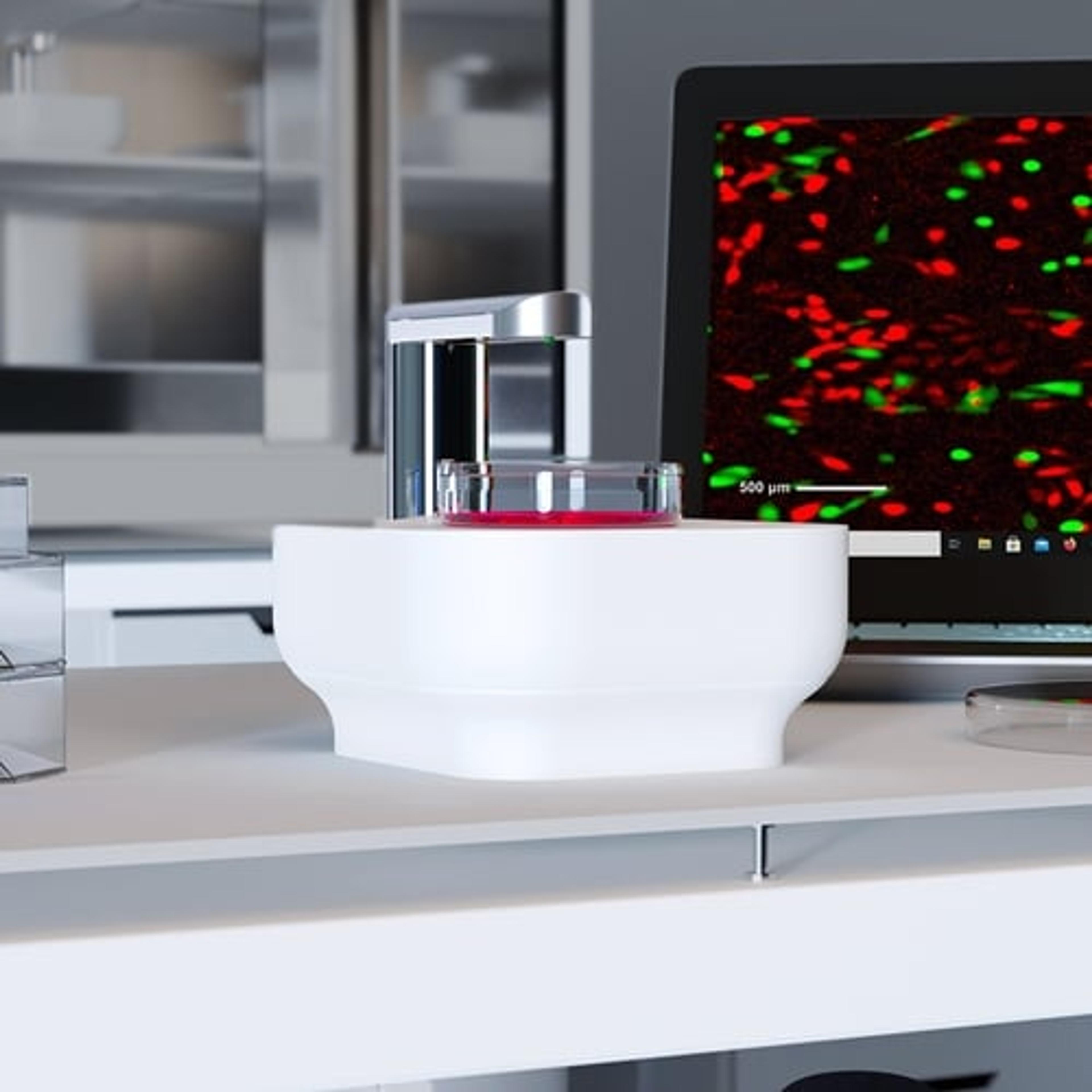
CytoSMART Technologies has announced the launch of two new fluorescence live-cell imaging systems – the Lux3 FL Duo Kit and the Multi Lux3 FL. The CytoSMART Lux3 FL Duo Kit is a compact and cost-effective imaging system consisting of two fluorescence microscopes, designed for side-by-side comparison of cell cultures. The CytoSMART Multi Lux3 FL fluorescence live-cell imaging system consists of four compact Lux3 FL devices, equipped with two fluorescent (green and red) and one brightfield channel, and designed for long-term comparative studies and larger research teams.

Both systems operate from within a standard CO2-incubator or hypoxia chamber, allowing to analyze cells in their desired culture environment. Each system of two and four microscopes is connected to a single laptop, maximizing precious laboratory space. Monitoring and analysis of the running experiments can be done at any time from anywhere via the CytoSMART Cloud.

Said Jan-Willem van Bree, CTO at CytoSMART Technologies, "Last year we launched our first fluorescence live-cell imager, the CytoSMART Lux3 FL, and our customers were pleased with its performance and expanded research possibilities. This year we decided to scale up fluorescence live-cell imaging possibilities by launching two new advanced systems: the Lux3 FL Duo Kit and the Multi Lux3 FL. We always aim to develop and offer versatile and flexible solutions to life scientists. For example, the Multi Lux3 FL allows to run up to four individual imaging experiments simultaneously, without affecting the time-lapse imaging experiments of other lab members. This is a very convenient lab equipment for every research group that studies cell viability, co-culture models, single-cell migration, and many other cell-based assays can benefit from it."

The main features and benefits of the CytoSMART fluorescence live-cell imaging systems include:

  • Ideal for comparative studies – directly compare fluorescently-labeled cell cultures.
  • Versatile - expand the number of variables you can examine using fluorescent labeling.
  • Flexible – connect devices to the same laptop and control them individually.
  • Incubator-friendly – study cells in their desired culture environment.
  • Full remote access via the CytoSMART Cloud - no need to enter the lab to inspect cell cultures.
  • Indispensable tool for long-term comparative studies – run up to four experiments simultaneously for days or weeks.
  • Cost-effective and efficient solution – two or four fluorescence imaging devices connected to one laptop, including unlimited storage and unlimited number of user accounts.

Do you use CytoSMART Technologies products in your lab? Write a review today for your chance to win a $400 Amazon Gift Card>>

Lux

Axion BioSystems

Single-well live-cell analysis with brightfield and fluorescent imaging from your incubator

(7)

Tags

Fluorescence SpectroscopyFluorometers and spectrofluorometers (also called fluorescence spectrometers) are used to measure the intensity and wavelength of fluorescent light emitted from a sample after excitation by illumination. Spectrofluorometers utilize monochromators to select the desired wavelengths, whereas filter fluorometers employ a set of filters. Spectrofluorometers for measuring steady-state fluorescence and lifetime fluorescence (or time-resolved fluorescence) are available, as well as fluorescence microscopes and microplate readers. Find the best fluorescence spectroscopy products in our peer-reviewed product directory: compare products, check customer reviews and receive pricing direct from manufacturers.Cell / Tissue CultureCell culture or tissue culture is used to study the biology of cells or tissues and to isolate cellular products in an environment which can be manipulated and well defined. Accurately control your culture environment with bioreactors or culture incubators, bind your cells to a surface or together with an extracellular matrix. Distinguish cell types with differential media or proliferate cells with certain characteristics using selective media. Enrich your media with supplements such as growth factors, sera and vitamins. Find the best cell and tissue culture products, kits and equipment in our peer-reviewed product directory: compare products, check customer reviews and receive pricing direct from manufacturers.Cell Lines Stem Cells and Primary CellsPrimary cell cultures, established cell lines and stem cells are vital for <i>in vitro</i> and <i>ex vivo</i> experimentation. High-quality cells, optimized for your applications, alongside optimized cell substrates, growth medium and supplements, are critical for experimental success. Explore a range of cells suitable for your applications, including isogenic cell lines, competent cells, induced pluripotent stem cell (iPSC)-derived cell lines, fungal/bacterial/mammalian cell lines, stem cells and cancer cell lines. Find the best cells for your research in our peer-reviewed product directory: compare products, check customer reviews and receive pricing direct from manufacturers.Gel Doc / Image AnalysisGel documentation (gel doc) or gel imaging systems are used for the analysis of proteins, antibodies and nucleic acid immobilized in polyacrylamide or agarose gels, membranes or microarrays. Explore a range of a gel imaging systems, densitometers, scanners, transilluminators or UV lamp + CCD cameras for your image analysis solutions. Colorimetric, fluorescent and/or radioisotopic samples can be visualized and documented for further analysis. See gel doc / Image analysis software for quantitative 1D and 2D analysis of your samples. Find the best gel doc / image analysis products in our peer-reviewed product directory: compare products, check customer reviews and receive pricing direct from manufacturers.In Vivo Imaging Systems<i>In vivo</i> imaging systems, including pre-clinical imaging systems and medical imaging systems are used to non-invasively visualize and capture images of live animals and plants. Monitor the natural processes or diseases of your subjects using small-animal pre-clinical imaging systems, including single photon positron emission tomography (SPECT), positron emission tomography (PET), computed tomography (micro-CT), magnetic resonance imaging (MRI), X-ray radiography, ultrasound, fluorescence and bioluminescence imagers. Multimodal systems and software solutions are also available for correlative analysis of organ, tissue, cell, or molecular-level processes. Find the best in vivo imaging products in our peer-reviewed product directory: compare products, check customer reviews and receive pricing direct from manufacturers.Cell ViabilityCell viability assays assess the health of cells and their ability to proliferate. These tests are crucial in drug development, toxicity testing, and cell-based research. Common methods for assessing viability include MTT, live/dead assays, and flow cytometry. Browse our peer-reviewed product directory to find the best tools for cell viability assays, compare products, check reviews, and get pricing directly from manufacturers.FluorescenceThe emission of fluorescence occurs when a photon of energy is supplied to a fluorescent chemical compound by an external source, causing it to become excited. Fluorescence can be detected and measured for different purposes using microplate readers, fluorescence microscopes, fluorescence scanners, and flow cytometers.Cell ImagingCell imaging can be achieved using a number of techniques including confocal microscopy, transmission electron microscopy, atomic force microscopy, and light sheet microscopy.ImagingImaging techniques are essential for obtaining visual representations of samples to understand structures, processes, and function in biological, chemical, and physical research. These tools range from traditional light microscopy to advanced imaging modalities like MRI and electron microscopy, providing researchers with valuable data for diagnostics, drug discovery, and material analysis. Explore imaging solutions in our peer-reviewed product directory to compare products, check reviews, and get pricing directly from manufacturers.Live Cell ImagingLive cell imaging is the study of living cells using microscopes and high-content imaging systems. This technique provides in-depth insight into fast and complex biological processes, by allowing dynamic imaging of living cells instead of acquiring an individual image at a single point in time.
CytoSMART expands long-term fluorescence live-cell imaging possibilities for simultaneous comparative studies