
Cytena GmbH announces acquisition by 3D bioprinter provider CELLINK
Complementary product portfolios will support and accelerate expansion into the pharmaceutical industry
6 Aug 2019
Industry news
The owners of Cytena GmbH have agreed to sell all Cytena shares to CELLINK AB for a purchase price of 30.25M euros. Through CELLINK’s complimentary technology offering Cytena sees great synergies that will support and accelerate future growth of Cytena. An extended product offering and a stronger global presence are just some of the benefits for our Cytena’s customers and partners.
Through this strategic acquisition, CELLINK expands its technology portfolio, supporting further expansion into the pharmaceutical industry. CELLINK offers bioink, bioprinters, rapid dispensers and live cell imaging systems that enable creation and monitoring of human tissues and 3D cell culture models. Cytena’s single-cell dispensing platform enables pharmaceutical companies to develop antibodies and cell lines and offers a great complement to CELLINK’s 3D bioprinting technologies.
The companies’ synergies enable greater market opportunities for Cytena’s and CELLINK’s product portfolio and global sales forces. The products are well-suited to be sold together to Cytena’s and CELLINK's existing customer base.
- Cytena’s technology platform allows dispensing of single cells, enabling researchers to isolate cells for cell line development and build microtissues faster and more reproducibly.
- Cytena’s products fit well within CELLINK's current product portfolio and will enhance the group’s product offering.
- Cytena’s products are most suitable for pharmaceutical companies, an area and market in which CELLINK has communicated interest in expanding further into. With this acquisition, CELLINK aims to increase market penetration in the pharmaceutical field.
- Cytena’s products are based on patented single-cell dispensing technologies, providing both protection and freedom to operate.
- The acquisition is in line with CELLINK’s commercial strategy, strengthening CELLINK’s product offering and providing a more complete 3D cell culturing solution.
- Cytena will remain under current entity and management post-transaction.
"We are extremely looking forward to being part of the CELLINK family. In CELLINK we have found a great partner, which shares our vision for the company and will help us to further accelerate cytena’s growth. We see interesting synergies in marketing, sales and R&D between all four group member companies: cytena GmbH in Germany, cytena Bioprocess Solutions Co. Ltd. in Taiwan, CELLINK in Sweden and the US, as well as Dispendix GmbH in Germany. Our customers and partners will benefit from an extended product offering and a stronger global presence." - Dr. Jonas Schoendube, CEO, Cytena.
"We are excited to welcome Cytena to the CELLINK family of life-science companies with this strategic acquisition. We are furthering CELLINK's global commercial strategy by focusing on the pharmaceutical industry and providing the most innovative solutions to researchers around the world. With Cytena’s revolutionary technology platforms we will streamline workflows for our present and future customers, and enhance our presence in the pharmaceutical industry, a strategy that is well aligned with our vision. Together with Dispendix, we will be well-positioned to offer comprehensive solutions for both academic and pharmaceutical customers worldwide." - Erik Gatenholm, CEO, CELLINK.
About Cytena
Cytena is a life science company focusing on single cell technologies. Cytena was founded in 2014 from the Institute for Microsystems Technology (IMTEK) at the University of Freiburg, and primarily sells solutions for handling biological cells. The Cytena team has developed a patented single-cell printer™ technology, which enables users to isolate and dispense single cells in a documented, gentle and sterile process. The single-cell printers have been manufactured in Germany since 2015 and are marketed worldwide. In 2018, the x.sight™ series was added to the company’s product portfolio. Most of top ten pharmaceutical companies use Cytena’s single-cell printers to produce clonal cell lines for manufacturing biologicals, such as antibodies.
About CELLINK
CELLINK is one of the leading 3D bioprinter providers and the first bioink company in the world. CELLINK focuses on developing and commercializing bioprinting technologies to allow researchers to print human organs and tissues for pharmaceutical and cosmetic applications. Founded in 2016 and active in more than 50 countries, CELLINK is aiming to change the future of medicine. CELLINK is listed on Nasdaq First North under CLNK.
Do you use CELLINK products in your lab? Write a review today for your chance to win a $400 Amazon gift card>>
Related products
Request Quote for All Products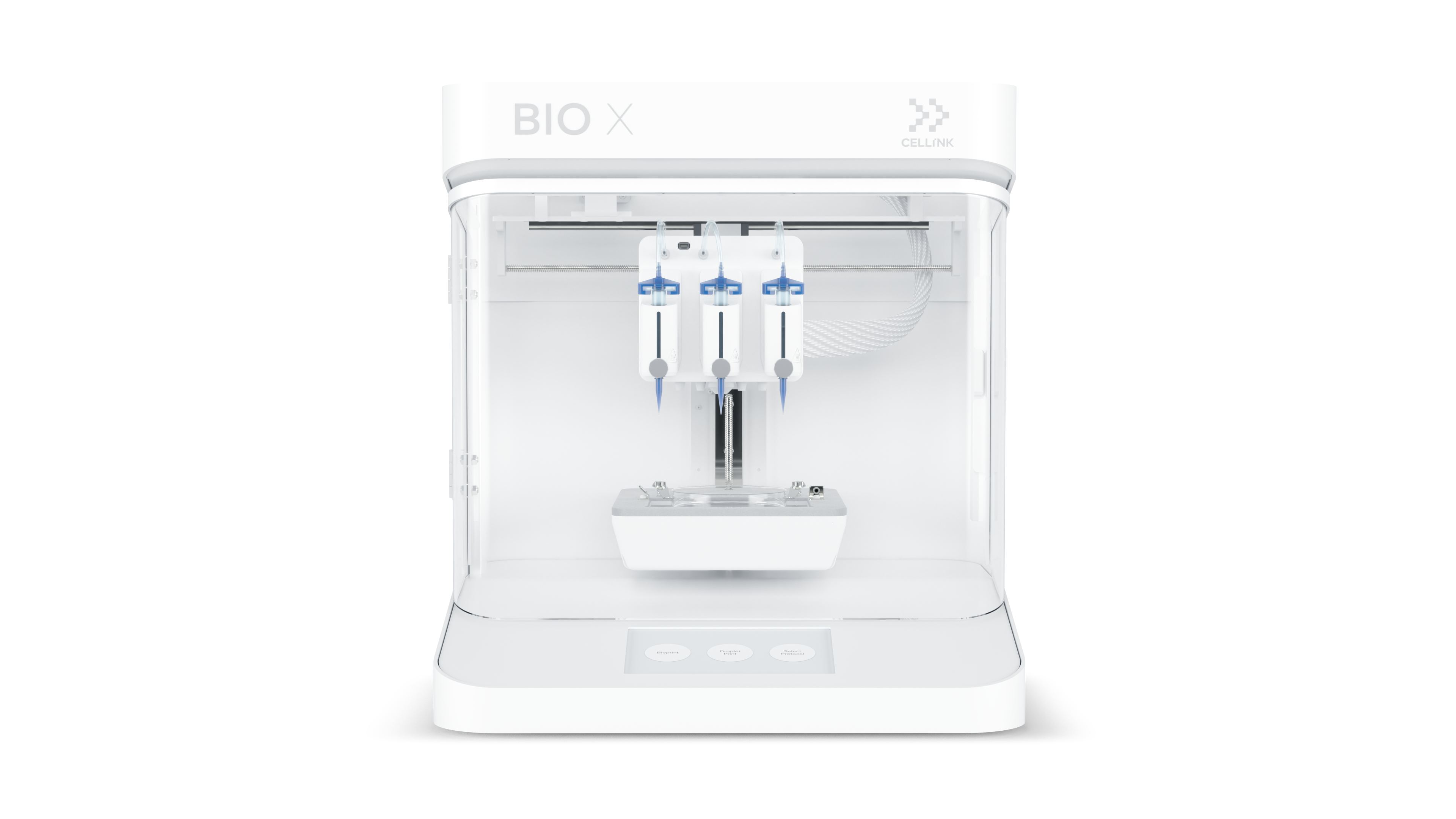
CELLINK BIO X
CELLINKThe CELLINK BIO X 3D Bioprinter is the most userfriendly yet high quality, cost-effective bioprinting platform in the world. The system provides our patented Clean Chamber Technology, exchangable heated and cooled print heads to offer pneumatic extrusion, ink-jet extrusion, thermo plastic extrusion, and even syringe based extrusion all in one system., and a user-friendly software that guides the user throughout the printing process.