
Corning Introduces New HYPERFlask Cell-Culture Vessel for Manual Use
9 Sept 2009Product news
Corning Incorporated today announced the new High Yielding Performance Flask Manual (HYPERFlask® M) cell-culture vessel. Corning developed this latest high-density, cell-culture technology in direct response to customer demand for the features and functionality of Corning’s original HYPERFlask vessel for automation. The new HYPERFlask M vessel became commercially available on Sept. 1.
Like its predecessor, the HYPERFlask M features a novel multi-layer design that has the same overall dimensions as a standard T175 flask but grows approximately 10 times as many cells. Also, to meet the specific needs of bench top users, the new HYPERFlask M features an ergonomic cap that requires less torque to seal the cap to the vessel. It also has a new adaptor grid that allows for faster filling and emptying, while reducing foam generation. Additionally, each HYPERFlask M vessel has an individual serial number that can be read by the unaided eye or by a handheld barcode reader.
“Since offering our first-of-its-kind HYPERFlask technology to automated users in 2007, we have seen the demand rise among our bench top customers for a novel, cell-culture vessel solution for manual use that significantly decreases processing and handling time, while reducing space utilization and disposal requirements,” said Jeff Mooney, director commercial technology, Corning Life Sciences. “Our new HYPERFlask M vessel builds on the strong heritage of our original version, delivering significant capabilities and benefits in a manual design and helping customers continue to drive quality results in their laboratories.”
Additional HYPERFlask Manual cell-culture vessel features and benefits include:
• USP ClassVI Materials – molded and assembled in a Certified Class 100,000 clean room
• Sterility – gamma irradiated to sterility assurance level (SAL) 10-6
• Clean room packaging – each pack is double bagged
• Innovative 10-layer design – 10 interconnected polystyrene growth surfaces
• Optimum cell attachment and growth – treated with the Corning CellBIND® Surface
• Increased cell yield –10-fold higher cell yield increases productivity and capacity
• Time and space savings – reduces processing time and incubator storage space by handling one flask compared to 10 traditional 175cm2 flasks
Corning Life Sciences helps customers succeed by providing innovative, high-quality products and services in the areas of polymer science, biochemistry and molecular biology, glass melting and forming, surface modification, and characterization science. Corning cell-culture and assay labware products include tissue culture dishes, six-, 12-, 24-, and 48-cell culture plates, 96-, 384-, and 1536-well microplates, roller bottles, flasks, and CellSTACK® culture chambers. The business’ dedication to quality, technology, and innovation has enabled it to produce a comprehensive line of plastic laboratory disposables and reusable glassware that exceeds American Standard Testing Method (ASTM) standards for life science research.
Related products
Request Quote for All Products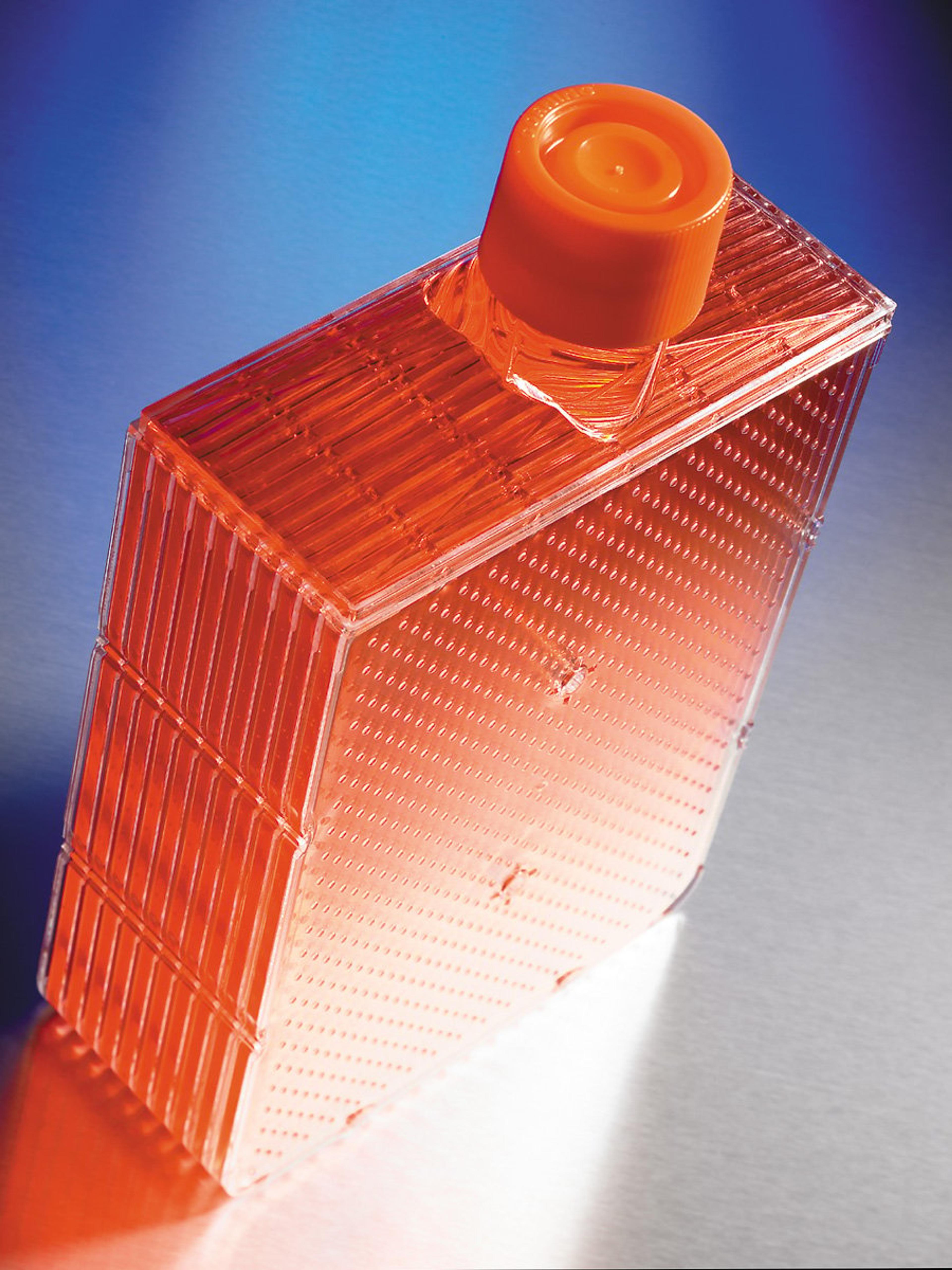
Corning® CellBIND® Surface HYPERFlask® Cell Culture Vessel
Corning Life SciencesThe High Yield PERformance Flask (HYPERFlask) cell culture vessel has 1720 cm2 available growth area on a polystyrene gas permeable surface. Treated for optimal cell attachment and gamma sterilized. Bar coded and compatible for use on Cell Culture Automation Platforms. Solid cap with liner on a straight neck designed for filling with growth medium. Made with USP Class VI Materials – molded and assembled in a Certified Class 100,000 clean room Sterile – gamma irradiated to sterility assurance level (SAL) 10⁻⁶ Clean Room Packaging – each pack is double bagged. Innovative 10Layer Design – 10 interconnected polystyrene growth surfaces Optimal Growth – Corning CellBIND® Surface treated gas permeable polystyrene for superior cell attachment and growth Increase Cell Yield – 10-fold higher cell yield increases productivity and capacity Time and Space Savings – Reduce processing time and incubator storage space by handling one flask compared to 10 traditional 175 cm2 flasks