
Comprehensive Antibody Characterisation
11 Mar 2008Product news
Guava Technologies, Inc., a leading developer of easy-to-use, on-demand, benchtop cell analysis systems, provides new levels of flexibility and analysis with its Guava RapidQuant™ IgG Assays for quantification of mouse and human antibodies.
Used in combination with the Guava Express®, Guava ViaCount® and other Guava® Assays the new Guava RapidQuant IgG Assays provide unmatched antibody characterisation on a single cellular analysis platform - the Guava EasyCyte™ Plus ™ System.
With their simplicity and ease of use, the new microplate-based Guava RapidQuant™ IgG Assays have raised the bar for IgG titering in tissue culture supernatants. Designed to be time-saving, labour-saving and money-saving, RapidQuant Assays eliminate the most tedious portions of antibody titering methods. The no wash RapidQuant Assays are bead-based and rely on sensitive fluorescence detection for the quantitative measurements. Standard curves are automatically produced by the easy to use software interface, removing the need for time consuming calculations performed by the user during analysis. The fluorescent intensity is proportional to the concentrations of antibody captured on the beads. Using fluorescence provides tremendous reliability and precision so you can have confidence in every result. RapidQuant Assays have been tested extensively with human and mouse antibodies of all IgG subtypes and in many types of hybridoma media and have performed well in all cases tested. RapidQuant Kits are extremely specific for IgG and are not hindered by the presence of FBS or IgM in the media. The RapidQuant Assay can be used to determine absolute concentrations of antibody present in cell culture medium or in purified preparations by comparison to a standard curve. Results from this assay can also be combined with results from the Guava Express Assay to determine relative antibody affinities.
The Guava ViaCount® Assay has become a leading standard for viability and cell counting. Used in laboratories characterising antibodies the ViaCount Assay provides a rapid and reliable assessment of the cell concentration and viability of clones for production. Combining results from the RapidQuant and ViaCount Assays delivers the benefit of simultaneous assessment of IgG production and cell health parameters.
The complete antibody characterisation suite from Guava Technologies extends your capabilities for assessing target activity of antibody clones, or identifying cell populations that express a specific protein marker. For example, the Guava Express® Assays provide superior sensitivity and excellent discrimination between cells expressing low and high levels of antigen recognised by the antibody and may also be used to obtain information on specificity of antibodies in the screening steps. The Guava Nexin® and Guava® Cell Toxicity Assays deliver reliable results concerning the potency of the antibody to mediate apoptotic induction and cell killing, respectively. Using the RapidQuant, Express and other Guava Assays provides a highly specific and quantitative assessment tool for obtaining multiple layers of information about your antibodies.
Optimised for use with Guava® microcapillary flow cytometry systems, all Guava Assays, including RapidQuant, Guava Express and ViaCount, require very small volumes of sample for accurate antibody characterisations enabling multiple analyses of each supernatant to be performed from a single 96-well plate.
Faster and easier than the average enzyme-linked immunosorbent assay (ELISA), the traditional approach for antibody quantification, the Guava RapidQuant IgG Assays efficiently quantify the amount of antibody present. When coupled with the suite of other available microplate-based Guava Assays more comprehensive data on antibodies can be generated enabling users to conveniently and productively select optimal clones from hybridoma screens.
Related products
Request Quote for All Products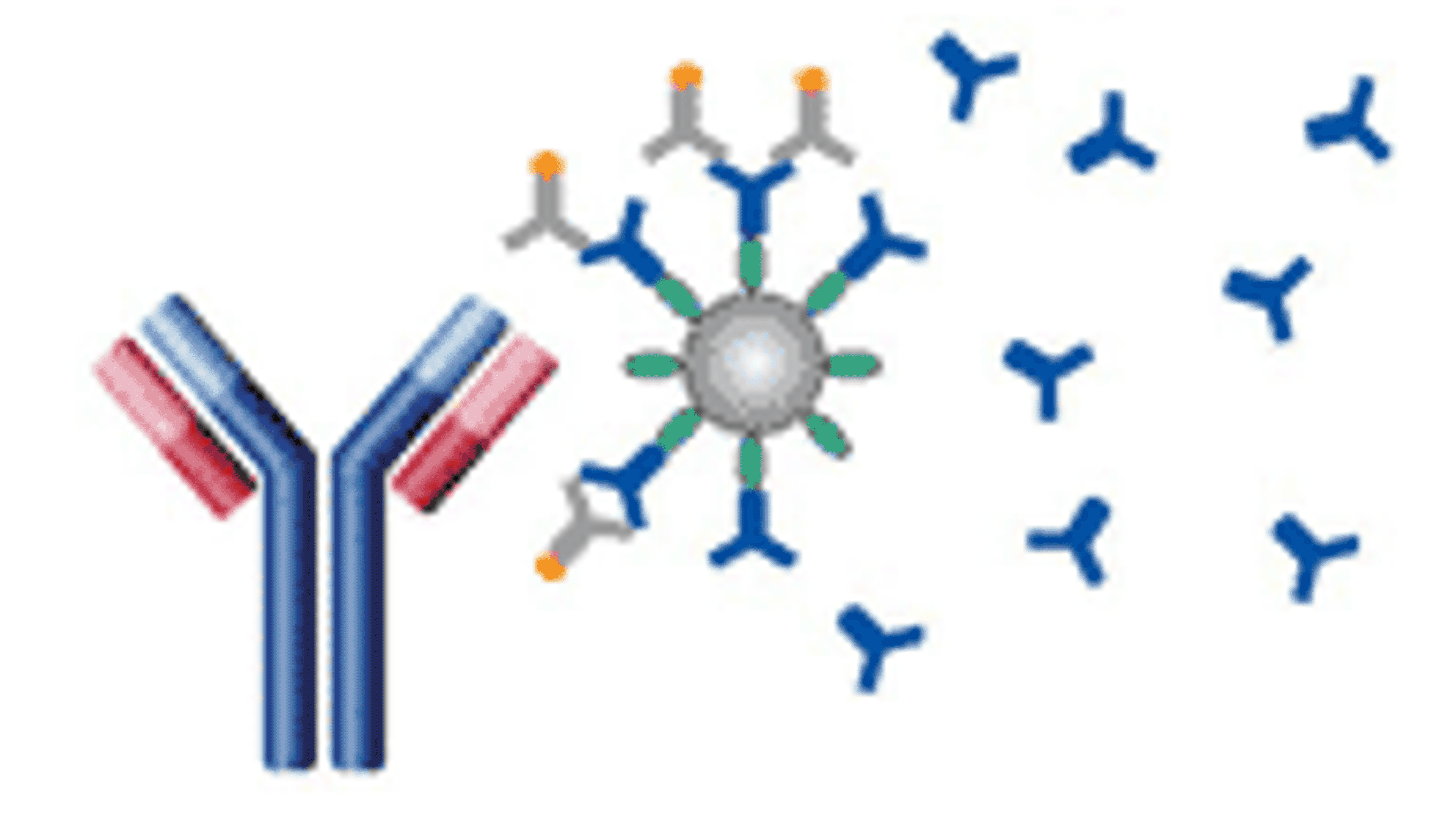
RapidQuant™ Mouse & Human IgG Antibody Quantification Assays
MerckQuick and Easy Antibody Quantitation:With its simplicity and ease of use, Guava’s new RapidQuantTM IgG Kits have raised the bar for IgG titering assays. Designed to be time-saving, labor-saving and money-saving, Guava’s RapidQuant kits eliminate the most tedious, laborious portions of antibody titering methods with Guava’s signature ease of use. • Robust, rapid and highly reproducible • Relevant quantitative range • Quantifies most IgG subtypes equivalently • Nearly twice as fast as typical ELISA assays • Ideal for use with robotic plate handler automation Guava RapidQuant kits are bead-based assays that rely on fluorescence for the quantitative measurements. The fluorescent intensity is proportional to the concentrations of antibody captured on the beads. The assay can be used to determine relative Ab production levels by different hybridoma clones or to determine absolute concentrations of antibody by comparison to a standard curve. Using fluorescence provides tremendous reliability and precision so you can have confidence in every result. RapidQuant assays have been tested extensively with both human and mouse antibodies of all IgG subtypes and in many types of hybridoma media and have performed well in all cases tested. RapidQuant IgG kits are extremely specific and will not be hindered by the presence of FBS or IgM in the media. RapidQuant kits also require very small volumes of sample for accurate determinations of antibody concentation so you can perform multiple analyses of each supernatant from a single 96-well plate. Unlike many current colorimetric immunoassays, the fluorescence readout allows multiple plates to be prepared, refrigerated and read hours or days later, without a loss of signal. This unprecedented stability and robustness makes the assay ideal for large scale screening on robotic systems where multiple plates are prepared prior to sampling.

ViaCount™ Assay
MerckGuava Technologies' ViaCount assay is revolutionizing the way cell counting and viability assessment are done in today's laboratories. Fast, automated, and highly reproducible, the Guava ViaCount assay addresses many of the difficulties of conventional cell counting and viability assessment methods. The Guava ViaCount assay provides: Cell counts up to ten times faster than manual counting, in a convenient turnkey assay. Accurate, reproducible counts with very low density cell samples or small sample volumes. Absolute cell counts, viability assessments and apoptotic cell counts in a single measurement. By providing data on all these cell populations in a single measurement, the Guava ViaCount assay enables a more precise evaluation of culture conditions and viable cell populations so you can best optimize culture conditions. Flexibility for many cell types. Accurately counts adherent, clumpy and even non-mammalian cells, such as insect cell lines. More experimental consistency. These precise, accurate cell counts can provide more consistency in experiments that require accurate viable cell counts for success, such as ELISpot, cell-based fluorescence assays or cytokine production assays. The Guava ViaCount assay uses proprietary easy-to-use Guava software, and reagent kits optimized for use with the Guava PCA and PCA-96 systems. Guava ViaCount is fast becoming the method of choice for monitoring cell culture or bioreactor conditions and cell count/viability assessments.

Nexin Assay Kit
MerckThe new Guava Nexin® reagent monitors induction of apoptosis quickly and easily, with minimal chance for contamination. Annexin V is a calcium-dependent phospholipid binding protein with high affinity for phosphatidylserine (PS), a membrane component normally localized to the internal face of the cell membrane. Early in the apoptotic pathway, molecules of PS are translocated to the outer surface of the cell membrane where Annexin V can readily bind them. The Guava Nexin® assay incorporates this PS-Annexin V binding as an indicator of early stage apoptotic cells. The Guava Nexin® assay kit utilizes Annexin V-PE to detect PS on the external membrane of apoptotic cells. The cell impermeant dye 7-AAD is included in the Nexin kit as an indicator of membrane structural integrity. 7-AAD is excluded from live, healthy cells and early apoptotic cells, but permeates late stage apoptotic and dead cells. The following populations of cells can be distinguished in this assay: Non-apoptotic cells: Annexin V(-) and 7-AAD(-) Early apoptotic cells: Annexin V (+) and 7-AAD(-) Late stage apoptotic and dead cells: Annexin V(+) and 7-AAD(+)