
CLC bio presents the World’s first fully customizable bioinformatics solution
20 Dec 2006Product news
After two years of intensive product development, CLC bio today announced the release of their Software Developer Kit (SDK), called CLC Developer Kit, which will be a free add-on to all CLC bio’s bioinformatics software products.
The CLC Developer Kit will enable the more than 26,000 worldwide users of CLC bio’s software to customize their bioinformatics workbenches to their specific needs. Users can customize their software on two levels:
Customization through use of downloadable software modules (plug-ins) developed by third parties
Customization through users’ own plug-ins
Plug-ins developed by third parties
With the SDK, a large number of specialized plug-ins will be developed and made available for download for users of CLC bio’s software. Some will be developed by CLC bio while others by freelance developers or by larger organizations - for example Beijing Genomics Institute.
Songgang Li, Head of Bioinformatics Department at Beijing Genomics Institute states: “Our large scale genome research center in Beijing has developed a number of leading bioinformatics algorithms that have so far been web-based tools. With the fantastic CLC Developer Kit, we will be able to integrate many of them into the World’s most advanced desktop bioinformatics applications, followed by distribution on CLC bio’s website and through CLC bio’s Global sales network. We’re thrilled by the potential business opportunities that this adaptable product will provide us with.”
Among other plug-ins, BGI plans to integrate the following tools to CLC bio’s platform: Ka/Ks for computation of non-synonymous and synonymous substitution rates (Ka and Ks) among protein-coding sequences, BGF: Beijing Gene Finder, and ReAS for DNA repeat analysis.
Plug-ins developed by the user’s own organisation
With CLC bio’s SDK, users can - themselves or with the assistance of CLC bio’s consultants expand their software with numerous modules of their own choice and design. Examples are integration with the organization’s local or even proprietary databases, integrating with proprietary bioinformatics algorithms, and design of modules supporting individual workflows in the organization.
In this way, large amounts of time, much manual work, and costly resources can be reduced dramatically. Another important aspect is significantly reducing the risk of errors through automated workflows.
Plug-ins are programmed in Java, and it is very easy to integrate modules programmed in other languages like C/C++ and Python.
To learn more or sign up as a user of the CLC Developer Kit, visit www.clcdeveloper.com
Available for download
As from today, the following plug-ins, developed by CLC bio, are available free of charge on www.clcbio.com/plug-ins:
- Five different alignments that are fully integrated with CLC bio’s graphical framework:
ClustalW, K-Align, MUSCLE, MAFFT, and T-Coffee - Automatic extracting of user-defined annotations from one or more DNA or protein
sequences for further graphical or textual analysis. - A special type of file navigator to supplement the one that is already in the programs
- A plug-in that allows book-marking of files inside the bioinformatics application,
An advanced platform as the base for customization
CLC bio’s software includes advanced and integrated DNA, RNA, and protein sequence analysis. One product is CLC Gene Workbench which notably includes advanced primer design, assembly of DNA sequencing data, and in silico molecular cloning. CLC Protein Workbench includes protein structure prediction, protein function prediction, and much more.
Related products
Request Quote for All Products
CLC DNA Workbench Software
CLC bioThe New Standard for Desktop-Based Bioinformatics Tools CLC DNA Workbench provides a software environment which enables users to perform advanced DNA sequence analyses such as assembly of DNA sequence data, graphically and algorithmically advanced primer design, while offering user-friendly molecular cloning tools. CLC DNA Workbench is a bioinformatics software package containing a range of specialized DNA analyses and bioinformatics tools for molecular biology. It is based on the CLC Free Workbench framework, and has similar work environment, user interface, and framework for graphical viewing. When using CLC DNA Workbench, researchers working in molecular biology labs will be able to do most daily bioinformatics work, including data management and reporting, in one single integrated and user-friendly software package. Platform independent CLC DNA Workbench is from the new generation of bioinformatics software - software that also runs on the latest versions of Mac OS X, Windows, and Linux. Efficient collaboration support The full compatibility between all types of CLC workbenches provides strong support for efficient collaboration within research groups; advanced analyses and data searches can be performed on a CLC DNA Workbench, while more basic work tasks may be performed by the remaining researchers equipped with CLC Free Workbenches. Throughout the project, all researchers can be given easy access to knowledge obtained through sharing of sequence data and sharing of research results. Examples could be figures showing annotated sequences, alignments and their underlying sequences, reports on DNA characteristics, phylogenetic trees, BLAST results etc.
CLC Protein Workbench Software
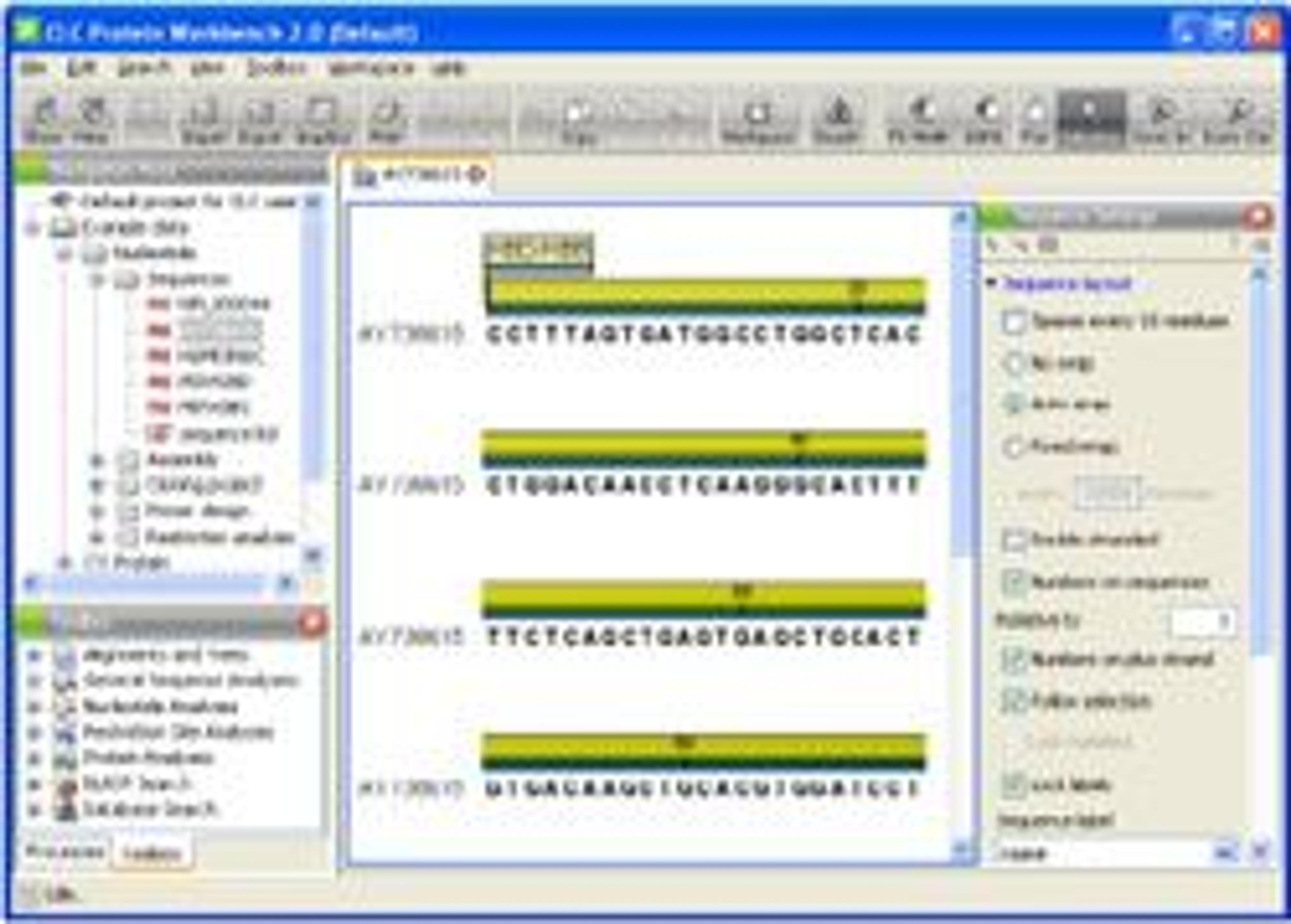
CLC bioProtein Analysis Software - the Next GenerationCLC Protein Workbench creates a software environment enabling users to make a large number of advanced protein sequence analyses, combined with smooth data management, and excellent graphical viewing and output options. Protein Workbench sets new standards for bioinformatics software with its overall graphical display, usability driven and user-friendly interface, while featuring a number of unique and innovative bioinformatics tools for supporting advanced biochemistry lab research. Platform independent CLC Protein Workbench is from the new generation of bioinformatics software - software that also runs on the latest versions of Mac OS X, Windows, and Linux. Innovative CLC Protein Workbench is based on a modern, post-genomic, IT architecture. The program is continuously expanded with additional features on the basis of user feedback. If you need any special analyses or data management options, we will implement it smoothly, efficiently - and fast! Intuitive Protein Workbench is developed on the basis of feedback from thousands of users. The result is a graphically based user-interface and a very user-friendly and intuitive program. CLC Protein Workbench can be learned in hours - not days. Effective CLC Protein Workbench reduces manual work tasks and the risk of errors to a minimum: All data management options, as well as all bioinformatics analyses such as BLAST searches, secondary structure predictions, PFAM domain searches, hydrophobicity analyses, and much more are integrated in one single program. Tedious copy/pasting and letter-typing is hereby eliminated while also erasing the risk of missing something in your electronic log of work performed during your research.

CLC Free Workbench Software
CLC bioFree Bioinformatics Software Not a demo. Not scaled down. No spyware. No need to register. Yet still a wide variety of features available - and - free! CLC Free Workbench creates a software environment enabling users to make a large number of bioinformatics analyses, combined with smooth data management, and excellent graphical viewing and output options. Some of the many bioinformatics analyses: • Interactive restriction site analysis • Creating and editing alignments • Phylogenetics • Integrated GenBank searches • Advanced DNA to Protein translation The software package is a community edition, available for Mac OS X, Windows, and Linux. Download and use is absolutely free of charge. Integration and platform independence CLC Free Workbench is fully integrated with all commercial products from CLC bio. That means data can be exchanged seamlessly between all workbenches, and viewed and handled according to the features available in the current workbench. The exchange of data is of course platform independent, so mixed environments with both Mac, Windows, and Linux computers is handled without any problems! Data exchange has never been this easy and convenient. This integrated workbench platform enables a modern workflow, where you don't need commercial licenses on all computers in order to work together - simply focus your attention and investments specifically where they're needed, and not only on an overall basis. Handling of different file formats CLC Free Workbench is very versatile when it comes to importing and exporting both data and graphics files. To name a few, you can export graphics as PNG, PDF, or EPS. Import data from Vector NTI, CLUSTAL W, or DNA Strider. And among others GenBank, Fasta, Swiss-Prot, UniProt and EMBL formats are supported for both im- and export.