
Cisbio Announces Results of GPCR-Focused Research in Collaboration with IGF
25 Jun 2008Product news
Cisbio Bioassays, a member of IBA group and a global developer of HTRF® (Homogeneous Time-Resolved Fluorescence) technology and services used in assay development and drug screening, today announced findings from its R&D collaboration with the Department of Molecular Pharmacology at the Institute of Functional Genomics (IGF) focused on the structural organization of G-Protein Coupled Receptors (GPCRs). The results of the collaboration, which describe new methodologies for analyzing receptors at the cell surface of living cells, allow for a better understanding of the spatial structure, mechanisms, and functionality of GPCRs, one of the most important target classes investigated in drug discovery research.
Using a combination of HTRF and SNAP-Tag™ technologies, Cisbio and IGF set up TR-FRET (Time-Resolved Fluorescence Resonance Energy Transfer) assays to demonstrate that GPCRs can adopt a specific organization on the cell surface. These investigations show, in particular, that different class C GPCRs can assemble into either strict dimers or larger oligomers. TR-FRET, on which HTRF is based, presents numerous advantages over assay technologies such as FRET and BRET (Bioluminescence Resonance Energy Transfer) for analyzing living cells as it offers a higher signal to noise ratio and discriminates between the cell surface protein and the intracellular cell compartment. The findings illustrate new methods for rapidly and quantitatively analyzing cell surface signaling complexes in living cells in a high throughput format that can potentially be applied to drug screening processes. This improved analysis of cell-to-cell communication can, in turn, facilitate research and discovery of new therapeutics.
Articles detailing the methodologies used were published in two journals, “Functioning of the dimeric GABAB receptor extracellular domain revealed by glycan wedge scanning” in The European Molecular Biology Organization Journal and “Cell-surface protein-protein interaction analysis with time-resolved FRET and snap-tag technologies: application to GPCR oligomerization” in Nature Methods. “This latest collaboration is an example of how Cisbio’s R&D expertise in chemistry, technology and biology were combined to bring technical breakthroughs to the GPCR field,” said Eric Trinquet, Head of Technology and Chemistry at Cisbio, who supervised the research. “Our dedication to R&D, innovation and our partnerships with top-notch research institutes like IGF position us at the forefront of GPCR research.”
Since 2001, Cisbio has been working on various projects in close collaboration with IGF, a renowned research institute in Montpellier, France specializing in GPCR studies and molecular pharmacology; IGF was first to report on GPCR activation by the main neurotransmitter glutamate. In 2006, Cisbio was awarded a $1.9 million grant by France’s National Research Agency (ANR) to establish an HTS-compatible technology for the quantification of biomolecular interactions in living cells targeting GPCRs. The published findings are the fruit of the work made possible by this award. Cisbio will continue to collaborate with IGF in this sector.
"The existence of GPCR oligomers has long been a matter of intense debate. Thanks to the TR-FRET/SNAP-Tag approach, we have been able to provide new and convincing evidence for the existence of such complexes that offer a number of possibilities to design more selective and more effective drugs," said Jean-Philippe Pin, Head of IGF’s Department of Molecular Pharmacology and supervisor of the project. "This technology is so easy to use that we are now working on new assays allowing the analysis of receptor complexes in native tissues, and new efficient ways to quantify ligand-receptor interaction."
Cisbio has a full technological GPCR platform incorporating HTRF, its highly sensitive, robust technology for the detection of molecular interactions of proteins in vitro. Earlier this year, this portfolio was reformatted with the Lumi4™-Tb terbium cryptate for increased sensitivity and an enhanced signal-to-noise ratio. These latest findings will lead to the development of new reagents associated with Lumi4-Tb for Cisbio’s GPCR product portfolio, specifically in the field of cell surface receptors. In the meantime, these assays are available to Cisbio’s customers as part of its custom assay development services.
Related products
Request Quote for All Products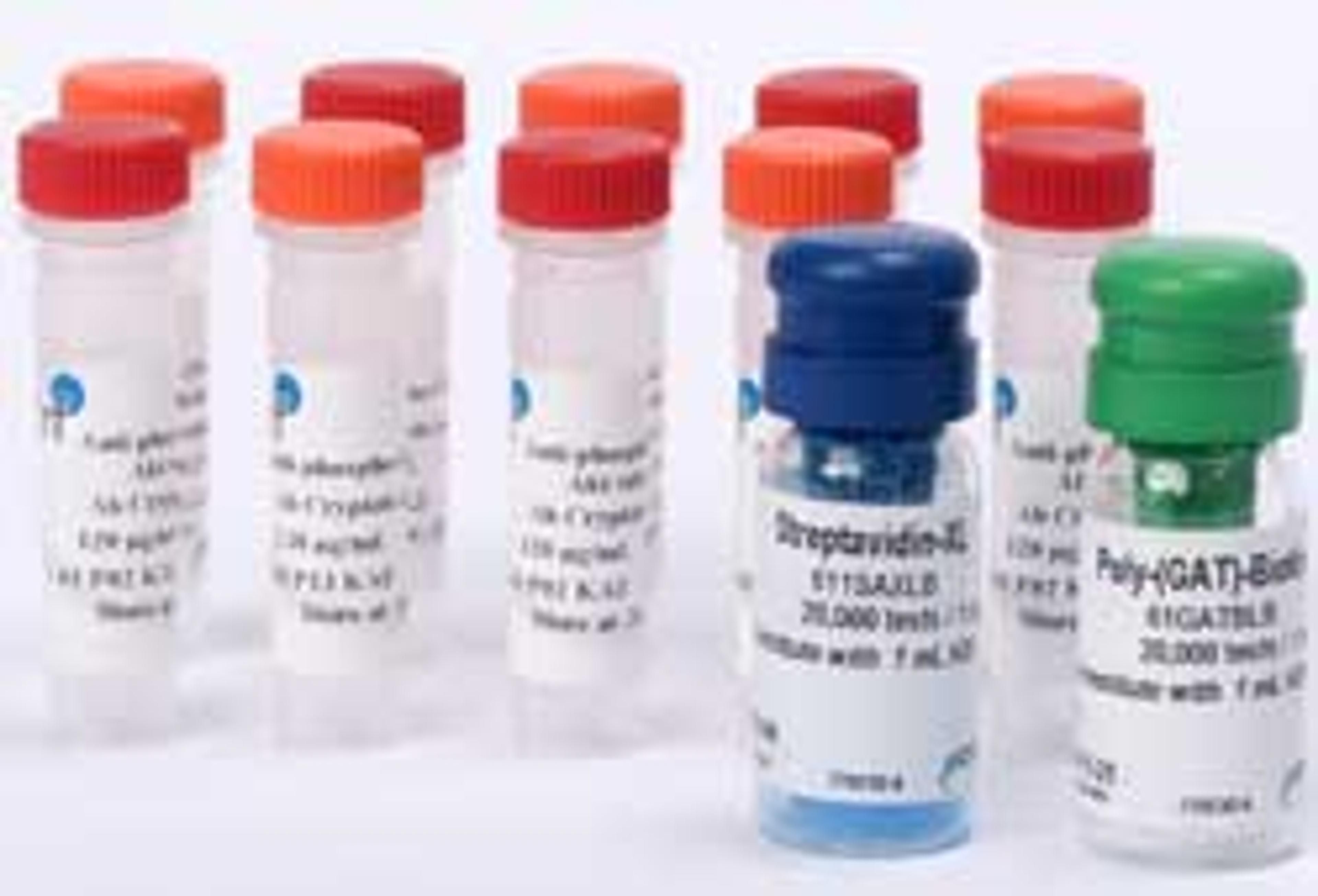
HTRF® Kinase reagent toolbox
Cisbio BioassaysA simple and straightforward procedure for measuring functional kinase activity.The Eu(K) labeled antibody and XL665 conjugate are added simultaneously after the enzymatic step. Results are available after a 2-hour incubation at room temperature. The two reagents are stable in solution, even in an excess of EDTA (0.5M), while the assay remains stable for >24 hours. An extended list of Eu3+-Cryptate labeled phospho-specific antibodies for Ser/Thr and Tyr is available, and Eu(K) custom labeling of any other antibody source is also possible. The assays are suitable for miniaturization down to 1536 format by proportional volume downsizing of the assay components.