
ChromoTek Introduces the new F2H® Kit for Protein-Protein Interaction Analysis
23 Apr 2014
Product news
ChromoTek GmbH (Martinsried, Germany) announces the launch of a new research assay for protein-protein interaction (PPI)analysis in live mammalian cells, the Fluorescence Two-Hybrid (F2H®) Kit. This new product is the result of Chromotek's long experience with applying the F2H technology in PPI compound screening for pharmaceutical and biotech customers. The new kit format overcomes limitations of currently available methods and will fascinate biomedical scientists, who investigate protein-protein interactions (PPIs) by its ease of use.
F2H principle
ChromoTek’s F2H® Kit enables effortless analysis of interactions between any GFP- and RFP- tagged protein pairs in living mammalian cells by conventional fluorescence microscopy. It is a fast, simple and quantitative way to characterize PPIs in intracellular environment, screen for PPI inhibitors and evaluate their activity in real time. Unlike available complementation assays, such as split-YFP, F2H® is a fully reversible assay and therefore better suitable for testing PPI antagonists. In comparison to FRET assays, the ingeniously simple optical read-out of F2H® does not require sophisticated equipment, making it much more affordable and at the same time robust and reliable.
Protein-protein interaction (PPI)analysis
“Our mission is to create new superior tools for better research,” comments Dr. Kourosh Zolghadr, Head of R&D and inventor of the F2H® technology. “F2H® Kit completes our toolbox for protein interaction analysis, now covering both in vitro and in vivo approaches. Over 4000 customers worldwide use our GFP-Trap®, successfully analyzing PPIs biochemically. Today we launch the Kit allowing a straight-forward testing of PPIs in living cells by microscopy. Just like our GFP-Trap®, F2H® takes advantage of simple fusions to fluorescent proteins (GFP and RFP), which most cell biologists generate for their proteins of interest anyways. In a speedy one-step procedure, these chimeric constructs can be used for PPI analysis, both biochemically and now also intracellularly.”
Save time!
“GFP-Trap® and F2H® Kit save your time and resources. Within one single week you have your pilot experiments completed, and your PPI of interest is validated both in vitro and in vivo,” notes Dr. Larisa Yurlova, senior cell biology scientist at ChromoTek. “It also gives you great flexibility: With this toolbox, you can identify protein domains involved in the interaction, screen for intracellularly active inhibitors, visualize their activity and compare their kinetics, etc. There are numerous applications possible!”
Related products
Request Quote for All Products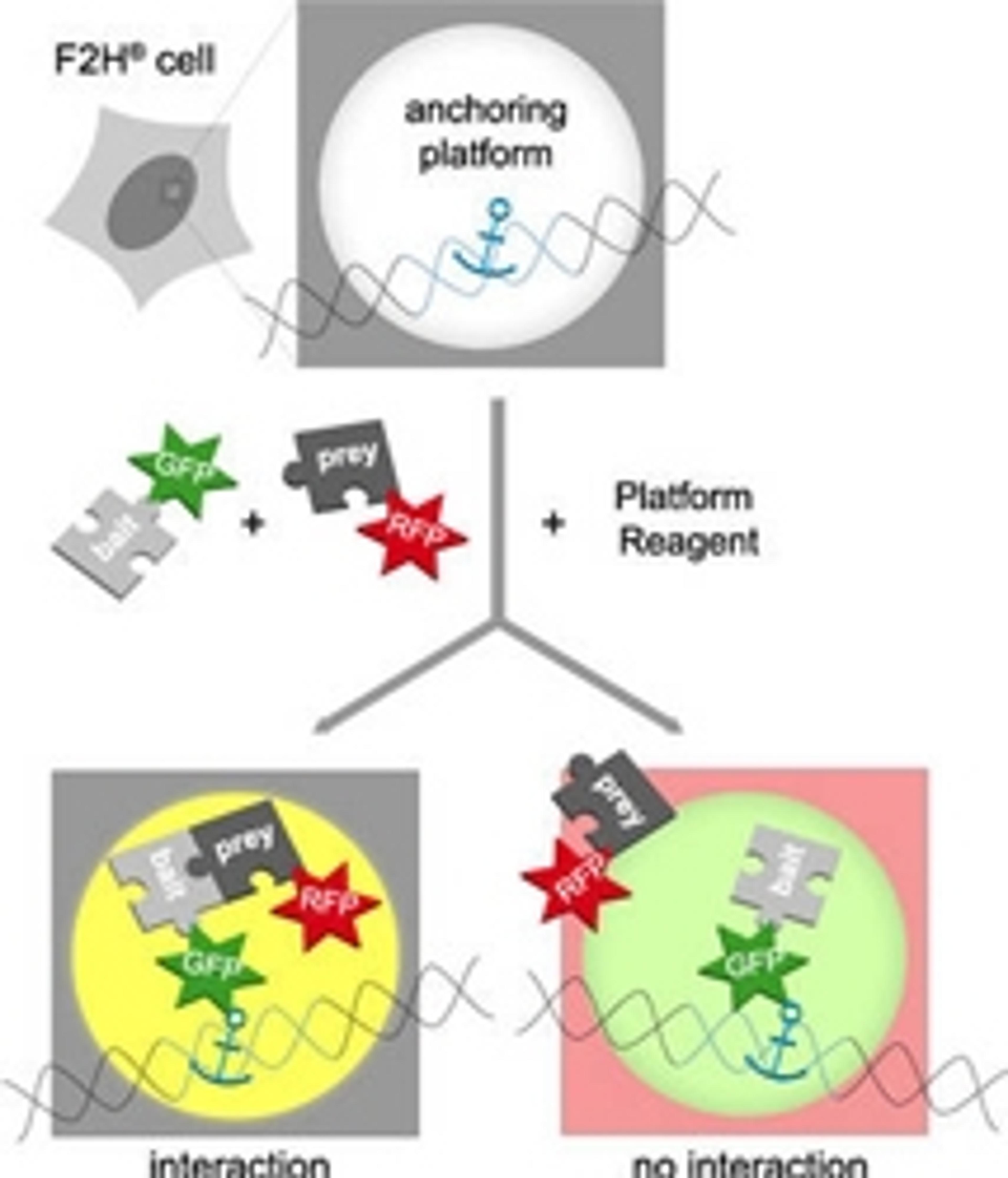
F2H Assay Kit
Chromotek GmbHF2H®-Kit Basic for effortless imaging of interactions between GFP- and RFP-tagged proteins of interest and domains thereof in live mammalian cells. The Fluorescent Two- Hybrid (F2H®) Technology is a fast and simple way to study protein-protein interactions (PPIs) by conventional fluorescence microscopy. Its direct optical readout is optimal for high-content analysis (HCA) and screening for PPI inhibitors.F2H® Principle: F2H® cells (BHK origin) carry a GFP-anchoring platform in the nucleus GFP- and RFP-fusion proteins (bait and prey) are transiently expressed in F2H® cells GFP-bait is recruited to the platform → bright green spot If RFP-prey interacts with the bait → red fluorescent spot co-localizes with the green spot If RFP-prey does not interact with the bait → no red spot, disperse red fluorescence

GFP-Trap®
Chromotek GmbHGFP -Trap® - use your fluorescence fusion as tag for biochemical studies.Curiously GFP, the most widely used labeling tag in cell biology, is rarely used for biochemical analyses. This may be due in part to limited GFP antibody availability and specificity as well as co-eluted heavy and light antibody chains that interfere with subsequent analyses.Our GFP-Trap® is a high quality GFP-binding protein coupled to a monovalent matrix (agarose beads, magnetic particles or in 96-multiwell plates) for biochemical analysis of GFP fusion proteins and their interacting partners.Features: Superior results in a fraction of the time - The ChromoTek GFP-Trap® overcomes these problems: The high quality GFP-binding protein is coupled to a monovalent matrix (agarose beads, magnetic particles or in 96-multiwell plates) for convenient one-step biochemical analyses of GFP fusion proteins and their interacting partners. Ease-of-use - Thanks to the high stability and specificity it’s easy to handle, the small size of the GFP-Trap® ensures clean results. Unparalleled Consistency - The controlled, recombinant manufacturing process of GFP-Trap® ensures highest reproducibility of the biochemical experiments. Applications: Pulldowns/ Immunoprecipitations Co-IP Mass spectroscopy Enzyme activity measurements ChIP analysis