
Boosting vaccine discovery & development in a post-pandemic era with fast, high-performance immunoassays
Guest editorial: Technology to meet the needs of faster vaccine development
7 Jan 2021
Editorial article
In this guest editorial, based on a blog post by Gyros Protein Technologies, learn about trends in vaccine development and how microfluidic immunoassays may hold the key to faster vaccine discovery and development.
Vaccines have become key weapons in the fight against infectious disease and as immunotherapies for other conditions including certain cancers and Alzheimer’s disease. Immunoassays in vaccine development play a key role and meeting ever more pressing deadlines means that efficient and flexible platforms are at a premium, especially in times like these, with the COVID-19 pandemic pressing vaccine R&D to the limit. Here, we look at how immunoassays can contribute to vaccine R&D.
A paradigm shift in vaccine R&D?
Vaccine development has typically been a slow and painful process1. Vaccines must be shown to be safe, pure, potent, and effective for regulatory approval, and typically this process can take up to 10–15 years. Added to that, vaccines have a high attrition rate compared to standard drugs, with fewer than 10% of vaccine candidates ever reaching the market2.
Vaccine development has changed gears in a radical way with the COVID-19 pandemic caused by the novel coronavirus SARS-CoV-23. The SARS-CoV-2 genome was published on January 11, 2020 and this triggered intense activity around the world to develop a vaccine that includes the evaluation of next-generation vaccine technology. As a result, records were broken with the first vaccine candidate entering human clinical testing already on March 16, 2020. By April 8, 2020, 115 vaccine candidates were being evaluated worldwide, and, by the end of 2020, several vaccines had already been given the green light by some countries under emergency use authorization.
The intense speed of COVID-19 vaccine development, together with the threat of future pandemics, may well represent a fundamental change in the way vaccines are developed. This need for speed and efficiency can be expected to increase the demand for more effective bioanalytical tools, including platforms to run the immunoassays that play such a fundamental role in supplying reliable data for vaccine R&D and manufacturing.
The need for high-performance immunoassays in vaccine development
Vaccine development involves a large number of tests to support vaccine R&D, from early, pre-clinical studies to final production, testing, and release of batches. Bioanalysis during vaccine development presents many challenges in diversity of assay complexity, sample matrices, analyte types, and demands on workflow efficiency. Immunoassays are used to characterize vaccine titer, purity, affinity, and potency, as well as their immunogenic response in both animals and humans.
Samples for analysis vary greatly, with a wide range of analytes that include polysaccharides, proteins and peptides that must be measured in diverse matrices. Added to that, the new generation of vaccines involves increasing numbers of antigens.
Plate-based immunoassays have become the gold standard for many aspects of vaccine bioanalysis, including quantifying antigen epitopes, assessing impurity levels, and vaccine potency assays, including vaccine titer and immunogenicity. Increasingly tight project timelines, however, are driving the search for improvements in immunoassay performance, including:
- The use of smaller amounts of precious reagents, such as vaccine candidate molecules and samples from small test animals
- Assays that can readily handle serum and plasma samples, formulations with aluminum particles, and emulsions
- Reduction of hands-on time
- Reduction of assay development time
The following examples demonstrate where effective immunoassays can contribute to speeding up vaccine R&D.
Rapid detection of antigen-specific antibodies in serum
Measuring the quantity and quality of antibodies in plasma samples or produced by memory B cells in vaccinated subjects is key to understanding how protective lifelong antibody responses can be induced. Determining the relative frequencies of antigen-specific memory B cells in human peripheral blood commonly involves a serial limiting dilution assay (sLDA) followed by analysis of cell culture supernatants by ELISA. The problem is that ELISA is laborious, consumes large amounts of reagents and sample, and slows productivity.
Gaining insights into antibody affinity
The precise and accurate determination of binding affinity between epitopes and elicited antibodies can be very valuable in vaccine R&D, and even in batch QC. Real-time, surface-based measurements such as surface plasmon resonance (SPR), biolayer interferometry (BLI), and quartz crystal microbalance (QCM) technology are commonly used to measure affinity but require that one of the interactants is attached to a solid surface, which may affect the determination of KD.
Immunoassays can be used to measure free unmodified interactants in equilibrated solutions and deliver more accurate affinity data providing the measurement method does not disturb the equilibrium. This is possible with a rapid flow-through immunoassay that enables the determination of free interactants in equilibrated solutions since interaction times of only a few seconds between sample and capture column avoid the equilibrium shifts that are inherent in assays requiring longer incubation times. Not only that, but with the right immunoassay platform it is also possible to rapidly affinity-screen analytes and reagents.
Reagent screening and comparison of vaccine lots for release testing
The complexity of vaccines is increasing. For example, HPV (human papillomavirus) vaccine has increased from bivalent to quadrivalent, and the latest generation includes a nonvalent form. Bioanalysis of multivalent vaccines requires the development of large numbers of assays to measure polysaccharide and protein analytes in multivalent vaccines, and lot-to-lot variation in antisera.
Increasing efficiency under these conditions means minimizing the efforts needed to develop assays and the consumption of, for example, labeled detection antibodies. Added to that there is the need for rapid turnaround time and high throughput. An ability to visualize the binding event can also be a real plus to give more insight into the quality of binding reactions. Again, choosing the right immunoassay platform can make this possible.
A number of leading vaccine manufacturers have been faced with these challenges and have chosen Gyrolab® technology as a solution to help boost the efficiency of their vaccine R&D, bioprocess development and manufacturing. A new application note illustrates how Gyrolab systems have boosted the performance of vaccine R&D, from detecting plasma antibodies in vaccinees and determining the affinity of antigen-antibody interactions in early development, to the measurement of antigen titer and HCP impurities in bioprocess.
Discover Gyrolab xPlore immunoassay system and learn how this technology can also benefit bioprocess development and production in this follow-up post by Gyros Protein Technologies.
References
Hamm N. Vaccinations in the Pipeline. Drug Topics. 2019
Pronker ES, Weenen TC, Commandeur H, Claassen EH, Osterhaus AD. Risk in vaccine research and development quantified. PLoS One. 2013
Thanh Le T, Andreadakis Z, Kumar A, Gómez Román R, Tollefsen S, Saville M, Mayhew S. The COVID-19 vaccine development landscape. Nat Rev Drug Discov. 2020
Related products
Request Quote for All Products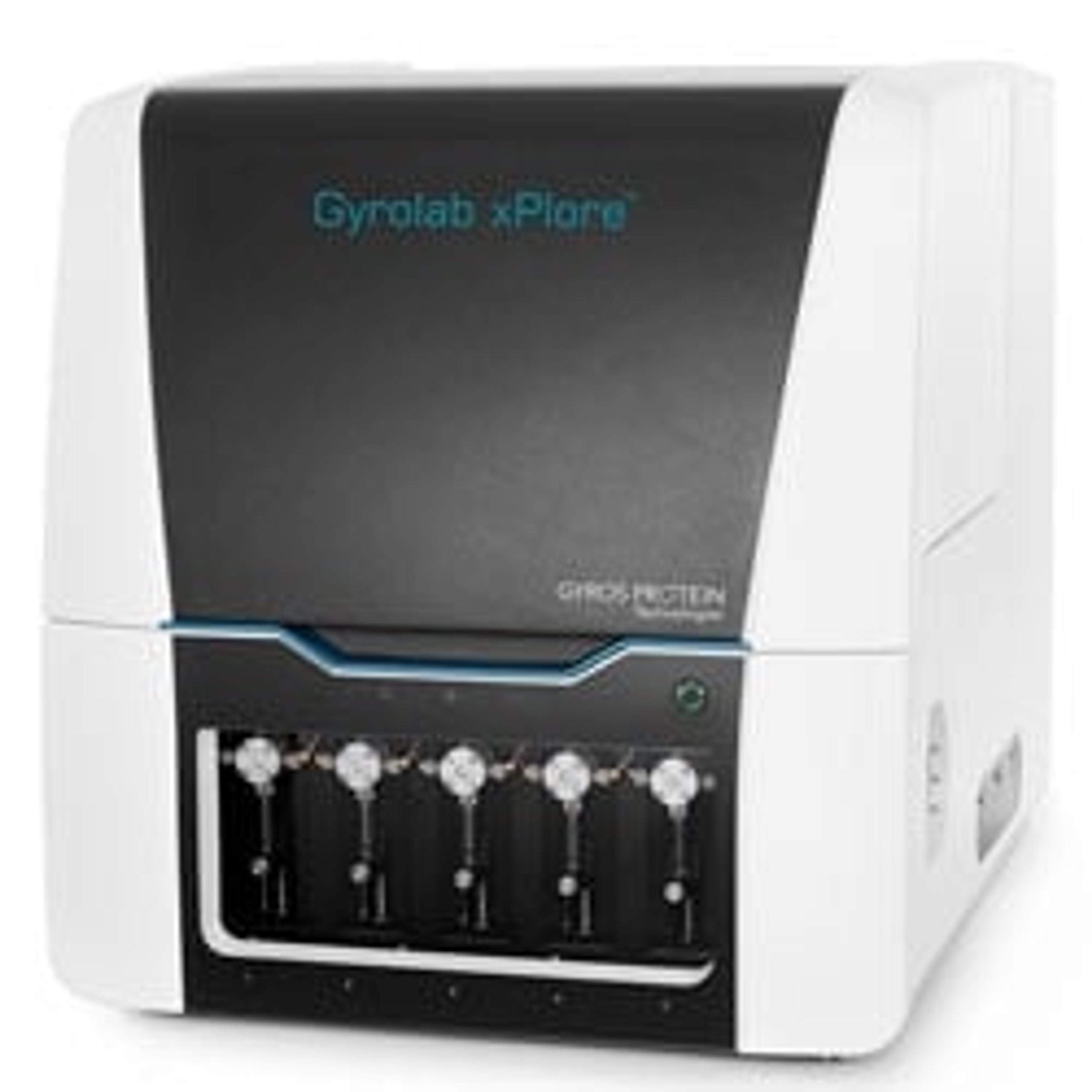
Gyrolab xPlore™ immunoassay system
Gyros Protein TechnologiesGyrolab xPlore is a single-CD, cost-effective microfluidic immunoassay platform for unattended parallel processing of 96 or 112 data points in one hour.