
BMG LABTECH's PHERAstar Microplate Reader Series is a Key Element in Lab Automation
6 Mar 2009Product news
The demands originating from high-throughput screening are the main drivers for laboratory automation and miniaturization in academia, biotech and the pharmaceutical industry. In the microplate based HTS field, low-volume assays, robotics, liquid handling and high-end microplate reader form a well tuned orchestra for time saving and cost efficient compound screening in microplate formats up to 1536 wells.
To satisfy the ever-increasing demands of the HTS community, BMG LABTECH established the PHERAstar Plus multi-detection microplate reader. The PHERAstar Plus is a simultaneous dual emission HTS microplate reader offering all leading detection technologies including fluorescence intensity / FRET, fluorescence polarization, time-resolved fluorescence / TR-FRET, laser-based AlphaScreenÒ, luminescence / BRET, and UV/Vis absorbance. This HTS reader provides both enhanced HTRFÒ performance with market leading Z’ and TR-FRET ratio performance and a fourfold increase in luminescence sensitivity. The PHERAstar Plus is the only microplate reader on the market with matched pairs of photomultiplier tubes (PMTs) and Simultaneous Dual Emission (SDE) technology optimized for specific reading modes and the capability to capture TR-FRET decay curves in real-time for assay optimization.
BMG LABTECH has now added a new instrument to the highly successful PHERAstar series, the new top of the line HTS plate reader, the PHERAstar FS. It is based on the successful PHERAstar Plus and incorporates the following new features: Tandem Technology, which uses highly sensitive, Filter based detection in all modes and an industry first, ultra-fast UV/Vis Spectrometer; on-board reagent injectors for precise kinetic measurements; advanced bottom reading for cell-based assays; and a dedicated UV-laser for all TR-FRET based assays. To learn more about this exciting new reader visit us at booth 208 at SBS 2009 in Lille, France.
The PHERAstar series is driven by BMG LABTECH’s well-known Reader Control software and data evaluation is performed by BMG’s exclusive Microplate Analysis and Reduction Software, MARS. The MARS Wizard creates an easy step-by-step calculation of a standard curve and the MARS Template Manager is an excellent tool for building complex data processing protocols. Thus, user-defined data analysis is one mouse click away. Enhanced robotic integration capabilities, digital signature, and the 21 CFR part 11 compliance of MARS complete this software package, making the PHERAstar series the ultimate choice for HTS.
For more information on how the PHERAstar series can be used for various HTS applications, please see our application notes including High-throughput protein-DNA affinity measurements using fluorescence anisotropy or Use of the PHERAstar for SNP Genotyping Chemistry Development and High Throughput Production Genotyping.
Related products
Request Quote for All Products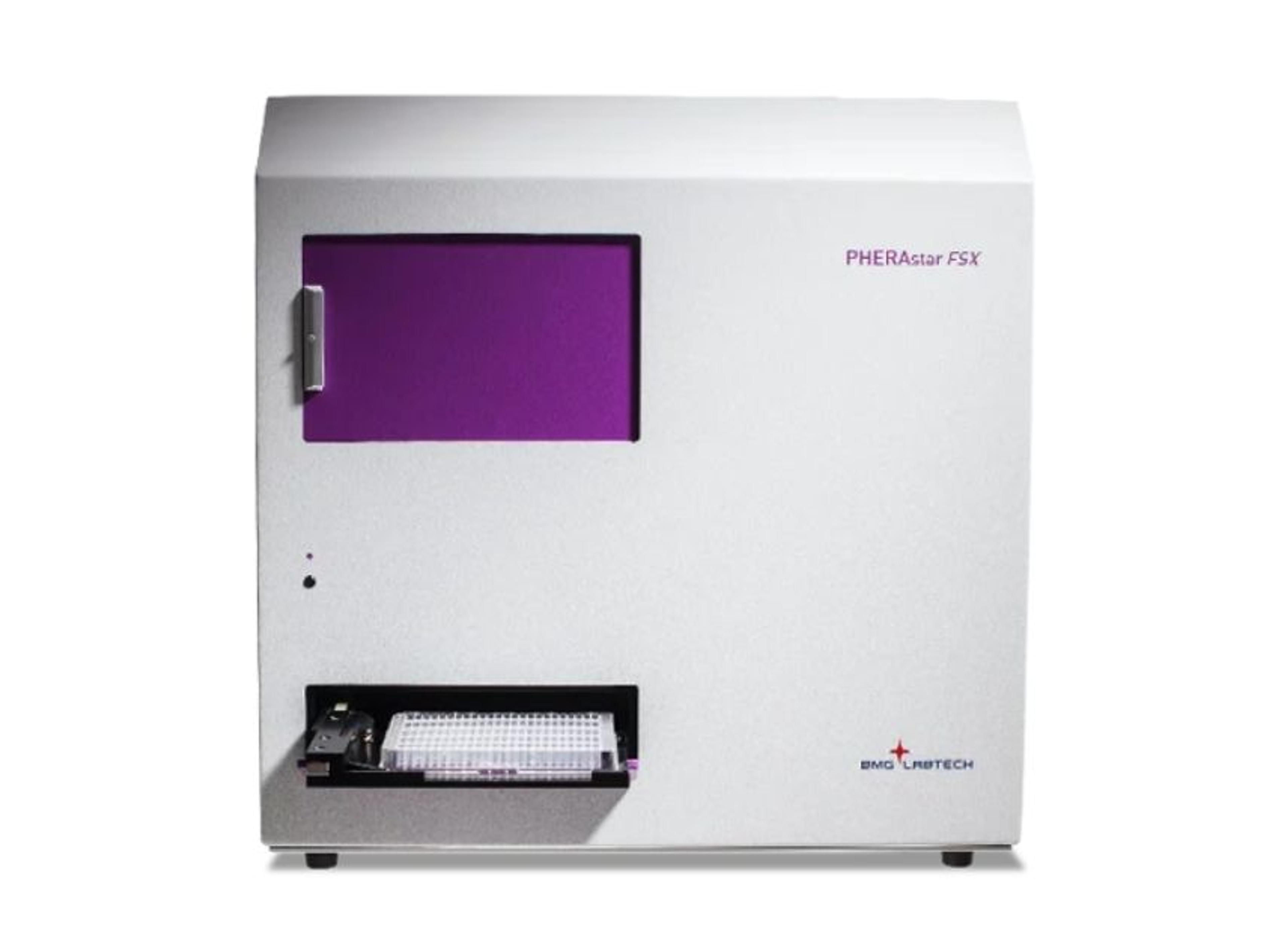
PHERAstar® FSX HTS Microplate Reader
BMG LABTECHThe most sensitive microplate reader for high-throughput screening