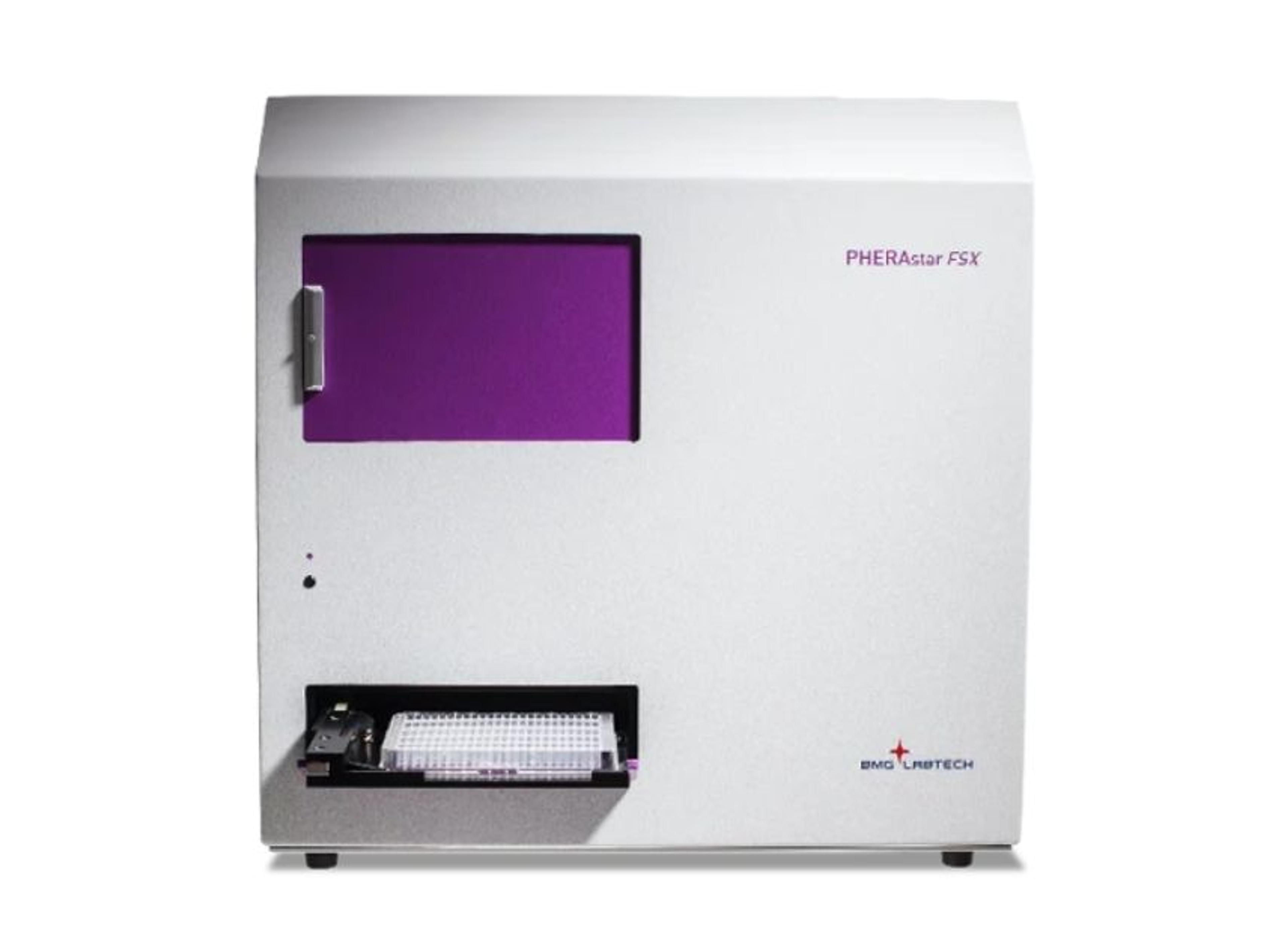
BMG LABTECH introduces the PHERAstar® FSX at SLAS2016

The most sensitive reader for high-throughput screening!

8 Jan 2016

Lynsey Forsyth
Post Doc / Research Fellow

Product news

The ultimate instrument for high-throughput screening applications

Built upon the highly successful PHERAstar FS platform, the improved features of the PHERAstar FSX make it superior to any other microplate reader currently on the market. The reader performs all leading non-isotopic detection technologies with ease and at high speed. Unmatched sensitivity and speed in fluorescence intensity and fluorescence polarization detection modes make the PHERAstar FSX the most sensitive reader around. In addition, an ultra-high dynamic range for luminescence measurements enables higher flexibility and more precise results.

Simultaneous Dual Emission for Alpha Technology

In order to maximize efficiency, screening facilities must constantly strive to increase throughput and minimize sample expenditure, while controlling costs. To meet these requirements, BMG LABTECH has pioneered the technique of Simultaneous Dual Emission detection in microplate readers. The PHERAstar® FSX can now also perform Simultaneous Dual Emission detection for AlphaPlex™ - increasing throughput significantly by cutting read times in a half.

BMG LABTECH Tutorials

Besides exhibiting at SLAS, BMG LABTECH will host four tutorials, including a 45 minute tutorial held by Associate Professor Pfleger from The University of Western Australia/Harry Perkins Institute of Medical Research. Professor Pfleger will present the research results performed by an international team which has, for the first time, demonstrated the principle of real-time ligand binding to G Protein-Coupled Receptors (GPCRs) using Bioluminescence Resonance Energy Transfer (BRET). This research further extends the established capability of BRET to monitor protein-protein interactions to real-time measurements in live cells, enhancing biologists’ and pharmacologists’ insights into real time cellular processes. This tutorial will take place at 12:30 on January 25th in room 9.

More information is available at www.bmglabtech.com/slas/ or at Booth #915.

Links

Tags

MicroplatesMicroplates are multi-well plates used to increase the throughput of biological investigations. The number of wells microplates contain can range from 6 to 3243 wells, with the 96-well format being the most commonly used. Microplates can come tailored for a range of applications including cell culture, PCR, filtration, storage, non-binding surface, protein crystallization, as well as pre-coated, deep well and normal Standard microplates. Additionally, options for microplate colors include clear , black, white or black with clear bottom and white with clear bottom for absorbance microplate reader applications. Find the best microplates for your lab in our peer-reviewed product directory: compare products, check customer reviews and receive pricing direct from manufacturers.High-Throughput ScreeningHigh-throughput screening (HTS) is an automated drug discovery technique for identification of active compounds against a compound library. Use HTS readers and integrated assay preparation / analysis workstations to screen your compounds. Identify active compounds against various HTS libraries, including membranes, proteins and peptides and HTS cell lines. Find the best high-throughput screening products in our peer-reviewed product directory: compare products, check customer reviews and receive pricing direct from manufacturers.Microplate Readers / DetectorsMicroplate readers are used to automate the detection and analysis of labeled or label-free components in microplates during assays or live-cell monitoring. Microplate readers are generally distinguished by their mode of detection. Types include absorbance, luminescence, fluorescence intensity, fluorescence polarization, TRF / FRET and multimode microplate readers. Microplate readers deliver a high throughput of samples by reading multiple wells simultaneously, with the 96-well format the most commonly used. As a result, microplate readers are often used in the drug discovery, bioassays, research and pharmaceutical industries for screening applications. Microplate loading can also be automated, with robotic microplate stackers to increase throughput. Find the best microplate readers in our peer-reviewed product directory: compare products, check customer reviews and receive pricing direct from manufacturers.Cell-Based AssaysCell-based assays are used to monitor the presence, quantity and activities of a desired cellular analyte including drug molecules or biomarkers. This can reveal information on cell health (apoptosis, cytotoxicity, viability and proliferation assays), cell metabolism, cell migration and cell signaling mechanisms. Find the best cell-based assay products, kits and equipment with our peer reviewed product directory: compare products, check customer reviews and receiving pricing direct from manufacturers.BiomarkersBiomarkers are biological markers which can be measured and evaluated to indicate a biological state. The use of biomarkers in research and diagnosis can indicate a normal or disease state or drug response of cells / tissues. Biomarkers include genetic markers, cell surface markers such as antigens, antibodies or receptors and secreted molecules such as cytokines. An assay system is required for identification of biomarkers. :Plate ProcessingAutomated plate processing is used in microplate technologies for high-throughput, speed and efficiency. Plate processing systems include microplate handlers for moving plates, heat sealers, stackers and carousels for storage, retrieval and delivery, microplate washers and piercers. Useful features of plate processors include walk-away automation, compatibility and easy integration with microplate systems.Cell ImagingCell imaging can be achieved using a number of techniques including confocal microscopy, transmission electron microscopy, atomic force microscopy, and light sheet microscopy.High ThroughputHigh throughput experiments allow the simultaneous processing of several samples. This parallelization reduces the cost per experiment and increases reproducibility and output volume of data.BiopharmaceuticalsBiopharmaceuticals are proteins and other compounds (such as nucleic acids) produced by living organisms that have uses as therapeutics or for in vivo diagnostics. The most well known example of a biopharmaceutical product, and the first to be approved for therapeutic use, was recombinant human insulin.BioluminescenceLive Cell ImagingLive cell imaging is the study of living cells using microscopes and high-content imaging systems. This technique provides in-depth insight into fast and complex biological processes, by allowing dynamic imaging of living cells instead of acquiring an individual image at a single point in time.SLASThe Society for Laboratory Automation and Screening (SLAS) is an organization focused on laboratory automation, high-throughput screening, and biotechnology innovation. SLAS promotes scientific advancements through conferences, publications, and industry collaborations.
BMG LABTECH introduces the PHERAstar® FSX at SLAS2016