BioTek Shines at SLAS 2017 with Versatile, Automated Life Science Instrumentation

26 Jan 2017

Emily Adam
Publishing / Media

Industry news

Join BioTek Instruments at the SLAS 2017 Conference and Exhibition to see how their life science instruments and automated systems can increase versatility and efficiency in reading, washing, dispensing and imaging workflows. The event will be held February 4-8 in Washington, D.C. BioTek’s booth #911 will feature their latest technologies listed below. Many BioTek instruments will also be featured in several automation partner booths throughout the exhibit hall.

BioTek’s featured life science innovations include:

  • BioSpa Live Cell Imaging System fully automates both fixed and live cell imaging and analysis by combining BioTek’s BioSpa™ 8 Automated Incubator and Cytation™ 5 Cell Imaging Multi-Mode Reader in a single, automated system. BioSpa 8 provides precise, real-time environmental control and monitoring for live cell assays in up to 8 lidded or unlidded plates or other labware, and incorporates a robotic gripper to move samples from BioSpa 8’s incubator drawer to Cytation 5 for automated image capture, processing and quantitative analysis of live cell assays. Cytation 5’s imaging modes include fluorescence, brightfield, color brightfield and phase contrast up to 60x magnification. BioTek’s washers and dispensers can be added to the system for complete workflow automation.
  • Lionheart™ FX Automated Live Cell Imager with Augmented Microscopy™ is a fully-integrated digital microscopy system. Imaging modes include fluorescence, brightfield, color brightfield and phase contrast up to 100x magnification, along with automated image capture, processing and analysis, providing publication-ready images and data. Temperature and gas control, plus an available humidity chamber and reagent injector provide optimal conditions for live cell imaging.
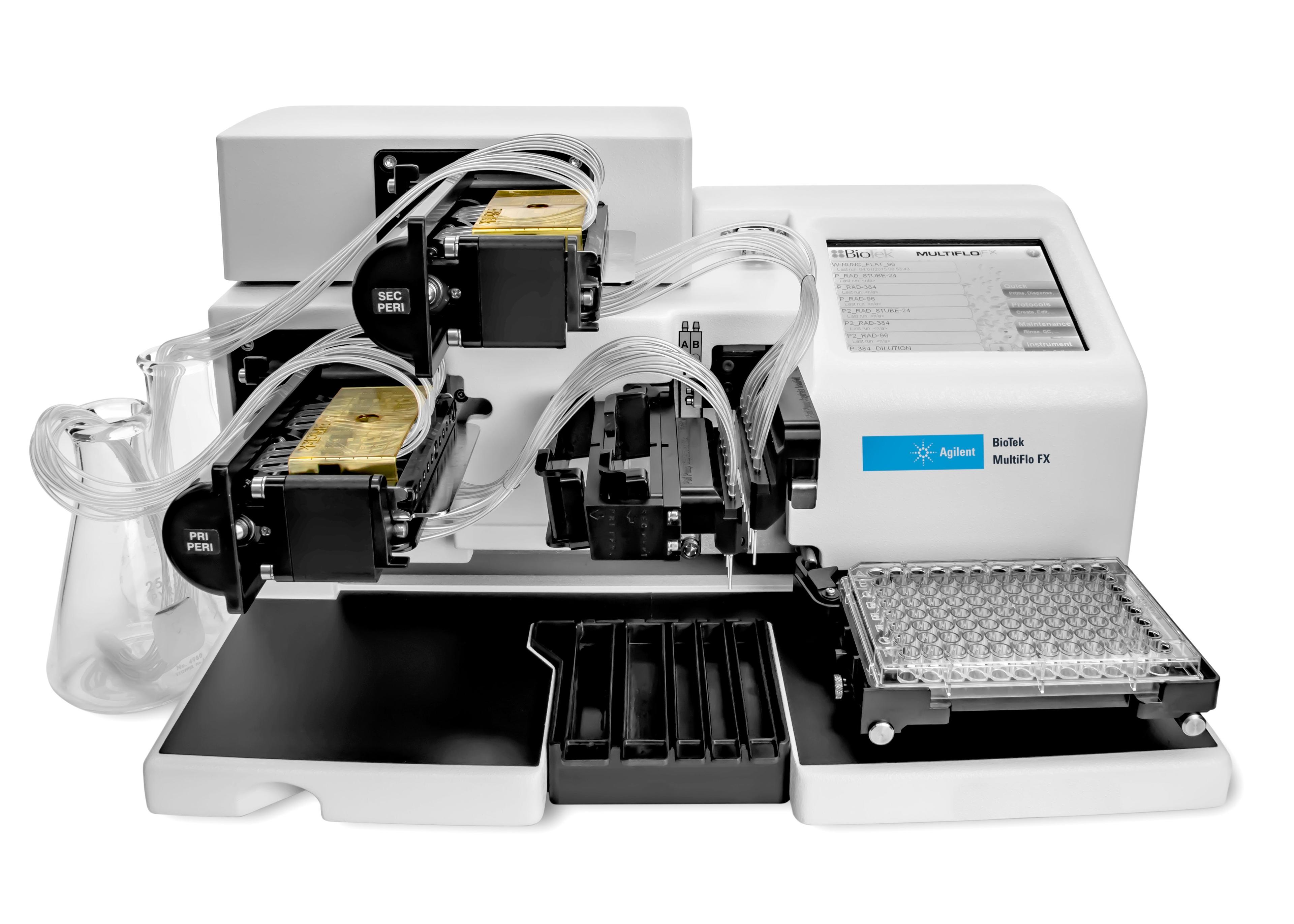
  • MultiFlo™ FX Microplate Dispenser replaces up to five separate liquid handlers to save time and instrument costs. One compact unit combines up to four independent dispensers and an optional wash module, and its simple, color touchscreen interface offers intuitive protocol creation and implementation. Parallel Dispense™ technology combines syringe and peristaltic pump-based dispensing to eliminate reagent carryover, while optional RAD™ technology enables random access dispensing.

BioTek’s application scientists will also present several posters validating use of their automated instruments in popular live cell, fixed cell and biochemical assay workflows. Click for BioTek’s complete SLAS 2017 activity list, and visit booth #911 to learn how BioTek’s automated life science instrumentation can unlock new versatility and efficiency throughout your laboratory.

BioTek Instruments, Inc., headquartered in Winooski, VT, USA, is a worldwide leader in the design, manufacture, and distribution of innovative life science instrumentation. Our comprehensive product line includes cell imaging systems, microplate readers, washers, dispensers, automated incubators, stackers and pipetting systems. These products enable life science research by providing high performance, cost-effective analysis and quantification of biomolecules, biomolecular interactions and cellular structure and function across diverse applications. BioTek espouses a "Think Possible" approach that sets the tone for fresh ideas, unsurpassed customer service and original innovations.

Links

Tags

Microplate Readers / DetectorsMicroplate readers are used to automate the detection and analysis of labeled or label-free components in microplates during assays or live-cell monitoring. Microplate readers are generally distinguished by their mode of detection. Types include absorbance, luminescence, fluorescence intensity, fluorescence polarization, TRF / FRET and multimode microplate readers. Microplate readers deliver a high throughput of samples by reading multiple wells simultaneously, with the 96-well format the most commonly used. As a result, microplate readers are often used in the drug discovery, bioassays, research and pharmaceutical industries for screening applications. Microplate loading can also be automated, with robotic microplate stackers to increase throughput. Find the best microplate readers in our peer-reviewed product directory: compare products, check customer reviews and receive pricing direct from manufacturers.Cell-Based AssaysCell-based assays are used to monitor the presence, quantity and activities of a desired cellular analyte including drug molecules or biomarkers. This can reveal information on cell health (apoptosis, cytotoxicity, viability and proliferation assays), cell metabolism, cell migration and cell signaling mechanisms. Find the best cell-based assay products, kits and equipment with our peer reviewed product directory: compare products, check customer reviews and receiving pricing direct from manufacturers.Robotic InstrumentsRobotic instruments can be used for high-throughput automation of many lab processes. Such processes use instruments for assays like cell based assays and ELISA, for sample preparation like shakers, centrifuges and incubators, and for analysis such as sequencing and western blot analyzers. Useful features of robotic instruments include speed, reproducibility, barcode readers, software and automation.Robotic WorkstationsRobotic workstations are automated platforms enabling the user to perform high-throughput, multi-application processes, from sample preparation tasks such as PCR set-up, DNA purification and NGS library preparation, to integrated sample prep and analysis workstations. Automation makes processes consistent, fast, precise and fully walk-away. Find the best robotic workstations in our peer-reviewed product directory: compare products, check customer reviews and receive pricing direct from manufacturers.Automation Supplies / AccessoriesAutomated accessories and consumables make lab processes fast, efficient and reliable. Useful automation accessories include microplate sealers, label printers and reagent reservoirs.Automated Liquid HandlingAutomated liquid handling equipment is used to mix, dilute and dispense allotted volumes of liquid into microplates and other vessels automatically. The robotic, liquid handling arms can dispense from single channel to 3456 multichannel as well as operate nanoliter dispensing, enabling high throughput of samples. Find the best automated liquid handlers in our peer-reviewed product directory: compare products, check customer reviews and receive pricing direct from manufacturers.Light MicroscopyLight microscopes or optical microscopes are used to visualize microscale objects under magnification, including cells, clinical specimens and materials. Lab equipment for light microscopy includes confocal microscopes, fluorescence microscopes, zoom and stereo microscopes. Microscope slides and imaging reagents are available for visualizing samples, as well as various microscope stages and incubators for large or temperature-sensitive samples. Find the best light microscopes in our peer-reviewed product directory: compare products, check customer reviews and receive pricing direct from manufacturers.AutomationAutomation in laboratories and manufacturing processes enhances efficiency, precision, and scalability by reducing the need for manual intervention. It plays a critical role in improving productivity, minimizing human error, and accelerating workflows in fields like diagnostics, drug development, and industrial testing. Automation technologies include robotic systems, automated liquid handlers, and process control systems that streamline complex tasks and ensure consistent, reproducible results. Explore our peer-reviewed product directory to discover the best automation solutions, compare options, read user reviews, and get prices directly from manufacturers.Cell ImagingCell imaging can be achieved using a number of techniques including confocal microscopy, transmission electron microscopy, atomic force microscopy, and light sheet microscopy.Liquid Handling WorkstationLiquid handling workstations automate the process of sample preparation, improving accuracy and efficiency. These systems are essential for high-throughput applications in biological, chemical, and pharmaceutical research, reducing human error and increasing reproducibility. Workstations come equipped with robotic arms, pipetting tools, and other accessories to streamline lab workflows. Explore liquid handling workstations in our peer-reviewed product directory; compare products, check reviews, and get pricing directly from manufacturers.Live Cell ImagingLive cell imaging is the study of living cells using microscopes and high-content imaging systems. This technique provides in-depth insight into fast and complex biological processes, by allowing dynamic imaging of living cells instead of acquiring an individual image at a single point in time.MicroscopyMicroscopy is a technique used to observe small objects in detail, from cells to materials, using light or electron microscopes. It enables researchers to examine structures with high resolution, aiding in fields such as biology, medicine, and materials science. With advanced microscopy techniques, scientists can gain insights into cellular processes, tissue structures, and material properties. Explore the best microscopy solutions in our peer-reviewed product directory, compare products, read customer reviews, and get pricing directly from manufacturers.SLASThe Society for Laboratory Automation and Screening (SLAS) is an organization focused on laboratory automation, high-throughput screening, and biotechnology innovation. SLAS promotes scientific advancements through conferences, publications, and industry collaborations.
BioTek Shines at SLAS 2017 with Versatile, Automated Life Science Instrumentation