BioTek Highlights Improved Workflows with their Latest Microplate Instruments at ASCB2013

28 Nov 2013

Sarah Thomas
Associate Editor

Product news

New microplate instrumentation from BioTek improves workflow efficiencies in detection, liquid handling and automation of these processes. BioTek will be highlighting four new products in Booth #1301 at the American Society for Cell Biology Annual Meeting, to be held December 14-18 in New Orleans, Louisiana.

The patent pending Cytation™ 3 Cell Imaging Multi-Mode Reader combines automated digital fluorescence microscopy and conventional microplate detection in a modular, upgradable platform. Quantitative and phenotypic analyses are easily and efficiently performed for a variety of assays, particularly live cell assays where Cytation 3’s temperature control and available gas control module support the ideal environment to grow, image, count and further analyze cells in microplates, slides, petri dishes and other vessels.

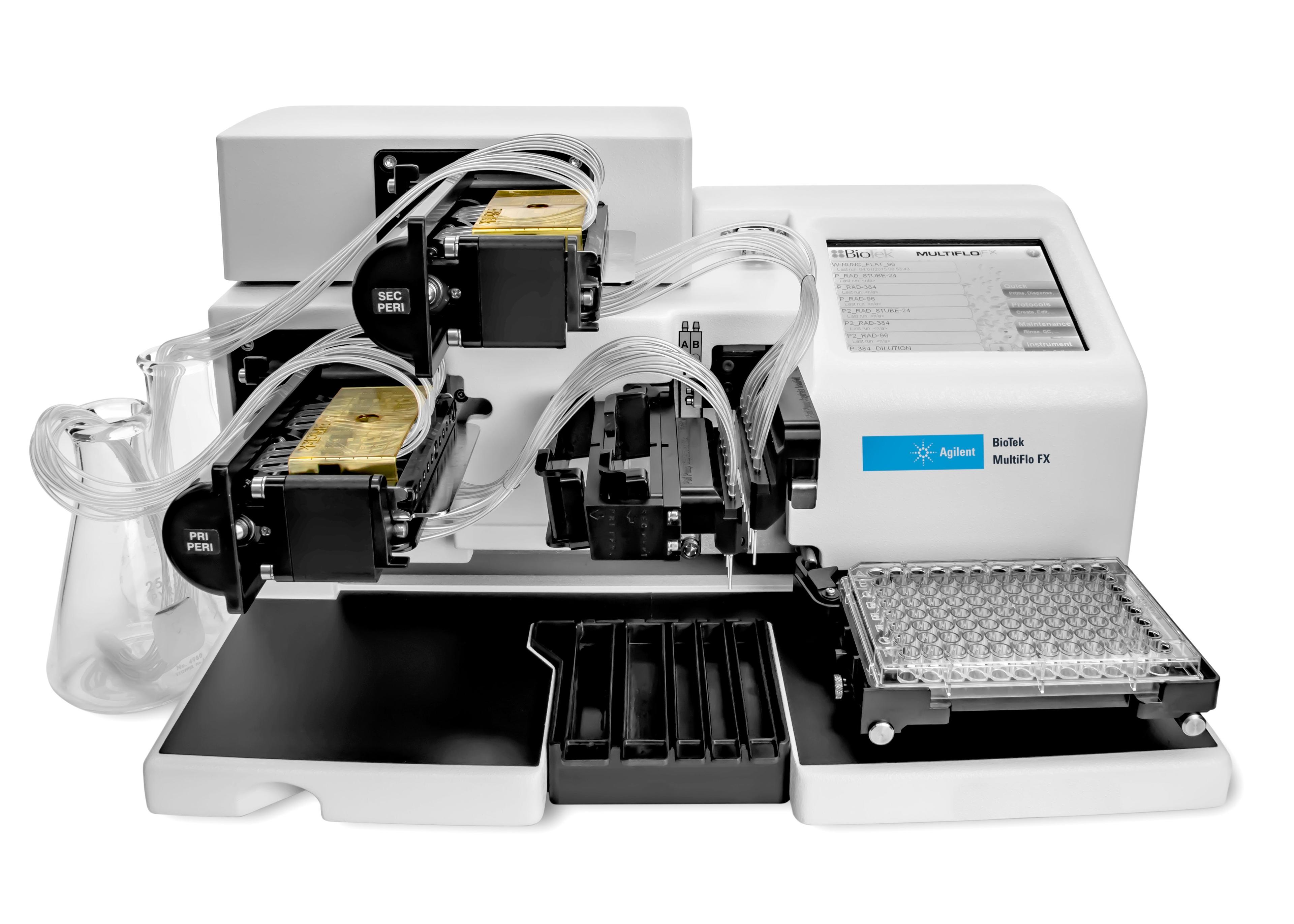
Color touch screens make programming easy and intuitive on the new MultiFlo™ FX Microplate Dispenser and 405 Touch Microplate Washer. MultiFlo FX offers up to four independent reagent dispensers plus an available wash module in a compact system. The unique Parallel Dispense™ technology combines syringe and peristaltic pump-based dispensing, eliminating potential carryover. Modules can be added as the laboratory’s requirements change. BioTek’s expertise in microplate washing is demonstrated with the 405 Touch Microplate Washer for 96- and 384-well plates, with very low flow rates for sensitive cell based assays, rigorous washing for robust assays, plus available vacuum filtration and biomagnetic separation capabilities. Both MultiFlo FX and 405 Touch can optionally be controlled with BioTek’s Liquid Handling Control™ (LHC™) software, when computer control is required.

Detection and liquid handling processes using with lidded or unlidded plates are easily automated with the new BioStack™ 4 Microplate Stacker, designed for use with 24- to 1536-well microplates. BioStack’s fast plate transfer speeds increase throughput and provide walkaway automation.

BioTek will have these products and more on exhibit at ASCB 2013. Visitors can stop by to learn more about how their processes can be streamlined.

BioTek Instruments, Inc., headquartered in Winooski, VT, USA, is a worldwide leader in the design, manufacture, and sale of microplate instrumentation and software. These technologies are used to aid life science research, facilitate drug discovery, provide rapid and cost-effective analysis, and enable sensitive, accurate quantification of molecules across diverse applications. BioTek espouses a “Think Possible” approach that sets the tone for fresh ideas, unsurpassed customer service and original innovations. As such, they are often honored for local accomplishments and technological innovations, including Best Places to Work in Vermont, North American New Product Innovation Award for Workflow Solutions in Life Sciences and Drug Discovery Product of the Year – Scientists' Choice Award.
Links

Tags

Cell Adhesion AssaysCell adhesion assays are used to quantitate attachment and analyze the molecular mechanisms for extracellular matrix adhesion, cell migration and sensitivity to inhibitors. Find the best cell adhesion assay equipment in our peer-reviewed product directory: compare products, check customer reviews and receive pricing direct from manufacturers.Cell / Tissue CultureCell culture or tissue culture is used to study the biology of cells or tissues and to isolate cellular products in an environment which can be manipulated and well defined. Accurately control your culture environment with bioreactors or culture incubators, bind your cells to a surface or together with an extracellular matrix. Distinguish cell types with differential media or proliferate cells with certain characteristics using selective media. Enrich your media with supplements such as growth factors, sera and vitamins. Find the best cell and tissue culture products, kits and equipment in our peer-reviewed product directory: compare products, check customer reviews and receive pricing direct from manufacturers.Cell Lines Stem Cells and Primary CellsPrimary cell cultures, established cell lines and stem cells are vital for <i>in vitro</i> and <i>ex vivo</i> experimentation. High-quality cells, optimized for your applications, alongside optimized cell substrates, growth medium and supplements, are critical for experimental success. Explore a range of cells suitable for your applications, including isogenic cell lines, competent cells, induced pluripotent stem cell (iPSC)-derived cell lines, fungal/bacterial/mammalian cell lines, stem cells and cancer cell lines. Find the best cells for your research in our peer-reviewed product directory: compare products, check customer reviews and receive pricing direct from manufacturers.Microplate Readers / DetectorsMicroplate readers are used to automate the detection and analysis of labeled or label-free components in microplates during assays or live-cell monitoring. Microplate readers are generally distinguished by their mode of detection. Types include absorbance, luminescence, fluorescence intensity, fluorescence polarization, TRF / FRET and multimode microplate readers. Microplate readers deliver a high throughput of samples by reading multiple wells simultaneously, with the 96-well format the most commonly used. As a result, microplate readers are often used in the drug discovery, bioassays, research and pharmaceutical industries for screening applications. Microplate loading can also be automated, with robotic microplate stackers to increase throughput. Find the best microplate readers in our peer-reviewed product directory: compare products, check customer reviews and receive pricing direct from manufacturers.Cell-Based AssaysCell-based assays are used to monitor the presence, quantity and activities of a desired cellular analyte including drug molecules or biomarkers. This can reveal information on cell health (apoptosis, cytotoxicity, viability and proliferation assays), cell metabolism, cell migration and cell signaling mechanisms. Find the best cell-based assay products, kits and equipment with our peer reviewed product directory: compare products, check customer reviews and receiving pricing direct from manufacturers.Software PlatformsSoftware platforms are useful for various stages of laboratory experiments from data collection to data storage and processing. For instance lab software is available for system control, data management, data analysis and qualification / validation.Plate ProcessingAutomated plate processing is used in microplate technologies for high-throughput, speed and efficiency. Plate processing systems include microplate handlers for moving plates, heat sealers, stackers and carousels for storage, retrieval and delivery, microplate washers and piercers. Useful features of plate processors include walk-away automation, compatibility and easy integration with microplate systems.Automated Liquid HandlingAutomated liquid handling equipment is used to mix, dilute and dispense allotted volumes of liquid into microplates and other vessels automatically. The robotic, liquid handling arms can dispense from single channel to 3456 multichannel as well as operate nanoliter dispensing, enabling high throughput of samples. Find the best automated liquid handlers in our peer-reviewed product directory: compare products, check customer reviews and receive pricing direct from manufacturers.Light MicroscopyLight microscopes or optical microscopes are used to visualize microscale objects under magnification, including cells, clinical specimens and materials. Lab equipment for light microscopy includes confocal microscopes, fluorescence microscopes, zoom and stereo microscopes. Microscope slides and imaging reagents are available for visualizing samples, as well as various microscope stages and incubators for large or temperature-sensitive samples. Find the best light microscopes in our peer-reviewed product directory: compare products, check customer reviews and receive pricing direct from manufacturers.ASCBFluorescence MicroscopyFluorescence microscopy has become an essential tool in biology, as well as in materials science. The application of many fluorochromes has made it possible to identify cells and sub-microscopic cellular components with a high degree of specificity. Using multiple fluorescence labels, different probes can simultaneously identify several target molecules.Cell AnalysisThe analysis of cells allows researchers to understand the factors which contribute to cell health and function. These influencing processes can then be predicted and altered, leading to the development of medication and disease treatments.