BioTek Brings New Efficiencies to Cancer Research Workflows at AACR 2017

30 Mar 2017
Weylan Kiam-Laine
Microbiologist

Product news

BioTek Instruments will feature its latest advancements to facilitate cancer research during the AACR Annual Meeting 2017, to be held April 1-5 in Washington, D.C. Expert scientific staff will be on hand at BioTek’s booth #1857 to discuss how these instruments can help advance cancer research. Highlights at this exhibition will include Lionheart FX, Cytation 5 and MultiFlo FX.

Lionheart™ FX Automated Microscope is a fully integrated digital inverted microscope for live and fixed cell imaging applications. Lionheart FX offers fluorescence, high contrast brightfield, color brightfield and phase contrast imaging with up to 100x magnification. Temperature control and available CO2/O2 control and humidity chamber optimize conditions for live cell imaging, while dual reagent injectors are available for fast kinetic assays. Along with Gen5 software, Lionheart FX provides Augmented Microscopy™, a workflow automation concept that provides automated image capture, processing and analysis for publication-ready images and data.

Cytation™ 5 Cell Imaging Multi-Mode Reader combines automated digital widefield microscopy with conventional multi-mode microplate reading in a unique, patented design to provide information-rich images and quantitative data for live cell assays, along with a broad range of other applications. Its patented Hybrid Technology™ offers filter- and monochromator-based multi-mode detection in a modular, upgradable design for versatility and workflow efficiency now and as laboratory needs evolve.

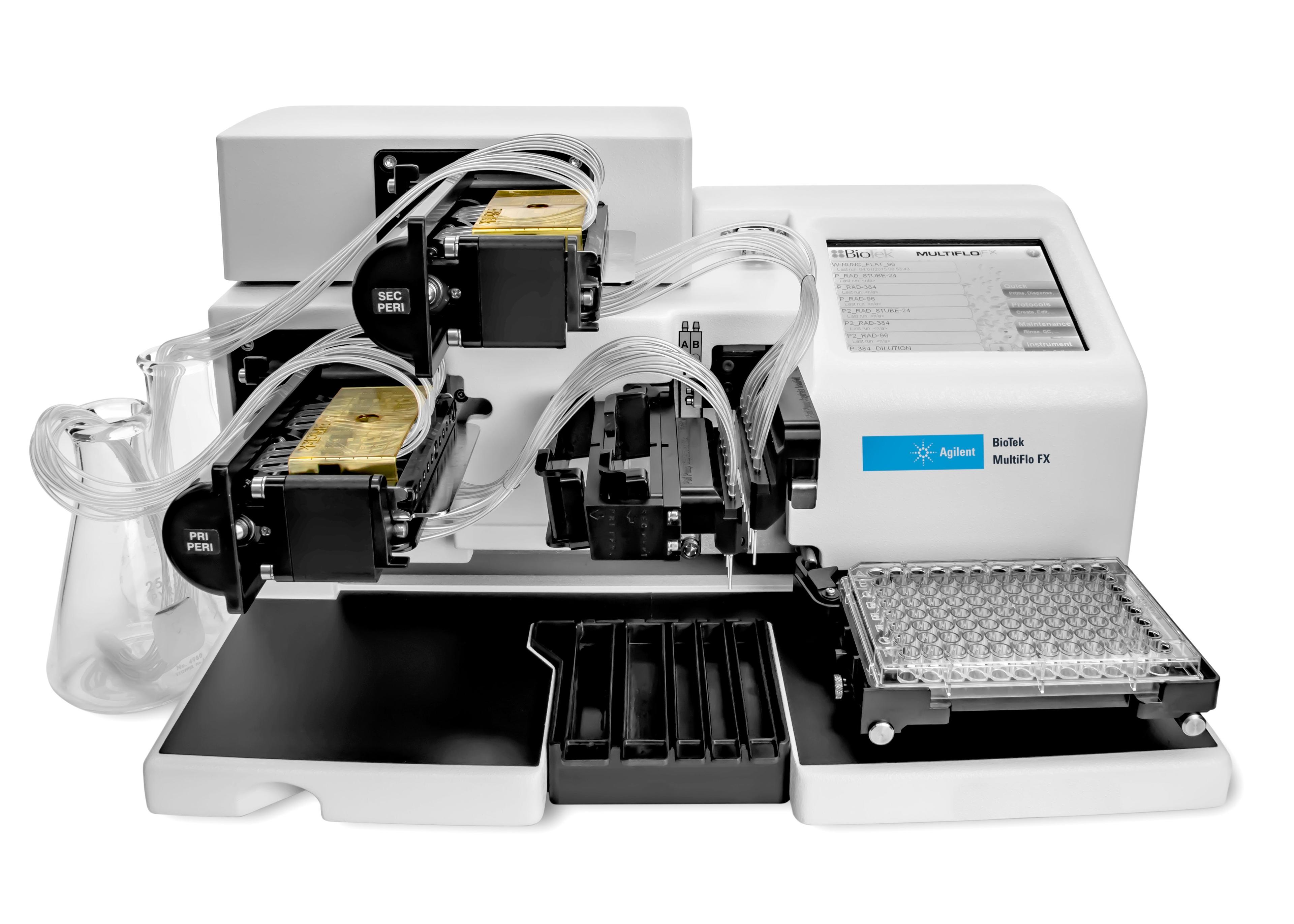
The modular MultiFlo™ FX Microplate Dispenser replaces up to five separate liquid handlers to save time and instrument costs when dispensing into 6- to 1536-well microplates. Up to four independent reagents are dispensed using Parallel Dispense™ technology, which combines syringe and peristaltic pumps to eliminate potential reagent carryover, while optional RAD™ technology enables random access dispensing to individual wells. An optional wash module expands application versatility. The user-friendly, color touchscreen interface offers intuitive protocol creation and implementation.

BioTek will present an exhibitor spotlight tutorial and poster presentation at the following times and locations in the Walter E. Washington Convention Center:

  • Demonstration of High Throughput, Image-Based 2D and 3D Natural Killer Cell Mediated Cytotoxicity Assays
    Tuesday, April 4, 4:00 - 5:00 PM
    Exhibitor Spotlight Theater B
  • A Combined, Affordable Solution for the Performance of Automated 3D in vitro Hepatotoxicity Testing
    Tuesday, April 4, 1:00 - 5:00 PM
    Partners: Hamilton, Reprocell, n3D Biosciences, Inc., UTHealth
    Poster: #4213

Links

Tags

Cell / Tissue CultureCell culture or tissue culture is used to study the biology of cells or tissues and to isolate cellular products in an environment which can be manipulated and well defined. Accurately control your culture environment with bioreactors or culture incubators, bind your cells to a surface or together with an extracellular matrix. Distinguish cell types with differential media or proliferate cells with certain characteristics using selective media. Enrich your media with supplements such as growth factors, sera and vitamins. Find the best cell and tissue culture products, kits and equipment in our peer-reviewed product directory: compare products, check customer reviews and receive pricing direct from manufacturers.MicroplatesMicroplates are multi-well plates used to increase the throughput of biological investigations. The number of wells microplates contain can range from 6 to 3243 wells, with the 96-well format being the most commonly used. Microplates can come tailored for a range of applications including cell culture, PCR, filtration, storage, non-binding surface, protein crystallization, as well as pre-coated, deep well and normal Standard microplates. Additionally, options for microplate colors include clear , black, white or black with clear bottom and white with clear bottom for absorbance microplate reader applications. Find the best microplates for your lab in our peer-reviewed product directory: compare products, check customer reviews and receive pricing direct from manufacturers.Microplate Readers / DetectorsMicroplate readers are used to automate the detection and analysis of labeled or label-free components in microplates during assays or live-cell monitoring. Microplate readers are generally distinguished by their mode of detection. Types include absorbance, luminescence, fluorescence intensity, fluorescence polarization, TRF / FRET and multimode microplate readers. Microplate readers deliver a high throughput of samples by reading multiple wells simultaneously, with the 96-well format the most commonly used. As a result, microplate readers are often used in the drug discovery, bioassays, research and pharmaceutical industries for screening applications. Microplate loading can also be automated, with robotic microplate stackers to increase throughput. Find the best microplate readers in our peer-reviewed product directory: compare products, check customer reviews and receive pricing direct from manufacturers.Cell-Based AssaysCell-based assays are used to monitor the presence, quantity and activities of a desired cellular analyte including drug molecules or biomarkers. This can reveal information on cell health (apoptosis, cytotoxicity, viability and proliferation assays), cell metabolism, cell migration and cell signaling mechanisms. Find the best cell-based assay products, kits and equipment with our peer reviewed product directory: compare products, check customer reviews and receiving pricing direct from manufacturers.BiomarkersBiomarkers are biological markers which can be measured and evaluated to indicate a biological state. The use of biomarkers in research and diagnosis can indicate a normal or disease state or drug response of cells / tissues. Biomarkers include genetic markers, cell surface markers such as antigens, antibodies or receptors and secreted molecules such as cytokines. An assay system is required for identification of biomarkers. :Light MicroscopyLight microscopes or optical microscopes are used to visualize microscale objects under magnification, including cells, clinical specimens and materials. Lab equipment for light microscopy includes confocal microscopes, fluorescence microscopes, zoom and stereo microscopes. Microscope slides and imaging reagents are available for visualizing samples, as well as various microscope stages and incubators for large or temperature-sensitive samples. Find the best light microscopes in our peer-reviewed product directory: compare products, check customer reviews and receive pricing direct from manufacturers.AutomationAutomation in laboratories and manufacturing processes enhances efficiency, precision, and scalability by reducing the need for manual intervention. It plays a critical role in improving productivity, minimizing human error, and accelerating workflows in fields like diagnostics, drug development, and industrial testing. Automation technologies include robotic systems, automated liquid handlers, and process control systems that streamline complex tasks and ensure consistent, reproducible results. Explore our peer-reviewed product directory to discover the best automation solutions, compare options, read user reviews, and get prices directly from manufacturers.Cell ImagingCell imaging can be achieved using a number of techniques including confocal microscopy, transmission electron microscopy, atomic force microscopy, and light sheet microscopy.High ThroughputHigh throughput experiments allow the simultaneous processing of several samples. This parallelization reduces the cost per experiment and increases reproducibility and output volume of data.Cancer ResearchCancer research aims to understand the mechanisms of cancer development and progression to improve prevention, diagnosis, and treatment. From molecular biology to clinical trials, research spans a wide range of disciplines, including immunotherapy, targeted therapies, and drug discovery. Explore the best cancer research products in our peer-reviewed product directory; compare products, check reviews, and get pricing directly from manufacturers.Live Cell ImagingLive cell imaging is the study of living cells using microscopes and high-content imaging systems. This technique provides in-depth insight into fast and complex biological processes, by allowing dynamic imaging of living cells instead of acquiring an individual image at a single point in time.MicroscopyMicroscopy is a technique used to observe small objects in detail, from cells to materials, using light or electron microscopes. It enables researchers to examine structures with high resolution, aiding in fields such as biology, medicine, and materials science. With advanced microscopy techniques, scientists can gain insights into cellular processes, tissue structures, and material properties. Explore the best microscopy solutions in our peer-reviewed product directory, compare products, read customer reviews, and get pricing directly from manufacturers.Bright Field MicroscopyAACRThe American Association for Cancer Research (AACR) is a leading organization focused on cancer research and treatment. It provides a platform for scientists, healthcare professionals, and industry leaders to share knowledge and collaborate in the fight against cancer.
BioTek Brings New Efficiencies to Cancer Research Workflows at AACR 2017