BioTek Announces Epoch Contest Winner

9 Dec 2010

Kerry Parker
CEO

Product news

BioTek Instruments, Inc., today announced the winner of the “Win an Epoch” contest, which ran April 15 - September 17, 2010 in the United Kingdom. The prize, BioTek's Epoch™ Multi-Volume Spectrophotometer System, is awarded in cooperation with Fisher Scientific. The winner, chosen at random, is Ms. Alison Tutt, Laboratory Manager in the Tenovus Research Laboratory, Cancer Sciences Division at Southampton University, United Kingdom.

“The BioTek Epoch equipment will be an enormous aid to the researchers in the laboratory,” notes Ms. Tutt. “It should speed up procedures that are already in house and will replace an old plate reader and dot matrix printer.” The Tenovus Research Laboratory investigates CD20 cancer cells and how antibodies effect lymphoma treatment. Currently, they seek to improve upon Rituximab effects through an increased understanding of the underlying mechanisms and biology. The Epoch will be used for the assessment of protein and DNA concentrations and purity.

The complete Epoch Multi-Volume Spectrophotometer System consists of the Epoch Microplate Spectrophotometer and the unique Take3™ Multi-Volume Plate. The monochromator-based Epoch measures absorbance from 200-999 nm in 6- to 384-well microplates. Along with endpoint readings for nucleic acid and protein quantification, Epoch can also perform wavelength scanning, kinetic and well area scanning measurements. The unique Take3 accessory measures up to sixteen 2 µL samples, two BioCells™ or a standard cuvette. Pre-programmed and user-generated programs, as well as data output, are controlled via Gen5™ Data Analysis Software.

Congratulations to Ms. Tutt, and the entire Tenovus Research Laboratory!

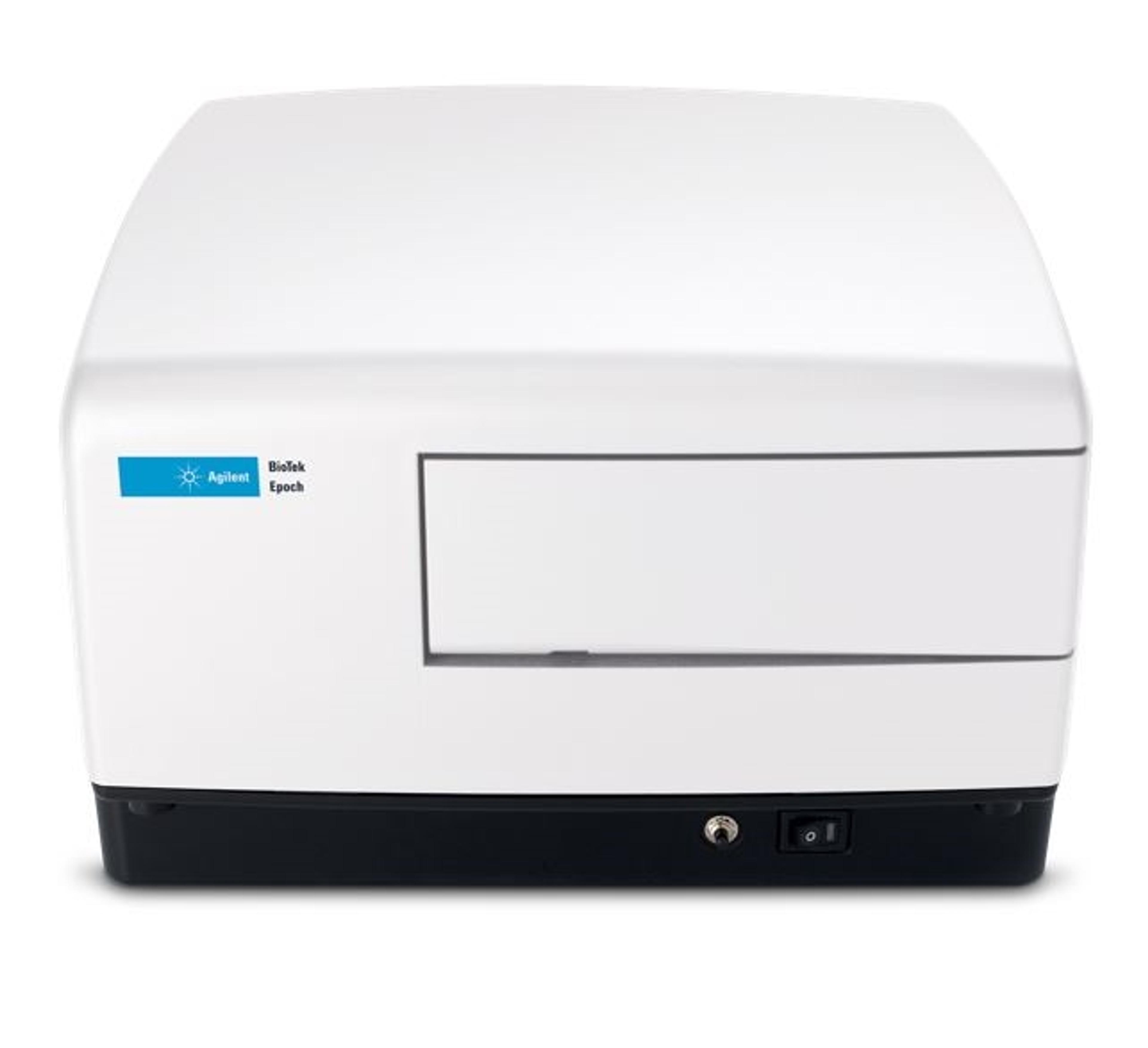
Agilent BioTek Epoch Microplate Spectrophotometer

Agilent Technologies

The Agilent BioTek Epoch microplate spectrophotometer has monochromator-based optics, for a filter-free, wide wavelength range for UV-Vis absorbance measurements. These measurements can be done in many microplate formats and in 2 µL samples when the available Take3 microvolume plate is used.

(8)

Links

Tags

Genome AnalysisGenomics, the study of genomes, includes functional genomics, evolutionary genomics and comparative genomics. There are many genomic technologies such as DNA sequencing of whole genomes, computational biology and bioinformatics. DNA and nucleic acids must be isolated and concentrated from cells for analysis with kits, automated analyzers and software. Other useful technologies for studying genomics include PCR, microarrays and electrophoresis.ProteomicsProteomics is the systemic bioinformatics study of proteins and amino acids, including their structure, size, function and identification. Tools used in proteomics include chromatography, blotting and gels, protein arrays, mass spectrometry and ELISA and associated analysis software. Analyzers and proteomic systems should be sensitive, high resolution, fast and may be automated for high-throughput.Microplate Readers / DetectorsMicroplate readers are used to automate the detection and analysis of labeled or label-free components in microplates during assays or live-cell monitoring. Microplate readers are generally distinguished by their mode of detection. Types include absorbance, luminescence, fluorescence intensity, fluorescence polarization, TRF / FRET and multimode microplate readers. Microplate readers deliver a high throughput of samples by reading multiple wells simultaneously, with the 96-well format the most commonly used. As a result, microplate readers are often used in the drug discovery, bioassays, research and pharmaceutical industries for screening applications. Microplate loading can also be automated, with robotic microplate stackers to increase throughput. Find the best microplate readers in our peer-reviewed product directory: compare products, check customer reviews and receive pricing direct from manufacturers.DNA / RNA Extraction and PurificationPurified DNA and RNA are required for numerous downstream molecular biology applications. Consequently, the importance of high-quality DNA/RNA extraction and purification equipment cannot be underestimated. Many purification kits are available and are typically optimized for nucleic acid type and source, including plasmid DNA, genomic DNA, mRNA, RNA and viral nucleic acid purification kits. Automated extraction and purification of nucleic acids can be implemented with magnetic bead separator instruments or high-throughput purification workstations. Find the best DNA/RNA extraction and purification equipment in our peer-reviewed product directory: compare products, check customer reviews and receive pricing direct from manufacturers.
BioTek Announces Epoch Contest Winner