
Biomolecular Quantitation System Launched Offering Advantages over Bradford and Lowry Assays
14 Mar 2012Product news
EMD Millipore has launched the Direct Detect™ system for rapid, simplified protein quantitation at Pittcon 2012. The Direct Detect™ system exploits EMD Millipore’s membrane expertise to enable infrared-based measurement of amide bonds in protein chains, an intrinsic component of every protein, without relying on amino acid composition, dye-binding properties, or redox potential. Conventional assays based on UV-Vis spectroscopy rely on absorbance by a protein’s aromatic amino acids and therefore have limited utility.
“In addition to its analytical powers, the Direct Detect™ system provides a groundbreaking departure from traditional sample prep requirements typical of biomolecular quantitation. After samples are spotted on assay cards, they can be stored in ambient conditions without appreciable change in readout,” describes John Sweeney, Head of Life Science Business Field, EMD Millipore. “Another important advantage over conventional assays is that the Direct Detect™ calibration standard curve requires generation once, which provides additional time savings and ease of use.”
The system employs a hydrophilic polytetrafluoroethylene (PTFE) membrane designed to be transparent in most of the infrared spectral region and enables application of biomolecule solutions directly onto the membrane. The Direct Detect™ system delivers more universally applicable and faster protein quantitation, requiring minimal sample consumption. System accuracy and precision are comparable with results obtained by amino acid analysis, an accurate standard for quantitation, yet can be time-consuming and often costly.
Because the system relies on IR-based detection of biomolecules, users can obtain accurate and reproducible protein quantitation in the presence of reducing agents and detergents. As a result, the Direct Detect™ system can measure protein concentrations from 0.2 mg/mL to 5 mg/mL within seconds, without any bio- or immunochemical staining, directly from samples, including buffered solutions.
The Direct Detect™ system can also be used to provide information on non-protein sample components, such as lipids and nucleic acids.
Related products
Request Quote for All Products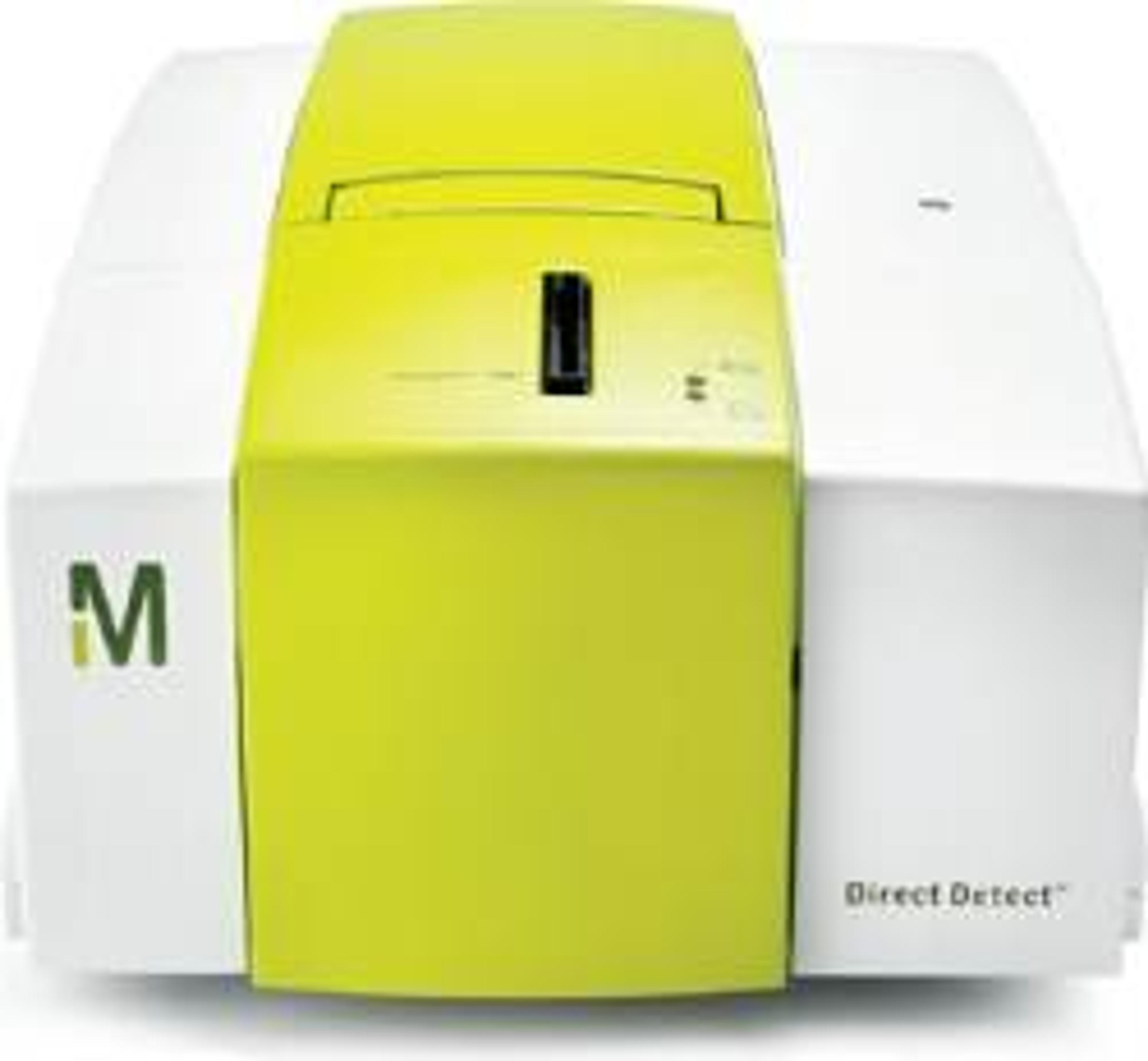
Direct Detect® Spectrometer
MerckIntroducing Direct Detect™, the first infrared (IR)-based biomolecular quantitation system. Just spot your sample, blank, and read! No sample prep, standard curves, messy cuvettes or liquid waste. With inherent amide bond detection, the Direct Detect™ system distinguishes proteins and peptides from interfering sample components, providing more accurate results without the pitfalls of colorimetric assays. Technology: FTIR Spectrometry and Protein Quantitation By measuring amide bonds in protein chains, the system accurately determines an intrinsic component of every protein without relying on amino acid composition, dye binding or redox potential. Accurately analyze components of complex mixtures: proteins, lipids, carbohydrates, and nucleic acids have separable IR spectra. Advantages of FTIR Quantitation: • Independent of amino acid composition • No extinction coefficient required, unlike UV-Vis/A280 methods • Improves speed and accuracy over traditional colorimetric assays • Works in the presence of detergents and reducing agents • Compatible with lysates and membrane preps