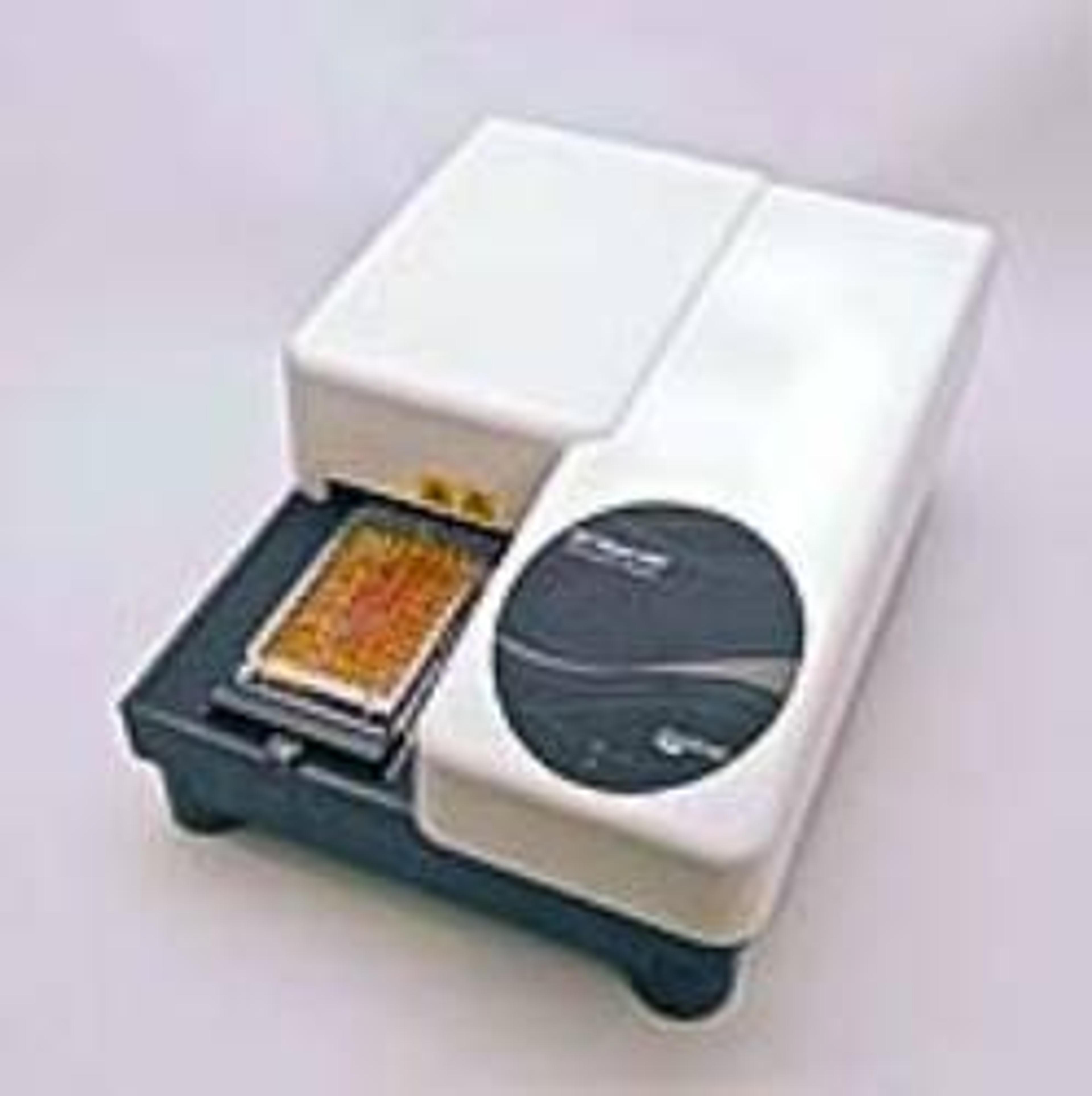
Biochrom Launches the New EZ Read 400 Microplate Reader

17 Mar 2011
bridget bridget
Laboratory Director

Product news

Biochrom Ltd has launched the new EZ Read 400 microplate reader. Customers can now benefit from the cost-effective and easy to use instrument. Offering flexibility and full performance with no redundant features, the filter-based, PC-controlled EZ Read 400 can be tailored to suit application requirements.

The ability to perform single or dual wavelength measurements to incorporate reference wavelength readings, and the option to do so at timed-intervals, means the EZ Read 400 is ideal for ELISA, protein, cell biology and kinetic assays. Designed to take up the minimum of bench space, and incorporating ADAP Basic PC software and USB connections for easy instrument connection and data transfer, the new EZ Read 400 can be configured with a choice of:

• Filter options within a wavelength range of 400-750 nm
• Choice of data analysis software packages
• QC plate for instrument validation

Biochrom has 40 years experience in the delivery of competitive, configurable instruments for the modern laboratory. Anyone interested in finding out more about the new generation EZ Read 400 microplate reader, details of their local distributor, or other Biochrom instruments, are invited to visit the company article page.

Biochrom EZ Read 400 Research Microplate Reader

Biochrom Ltd

The Biochrom EZ Read 400 Researc is an economically priced, easy-to-use microplate reader for 96-well plates, quick to set up and requiring minimal training. The simple, robust PC-controlled microplate reader has no un-necessary features and is ideally suited to labs with multi-level users performing ELISA, cell biology and protein assats.  The instrument is supplied with ADAP Basic PC software which is used for instrument control and to export of raw data to Microsoft® Excel for further analysis. Configured to meet your needs for ELISA assays! The Biochrom EZ Read 400 ELISA Microplate Reader is delivered as standard with filters covering the most common ELISA substrates, plus a reference filter. Research filter set includes: 405, 450, 492, 620, 595, 562, 650, 570 nmSoftware ADAP Basic Software Supplied with the Biochrom EZ Read 400, ADAP Basic PC software is used for instrument control, including filter selection, calibration, plate transporter operation, and endpoint, kinetic, and multi-wavelength measurements. Raw data can be stored or transferred to Microsoft® Excel for further analysis. ADAP Plus Software (optional) ADAP Plus software is a PC-based software including all functionality of ADAP Basic, plus plate layout, transformation formulae, replicate elimination and quantitative and qualitative analysis. ADAP Expert Software (optional) ADAP Expert, a PC-based software including all functionality of ADAP Plus as well as data reduction of kinetic assays, tracking of 32,000 sample IDs, and multi-test functions on one plate. ADAP software has user access at different levels allowing users to work within FDA 21 CFR Part 11 compliant environments.

(1)

Links

Tags

Combinatorial ChemistryCombinatorial chemistry, also known as combichem, is a technique used in drug discovery to create libraries of structurally related compounds. A library is generated by synthesis with a chemical reactor system or by computer-based modeling of compound combinations. When undertaking combinatorial chemistry consider reagents, buffers, resins and standards.MicroplatesMicroplates are multi-well plates used to increase the throughput of biological investigations. The number of wells microplates contain can range from 6 to 3243 wells, with the 96-well format being the most commonly used. Microplates can come tailored for a range of applications including cell culture, PCR, filtration, storage, non-binding surface, protein crystallization, as well as pre-coated, deep well and normal Standard microplates. Additionally, options for microplate colors include clear , black, white or black with clear bottom and white with clear bottom for absorbance microplate reader applications. Find the best microplates for your lab in our peer-reviewed product directory: compare products, check customer reviews and receive pricing direct from manufacturers.High-Throughput ScreeningHigh-throughput screening (HTS) is an automated drug discovery technique for identification of active compounds against a compound library. Use HTS readers and integrated assay preparation / analysis workstations to screen your compounds. Identify active compounds against various HTS libraries, including membranes, proteins and peptides and HTS cell lines. Find the best high-throughput screening products in our peer-reviewed product directory: compare products, check customer reviews and receive pricing direct from manufacturers.Microplate Readers / DetectorsMicroplate readers are used to automate the detection and analysis of labeled or label-free components in microplates during assays or live-cell monitoring. Microplate readers are generally distinguished by their mode of detection. Types include absorbance, luminescence, fluorescence intensity, fluorescence polarization, TRF / FRET and multimode microplate readers. Microplate readers deliver a high throughput of samples by reading multiple wells simultaneously, with the 96-well format the most commonly used. As a result, microplate readers are often used in the drug discovery, bioassays, research and pharmaceutical industries for screening applications. Microplate loading can also be automated, with robotic microplate stackers to increase throughput. Find the best microplate readers in our peer-reviewed product directory: compare products, check customer reviews and receive pricing direct from manufacturers.ADME-ToxicologyADME-toxicology (ADME-Tox) studies are used in pharmacology and pharmacokinetics to assess the activity/toxicity of drugs <i>in vivo</i> or <i>in vitro</i>. Find bioassays for absorption, distribution, metabolism, and excretion of drug molecules including cytotoxicity, transporter/permeability, metabolism and activity assays as well as hepatocytes and cell lines for ADME. Find the best ADME-toxicology products in our peer-reviewed product directory: compare products, check customer reviews and receive pricing direct from manufacturers.Assay AssemblyAssay Assembly is technique used in drug discovery to develop assays to test the cytotoxicity, genotoxicity, or other activities of a compound on a cell. Assay assembly requires chip assembly, a delivery system and a detection and analysis method. Beneficial features of assay kits or automated systems include high-throughput, high speed and sensitivity and low signal to noise ratio.Medicinal ChemistryMedicinal chemistry is a broad discipline encompassing the design, identification, synthesis and development of chemicals in drug discovery. It includes a number of techniques covering structural biology, synthetic chemistry and molecular biology. Technologies used in medicinal chemistry include ADME, lab-on-a-chip, high content screening and assay assembly.Microarray AnalysisMicroarrays, also known as biochips, are used for the detection and analysis of multiple genes, proteins, antibodies, or biomarkers on a single microchip. This can reveal information on protein or gene expression, single nucleotide polymorphism (SNP), copy number variation (CNV), epigenetics and patient health in clinical diagnostic tests. Discover a range of microarray scanners and prefabricated antibody, protein, RNA and DNA microarrays for your analysis or consider creating your own custom microarrays with a microarray printer. Find the best microarray products in our peer-reviewed product directory: compare products, check customer reviews and receive pricing direct from manufacturers.High-Content ScreeningHigh-content screening (HCS), also known as high-content analysis (HCA), is a high-throughput technique used in drug discovery to identify substances that alter the phenotype of cells. HCS uses fluorescent microscopic imaging and automated image analysis to investigate cellular events such as apoptosis, cell viability, GPCR activation, oxide production, neurite outgrowth, and cell signaling. Find the best fluorescent labeling reagents, cellular assays, and high-content imaging systems in our peer-reviewed product directory: compare products, check customer reviews and receive pricing direct from manufacturers.Biopharmaceutical AdvancesBiopharmaceutical advances follow the development of pharmaceuticals derived from biotechnology, also known as biotechnology medicines. Biopharmaceuticals may be produced from cell lines, plants, or microbial cells. Important considerations of biopharmaceutical use include application, cost, production process and purification.Plate ProcessingAutomated plate processing is used in microplate technologies for high-throughput, speed and efficiency. Plate processing systems include microplate handlers for moving plates, heat sealers, stackers and carousels for storage, retrieval and delivery, microplate washers and piercers. Useful features of plate processors include walk-away automation, compatibility and easy integration with microplate systems.
Biochrom Launches the New EZ Read 400 Microplate Reader