
Bio-Rad Launches New Reagents for Target-Specific Preamplification of Limited Templates for Real-Time PCR
12 Jun 2014
Product news
Bio-Rad Laboratories, Inc. has announced the launch of its SsoAdvanced™ PreAmp Supermix and PrimePCR™ PreAmp Assays. The supermix is formulated to permit unbiased, target-specific preamplification of cDNA or genomic DNA (gDNA), which allows researchers to stretch their limited nucleic acid samples. PrimePCR PreAmp assays are wet-lab validated preamplification primers that work seamlessly with the supermix to ensure optimal preamplification for real-time PCR.
The SsoAdvanced PreAmp Supermix is especially useful for researchers who are working with limited samples or are interrogating multiple targets simultaneously. It enables simultaneous 1,000-fold target-specific preamplification of as little as 100 pg of cDNA (or gDNA) for up to 100 genes while delivering the industry’s lowest bias. It is also more cost-effective than any other preamplification solution available.
The SsoAdvanced PreAmp Supermix can be paired with Bio-Rad’s iScript™ Advanced or iScript Supermix reverse transcription reagents. Using the PreAmp Supermix preamplification protocol (see illustration), researchers first isolate RNA and synthesize cDNA using either of the iScript reagents. After mixing the cDNA (or gDNA) with SsoAdvanced PreAmp Supermix and pooled primers (or with PrimePCR PreAmp assays), PCR is performed to preamplify targets of interest. The reaction is then ready for real-time PCR amplification and detection.
For the most accurate gene expression analysis, researchers should pair the SsoAdvanced PreAmp Supermix with PrimePCR PreAmp assays, which are available for every PrimePCR gene expression assay. PrimePCR assays are the only wet-lab validated and specificity-verified primers. The SsoAdvanced PreAmp Supermix is validated for SYBR® Green, probe-based (e.g. TaqMan®), and custom-designed real-time PCR assays.
Related products
Request Quote for All Products
iQ™ SYBR® Green Supermix, 100 x 50 µl rxns, 2.5 ml (2 x 1.25 ml)
Bio-Rad100 x 50 µl reactions, real-time PCR mix, 2x mix contains dNTPs, 50 U/ml iTaq™ DNA polymerase, 6 mM MgCl2, SYBR® Green I, 20 nM fluorescein
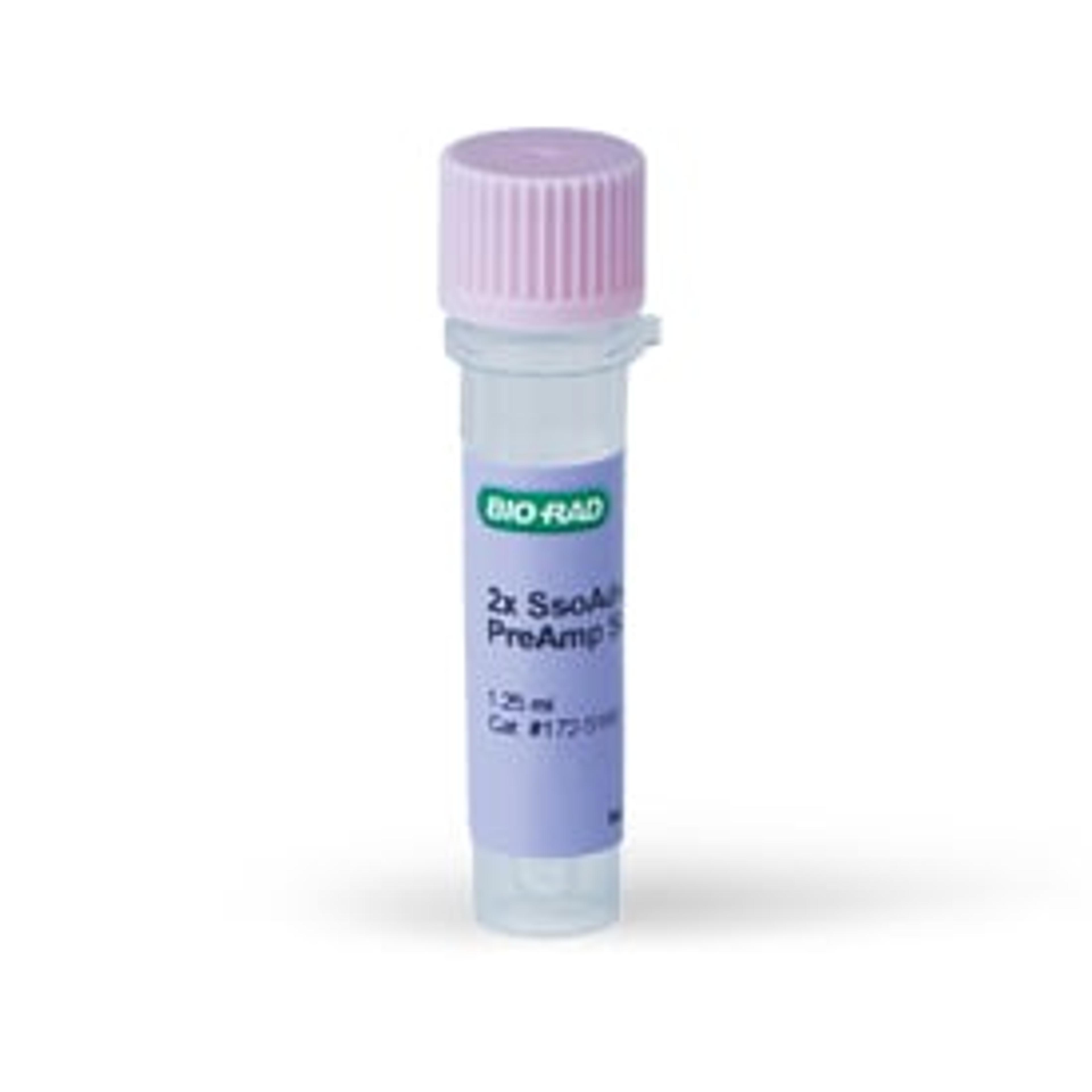
SsoAdvanced™ PreAmp Supermix, 50 x 50 µl rxns, 1.25 ml
Bio-Rad1 ml (1 x 1 ml vials), contains antibody-mediated hot-start Sso7d-based DNA polymerase (patented), dNTPs, salts, enhancers, stabilizers, for 50 x 50 µl reactions