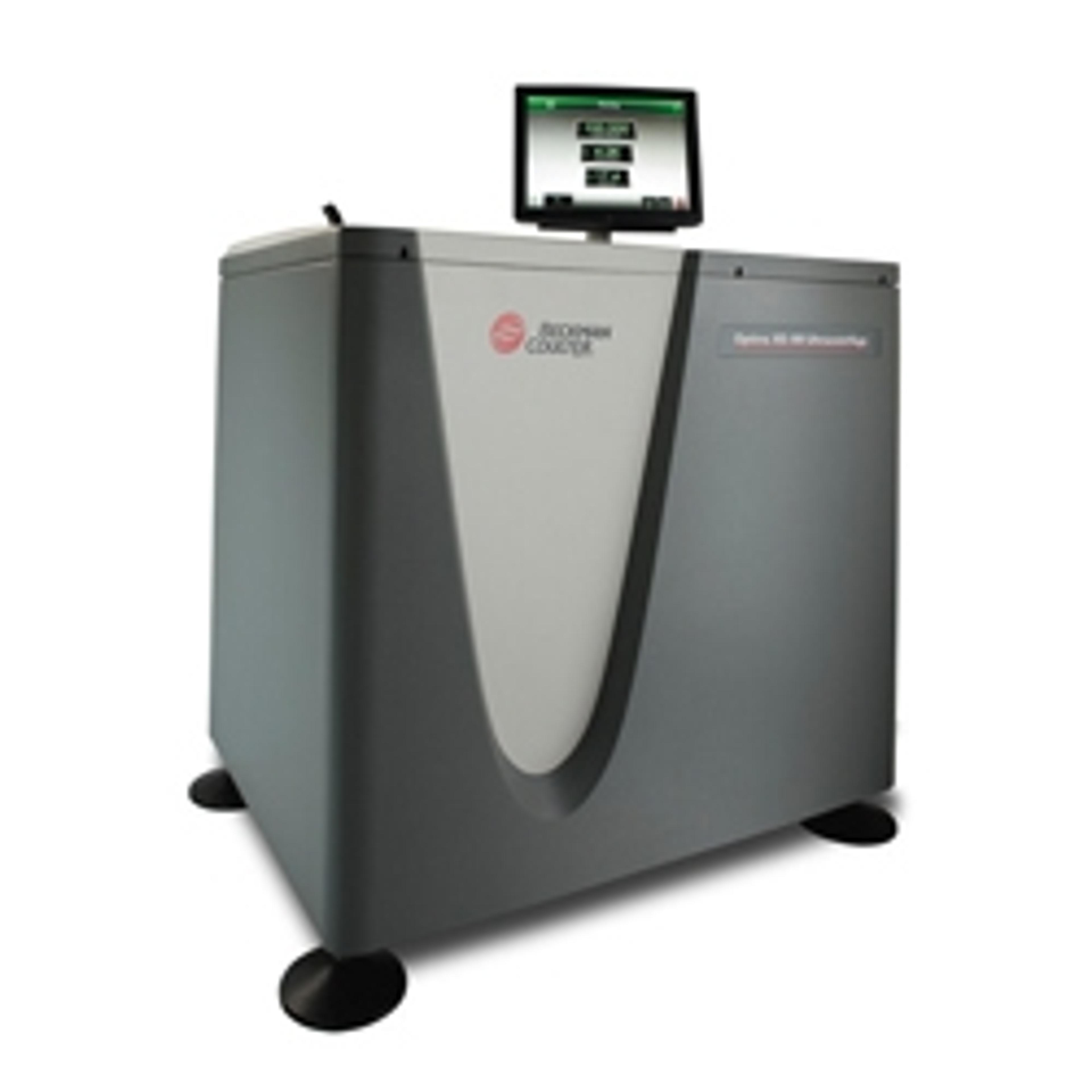
Beckman Coulter Unveils Next Generation Analytical Ultracentrifuge, Optima AUC, at analytica 2016

Delivers Enhanced Optics and Improved Software to Open New Applications

9 May 2016
Alex Waite
Editorial Assistant

Product news

Beckman Coulter Life Sciences launches the new Optima AUC at this year’s analytica: 25th International Trade Fair for Laboratory Technology, Analysis, Biotechnology and analytica conference in Munich, Germany, from May 10-13, 2016.

This next generation analytical ultracentrifuge has been developed with many enhanced capabilities. Visit booth # 302, Hall A3.

The new Optima AUC is a fast, sophisticated and easy-to use analytical research tool. A 38.1 cm (15 inch diagonal), touch-screen display eases operation and boosts efficiency. In addition, modern, intuitive software enables simple run-monitoring and data exports performed either locally or remotely. The optics are contained outside the rotor chamber, making it easier to clean, and reducing the impact of the g-force on the optics.

As Chad Schwartz, Ph.D., the Product Manager explained: “The new Optima AUC returns analytical ultracentrifugation to the forefront of solution-state protein and particle analysis for accurate molecular weight determination, thermodynamics of associating systems, viral and nanoparticle payload characterisation, and many additional emerging applications.”

Although analytical ultracentrifugation is a recognised technique for protein characterisation, researchers have realised the technology’s value for characterising a wide array of particles including peptides, polymers, metallic nanoparticles, liposomes and other non-biological materials. The Optima AUC allows molecules to float free and unbound so that researchers are able to characterize them in their native state.

Dr. Schwartz added: “Researchers are constantly pushing the boundaries of scientific advancements and require ever more precision and reproducibility from their instruments. The new analytical ultracentrifuge is the result of a successful collaboration with our customers. This latest offering continues Beckman Coulter’s commitment to innovation and provides users with the capabilities they seek to continue their research.”

This powerful technology determines molecular weight, size, shape, and polydispersity, and is capable of interactions between particles in a native, matrix-free environment. The new Optima AUC now allows multi-wavelength analysis.

“Rapid data acquisition coupled with reproducible and precise wavelength selections enable applications never before possible with AUC,” said Dr. Schwartz. Wavelength-specific monitoring now allows researchers to study complex systems easily and in a single experiment.”

Dr. Borries Demeler, University Texas Health Science Center, USA, singled out the following key technical innovations:

  • New Rayleigh interference system for higher resolution for more precise measurements, higher data density and higher confidence in the results
  • State of the art UV-visible absorption optics to provide reproducible wavelength selections, fast radial scanning for reduced temporal distortion, and sensitive detection in the far UV.

Commenting on their importance, he stressed: “For the first time, these advanced features enable revolutionary new multi-wavelength experiments, an entirely new class of experimental designs that can exploit the presence of multiple chromophores in complex mixtures through spectral decomposition.

“Coupled with the advanced high-performance UltraScan software, large multi-wavelength datasets can now be rapidly analysed to separate particles in three dimensions, based on size, shape and unique spectral contributions. This will further enhance the unsurpassed power of this analytical technique to help investigators analyse solution properties of complex mixtures without the need for standards.”

The Optima AUC improves temperature control and increases data storage, wavelength precision, and wavelength repeatability, providing researchers the confidence needed for clean, reproducible data. Additionally, the instrument’s modular design allows for the development of new detection systems, opening up the possibility for unique detection capabilities.

Links

Tags

ProteomicsProteomics is the systemic bioinformatics study of proteins and amino acids, including their structure, size, function and identification. Tools used in proteomics include chromatography, blotting and gels, protein arrays, mass spectrometry and ELISA and associated analysis software. Analyzers and proteomic systems should be sensitive, high resolution, fast and may be automated for high-throughput.CentrifugesCentrifuges are used to separate particulates suspended in a liquid via the application of a centrifugal force including cells, macromolecules, nanoparticles and precipitates. Centrifuges come in three sizes: microcentrifuges, benchtop and floor-standing centrifuges, depending on the volume and number of samples that require separation. When choosing a centrifuge, consider its maximum separation power indicated by its relative centrifugal force (RCF) value. Low force centrifuges reach a maximum RCF of 8,000 g, high-force centrifuges can reach maximum RCF values of 80,000 g. For extremely high forces, consider ultracentrifuges (up to 800,000 g). Refrigerated and vacuum centrifuges also known as concentrators are available for more specialized applications. A range of volumes are available for centrifuge tubes and microfuge tubes, depending on sample sizes. Find the best centrifuges in our peer-reviewed product directory: compare products, check customer reviews and receive pricing direct from manufacturers.Sample ManagementSample management systems include sample storage devices such as freezers and plate storers, sample environment enclosures and sample organization, retrieval and sorter systems. Useful system features include high-throughput, automation, robotic arms, automated liquid handling and associated database systems. Accessories in sample management include barcode scanners, heat sealers and tubes.Protein PurificationProtein purification is a vital step in drug discovery, therapeutics, biotech and life science research. The purification process typically involves subcellular or membrane protein extraction with cell lysis kits, separation of proteins from cell debris by filtration or spin columns, and the isolation of proteins of interest from other proteins and impurities with affinity purification (including fusion protein tags and antibody binding proteins A, G and L), immunoprecipitation or chromatographic methods, such as ion exchange, size exclusion and immobilized metal affinity chromatography. All purification methods come in multiple formats for your laboratory needs, including agarose or magnetic beads, resins, columns and filter plates. Find the best protein purification equipment in our peer-reviewed product directory: compare products, check customer reviews and receive pricing direct from manufacturers.Robotic InstrumentsRobotic instruments can be used for high-throughput automation of many lab processes. Such processes use instruments for assays like cell based assays and ELISA, for sample preparation like shakers, centrifuges and incubators, and for analysis such as sequencing and western blot analyzers. Useful features of robotic instruments include speed, reproducibility, barcode readers, software and automation.Automation Supplies / AccessoriesAutomated accessories and consumables make lab processes fast, efficient and reliable. Useful automation accessories include microplate sealers, label printers and reagent reservoirs.Particle CharacterizationParticle characterization instruments are used to determine particle size distribution, shape, surface area, zeta potential, density and porosity of particles and materials. Multiple tecchniques are available for determining particle size, shape and count including dynamic light scattering (DLS), laser diffraction, electrozone (Coulter technique), imaging particle analysis and single particle optical sensing. Determine the density of your material with a gas pycnometer or examine its surface area and porosity with gas adsorption analyzers and mercury porosimeters. Find the best particle characterization instruments in our peer-reviewed product directory: compare products, check customer reviews and receive pricing direct from manufacturers.Temperature ControlTemperature controlled processes are experiments carried out using ovens, furnaces, incubators, hotplates, refrigeration and freezers.Protein BiologyThe analysis of protein expression, identity and function is vital for many areas of life science research and drug discovery. Some of the most commonly used techniques in protein analysis include Western blotting, electrophoresis and mass spectrometry.analyticaAnalytica is a leading international trade fair for laboratory technology, analysis, and biotechnology, showcasing innovations and solutions in the scientific community. Stay updated with the latest trends and products in the industry. Molecular Weight AnalysisMolecular weight analysis determines the size and structure of biomolecules, essential in protein characterization, polymer studies, and drug development. Techniques like mass spectrometry ensure precise results. Compare solutions for molecular weight analysis in our peer-reviewed product directory.PeptidesPeptides are short chains of amino acids that play key roles in biological processes, including signaling, immune responses, and enzyme regulation. Peptide research is critical in drug discovery, diagnostics, and vaccine development. Browse our peer-reviewed product directory to find the best peptides and peptide-related products, compare options, check reviews, and get pricing directly from manufacturers.Centrifuge