Beckman Coulter, Inc showcases latest products at Analytica 2008

25 Feb 2008

Kerry Parker
CEO

Product news

At Analytica 2008, visit Beckman Coulter, Inc. in Area A3, Booth 201/302 to see the latest products in automation, cellular analysis and centrifugation. Highlights include:

PARADIGM™ Detection Platform - Cisbio has awarded its homogenous time-resolved fluorescence (HTRF*) certification to the PARADIGM™ Detection Platform. Cisbio’s certification verifies that the detection platform meets or exceeds performance criteria for HTRF assays. A new HTRF detection cartridge is now available for the unique, modular PARADIGM platform, bringing the growing total selection to 10. These detection cartridges can be interchanged in less than five minutes to meet different assay needs.

PARADIGM is the first user-upgradeable and -configurable multimode reader - ideal for labs with multiple users and applications. The high-throughput detector reads on the fly, in formats from 6 to 1,536 wells. Cisbio’s patented HTRF technology is incorporated into a growing selection of assays and reagents for drug discovery and screening. These popular assays produce superior results and are easily miniaturised and automated.

BioRAPTR FRD™ microfluidic workstation - comes in two configurations, tandalone and integrated with Beckman Coulter’s new PARADIGM™ Detection Platform, Biomek® NXp liquid handler and BRT Robotic Transport. With the addition of the BioRAPTR low-volume workstation, Beckman Coulter’s automation capabilities span the complete range of volumes, from tubes to microplates to 3,456-well ChemLib* plates. Ideal for assay miniaturization applications in drug discovery, genomics and proteomics, the BioRAPTR non-contact, high-precision dispenser delivers increased capacity and speed along with reduced reagent and consumable costs.

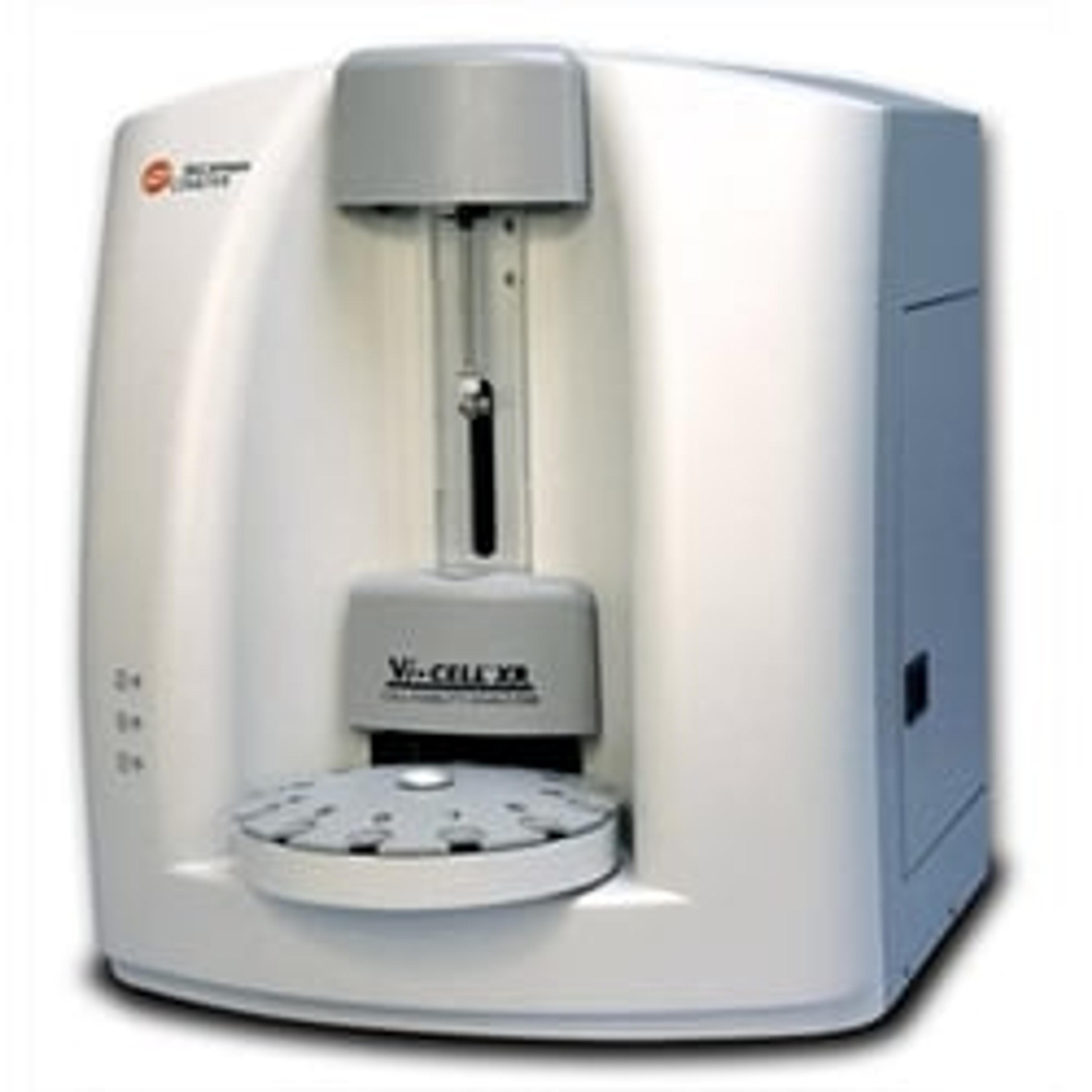
Vi-CELL™ XR Cell Viability Analyser - Beckman Coulter announces the successful integration of its Vi-CELL™ XR Cell Viability Analyser with Biomek® Laboratory Automation Workstations and other devices for real-time cellular imaging in a walk-away system for cell culture settings. Integrated automation adds flexibility to the application of the Vi-CELL instrument, from basic cellular research through drug development and scale up, and even into pharmaceutical manufacturing quality control. The Vi-CELL XR (extended range) measures the viability of cells and counts them in minutes, using the widely accepted Trypan Blue cell viability tissue culture protocol. The instrument measures 15 to 30 times more volume than competitive systems in the same amount of time, with a more comprehensive array of parameters. The automated, integrated solution monitors cell growth over time.

High-Throughput Cellular Analysis - Beckman Coulter integrates its Cell Lab Quanta SC MPL into a fully automated “seed and feed” cell culture system. The integrated system provides data and cellular growth parameters for the evaluation of clone selection, cell expansion and protein expression results. The Quanta SC MPL is integrated online with other peripheral devices and a robotic arm that moves cell culture plates to the flow cytometer for analysis. Data from the analysis is automatically captured by the Quanta SC MPL’s software for real-time and subsequent analysis and interpretation.

The ability to integrate this advanced flow cytometer provides an expanded range of measurements for high-throughput, walkaway cell analyses, including such as cell count and viability, apoptosis, cell cycle and cell surface marker. The system, designed and customised by Beckman Coulter’s Integrated Solutions Group, delivers important measurement data for monitoring and process optimisation in drug discovery and development applications.

Optima™ MAX-XP benchtop ultracentrifuge - delivers fast run times of up to 150,000 RPM (2,500 revolutions per second) and is exceptionally quiet – producing only half the sound power of other benchtop models. A new MLA-150 fixed-angle rotor for the Optima MAX-XP has a low k-factor for rapid separation of small volume samples such as subcellular particles, viruses and proteins.

The Optima MAX-XP features redesigned software with significant ease-of-use enhancements. The user interface is intuitive and customisable with control via a full-colour touch screen. Optional remote monitoring and control of the system is also available. Users can easily switch between RPM and RCF modes. Important data, including detailed run histories, can be easily exported through a USB port. The software supports 21 CFR Part 11, GLP and GMP compliance and new user ID and login features provide important lab management tools.

Delsa™Nano Series Particle Analyzer - now being shipped. The new instruments perform zeta potential and particle size analysis on the same sample. The systems are designed to deliver accurate size measurement on particles ranging from 0.6 nm to 7 µm. The DelsaNano is also designed to measure the zeta potential of concentrated material and solid flat surfaces such as films, paper and glass. It is ideal for any liquid application, including pharmaceuticals, water treatment, paints, paper and petrochemicals. Beckman Coulter offers two models – the DelsaNano S for particle size analysis and the DelsaNano C for size and zeta potential measurement of particles in liquid suspension or zeta potential measurement of solid surfaces. An optional Auto Titrator is easily integrated for pH adjustment of the sample.

Links

Tags

Cell / Tissue CultureCell culture or tissue culture is used to study the biology of cells or tissues and to isolate cellular products in an environment which can be manipulated and well defined. Accurately control your culture environment with bioreactors or culture incubators, bind your cells to a surface or together with an extracellular matrix. Distinguish cell types with differential media or proliferate cells with certain characteristics using selective media. Enrich your media with supplements such as growth factors, sera and vitamins. Find the best cell and tissue culture products, kits and equipment in our peer-reviewed product directory: compare products, check customer reviews and receive pricing direct from manufacturers.Genome AnalysisGenomics, the study of genomes, includes functional genomics, evolutionary genomics and comparative genomics. There are many genomic technologies such as DNA sequencing of whole genomes, computational biology and bioinformatics. DNA and nucleic acids must be isolated and concentrated from cells for analysis with kits, automated analyzers and software. Other useful technologies for studying genomics include PCR, microarrays and electrophoresis.Lab-on-a-ChipLab-on-a-chip (LOC) technology uses microfluidic chips, such as microarrays, to perform biochemical assays on a small scale. Benefits of lab-on-a-chip include the small volume of sample required as well as the speed of analysis. In selecting lab-on-a-chip devices consider the assay, cost, reliability, sensitivity and signal to noise ratio.ProteomicsProteomics is the systemic bioinformatics study of proteins and amino acids, including their structure, size, function and identification. Tools used in proteomics include chromatography, blotting and gels, protein arrays, mass spectrometry and ELISA and associated analysis software. Analyzers and proteomic systems should be sensitive, high resolution, fast and may be automated for high-throughput.High-Throughput ScreeningHigh-throughput screening (HTS) is an automated drug discovery technique for identification of active compounds against a compound library. Use HTS readers and integrated assay preparation / analysis workstations to screen your compounds. Identify active compounds against various HTS libraries, including membranes, proteins and peptides and HTS cell lines. Find the best high-throughput screening products in our peer-reviewed product directory: compare products, check customer reviews and receive pricing direct from manufacturers.Microplate Readers / DetectorsMicroplate readers are used to automate the detection and analysis of labeled or label-free components in microplates during assays or live-cell monitoring. Microplate readers are generally distinguished by their mode of detection. Types include absorbance, luminescence, fluorescence intensity, fluorescence polarization, TRF / FRET and multimode microplate readers. Microplate readers deliver a high throughput of samples by reading multiple wells simultaneously, with the 96-well format the most commonly used. As a result, microplate readers are often used in the drug discovery, bioassays, research and pharmaceutical industries for screening applications. Microplate loading can also be automated, with robotic microplate stackers to increase throughput. Find the best microplate readers in our peer-reviewed product directory: compare products, check customer reviews and receive pricing direct from manufacturers.CentrifugesCentrifuges are used to separate particulates suspended in a liquid via the application of a centrifugal force including cells, macromolecules, nanoparticles and precipitates. Centrifuges come in three sizes: microcentrifuges, benchtop and floor-standing centrifuges, depending on the volume and number of samples that require separation. When choosing a centrifuge, consider its maximum separation power indicated by its relative centrifugal force (RCF) value. Low force centrifuges reach a maximum RCF of 8,000 g, high-force centrifuges can reach maximum RCF values of 80,000 g. For extremely high forces, consider ultracentrifuges (up to 800,000 g). Refrigerated and vacuum centrifuges also known as concentrators are available for more specialized applications. A range of volumes are available for centrifuge tubes and microfuge tubes, depending on sample sizes. Find the best centrifuges in our peer-reviewed product directory: compare products, check customer reviews and receive pricing direct from manufacturers.Flow Cytometry / Cell CountingFlow cytometers are used to count, sort and examine multiple characteristics of cells. Other cell analysis equipment includes image cytometers, cell counters, fluorescence-activated cell sorters (FACS), magnetic-activated cell sorters (MACS), and a range of flow cytometry assay kits. Flow cytometers can reveal information on cell viability, cell proliferation, apoptosis and cell cycle progression, as well as identify cell populations and intracellular or cell-surface molecules. Additionally, some flow cytometers, known as FACS, have an additional sorting function after analysis. Cell counters and image cytometers count live and dead cell populations and can also conduct cell proliferation assays. Find the best flow cytometers, cell counters and cell sorters in our peer-reviewed product directory: compare products, check customer reviews and receive pricing direct from manufacturers.Cell-Based AssaysCell-based assays are used to monitor the presence, quantity and activities of a desired cellular analyte including drug molecules or biomarkers. This can reveal information on cell health (apoptosis, cytotoxicity, viability and proliferation assays), cell metabolism, cell migration and cell signaling mechanisms. Find the best cell-based assay products, kits and equipment with our peer reviewed product directory: compare products, check customer reviews and receiving pricing direct from manufacturers.Particle CharacterizationParticle characterization instruments are used to determine particle size distribution, shape, surface area, zeta potential, density and porosity of particles and materials. Multiple tecchniques are available for determining particle size, shape and count including dynamic light scattering (DLS), laser diffraction, electrozone (Coulter technique), imaging particle analysis and single particle optical sensing. Determine the density of your material with a gas pycnometer or examine its surface area and porosity with gas adsorption analyzers and mercury porosimeters. Find the best particle characterization instruments in our peer-reviewed product directory: compare products, check customer reviews and receive pricing direct from manufacturers.
Beckman Coulter, Inc showcases latest products at Analytica 2008