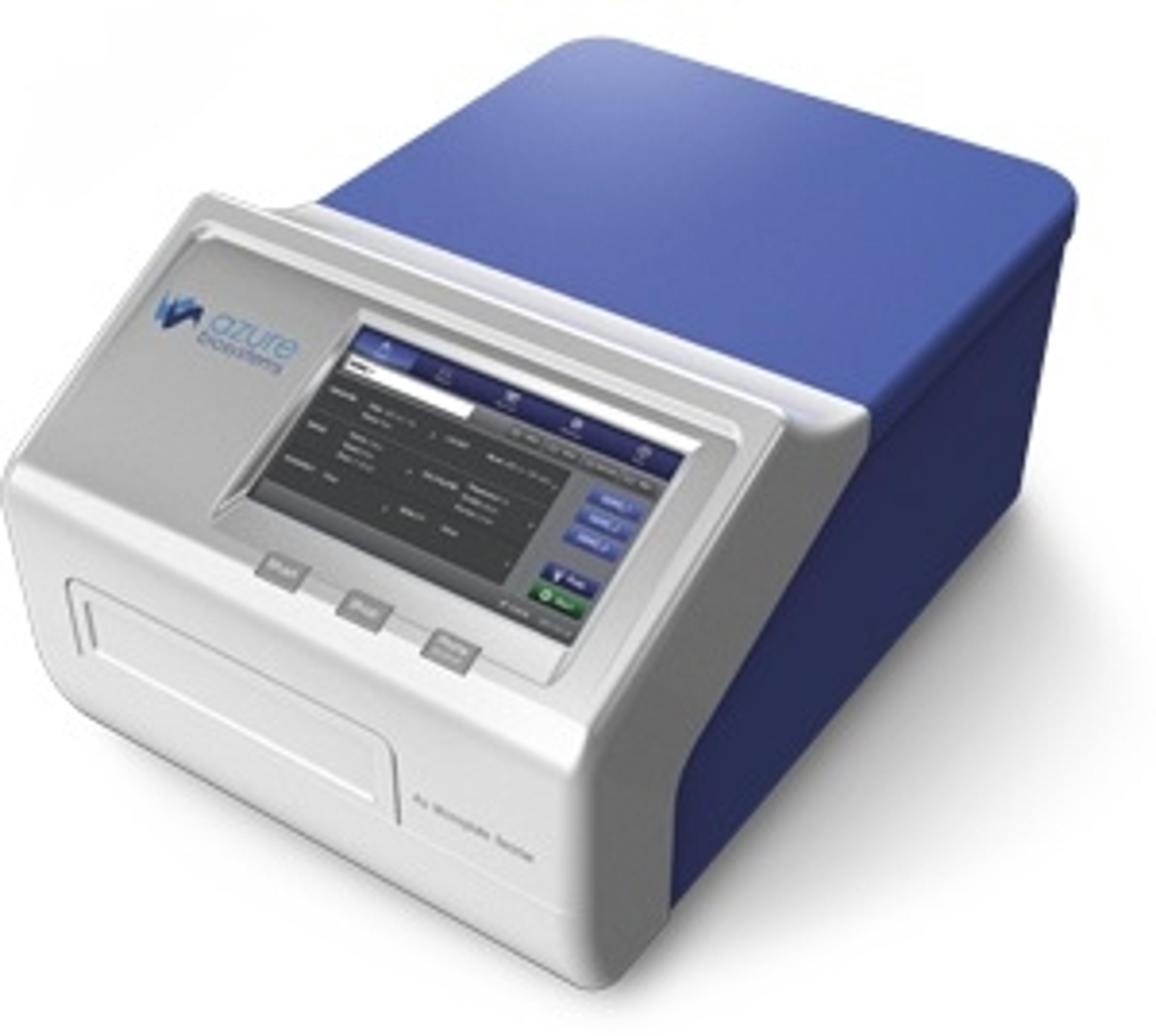
Azure Biosystems Introduces the Azure Ao Absorbance Microplate Reader

Offering application flexibility and an effortless user experience at the touch of a finger

6 Sept 2016
Alex Waite
Editorial Assistant

Product news

Biosystems, Inc. introduces the Ao absorbance microplate reader: a stand-alone 96-well plate reader, combining application flexibility and performance in a user-friendly system. An extensive array of 96-well plate-based applications are supported, including ELISAs, nucleic acid quantification, protein quantification, enzyme kinetics, and other colorimetric assays.

The Ao was developed in line with the core value of Azure Biosystems – a focus on user requirements for small, easy-to-use laboratory equipment supporting protein, nucleic acid, and enzyme research.

Focusing on the idea that laboratory equipment should be intuitive and easy to use, the Ao absorbance reader was designed with a 7-inch full touch screen interface, a feature typically restricted to much more expensive systems. Other microplate readers in the same category require a companion computer or laborious key pad-based entry. Setting up a plate with the Ao can now be done quickly at the touch of a finger. The 8-position filter wheel includes 5 standard filters at 405, 450, 492, 595, and 630 nm, plus 3 user-choice filters selected from 340-750 nm providing maximum application flexibility and customization for the individual lab. A built-in shaker, pre-set and customizable protocols, single and dual wavelength detection modes, and a motorized door for easy loading and unloading are all included in the Ao absorbance reader. The software supports pre-processing analysis, concentration determination, interpretation with controls, and kinetic measurement analysis and curves. Azure is offering a standard 2-year warranty with the Ao absorbance reader.

Lisa Isailovic, Director of Marketing at Azure Biosystems says of the Ao, “Microplate readers are essential instruments in life science research, and Azure is excited that our Ao microplate reader will expand Azure’s support to a broader range of applications with a distinct user-friendly system. The Ao compliments Azure’s existing cSeries gel and Western blot imaging systems by providing another tool for protein and nucleic acid research.”

Azure Biosystems will begin shipping the Ao absorbance microplate Reader in September 2016.

Links

Tags

Western BlottingWestern blotting equipment is used to transfer and identify specific proteins within a sample, reveal protein modifications, as well as give a semi-quantitative estimation of their concentration. Western blotting equipment includes all apparatus necessary to transfer proteins from gel to membrane and subsequent processing steps. Protein transfer can be performed by electroblotting with wet, semi-dry and dry transfer systems onto nitrocellulose and PVDF membranes. Blocking, washing and labeling of membranes follows, involving buffers, blocking reagents, blotting / incubation trays, labeling reagents, immunoblotting assays, antibodies and conjugates. Automated equipment for these steps is available to accelerate your lab workflow. Finally, detection and imaging of proteins can be conducted using gel documentation and imaging systems. Find the best western blotting equipment in our peer-reviewed product directory: compare products, check customer reviews and receive pricing direct from manufacturers.MicroplatesMicroplates are multi-well plates used to increase the throughput of biological investigations. The number of wells microplates contain can range from 6 to 3243 wells, with the 96-well format being the most commonly used. Microplates can come tailored for a range of applications including cell culture, PCR, filtration, storage, non-binding surface, protein crystallization, as well as pre-coated, deep well and normal Standard microplates. Additionally, options for microplate colors include clear , black, white or black with clear bottom and white with clear bottom for absorbance microplate reader applications. Find the best microplates for your lab in our peer-reviewed product directory: compare products, check customer reviews and receive pricing direct from manufacturers.ProteomicsProteomics is the systemic bioinformatics study of proteins and amino acids, including their structure, size, function and identification. Tools used in proteomics include chromatography, blotting and gels, protein arrays, mass spectrometry and ELISA and associated analysis software. Analyzers and proteomic systems should be sensitive, high resolution, fast and may be automated for high-throughput.Microplate Readers / DetectorsMicroplate readers are used to automate the detection and analysis of labeled or label-free components in microplates during assays or live-cell monitoring. Microplate readers are generally distinguished by their mode of detection. Types include absorbance, luminescence, fluorescence intensity, fluorescence polarization, TRF / FRET and multimode microplate readers. Microplate readers deliver a high throughput of samples by reading multiple wells simultaneously, with the 96-well format the most commonly used. As a result, microplate readers are often used in the drug discovery, bioassays, research and pharmaceutical industries for screening applications. Microplate loading can also be automated, with robotic microplate stackers to increase throughput. Find the best microplate readers in our peer-reviewed product directory: compare products, check customer reviews and receive pricing direct from manufacturers.DNA / RNA Extraction and PurificationPurified DNA and RNA are required for numerous downstream molecular biology applications. Consequently, the importance of high-quality DNA/RNA extraction and purification equipment cannot be underestimated. Many purification kits are available and are typically optimized for nucleic acid type and source, including plasmid DNA, genomic DNA, mRNA, RNA and viral nucleic acid purification kits. Automated extraction and purification of nucleic acids can be implemented with magnetic bead separator instruments or high-throughput purification workstations. Find the best DNA/RNA extraction and purification equipment in our peer-reviewed product directory: compare products, check customer reviews and receive pricing direct from manufacturers.Protein PurificationProtein purification is a vital step in drug discovery, therapeutics, biotech and life science research. The purification process typically involves subcellular or membrane protein extraction with cell lysis kits, separation of proteins from cell debris by filtration or spin columns, and the isolation of proteins of interest from other proteins and impurities with affinity purification (including fusion protein tags and antibody binding proteins A, G and L), immunoprecipitation or chromatographic methods, such as ion exchange, size exclusion and immobilized metal affinity chromatography. All purification methods come in multiple formats for your laboratory needs, including agarose or magnetic beads, resins, columns and filter plates. Find the best protein purification equipment in our peer-reviewed product directory: compare products, check customer reviews and receive pricing direct from manufacturers.Software PlatformsSoftware platforms are useful for various stages of laboratory experiments from data collection to data storage and processing. For instance lab software is available for system control, data management, data analysis and qualification / validation.Plate ProcessingAutomated plate processing is used in microplate technologies for high-throughput, speed and efficiency. Plate processing systems include microplate handlers for moving plates, heat sealers, stackers and carousels for storage, retrieval and delivery, microplate washers and piercers. Useful features of plate processors include walk-away automation, compatibility and easy integration with microplate systems.Microplate Reader SoftwareEnzymesELISAProtein Quantification
Azure Biosystems Introduces the Azure Ao Absorbance Microplate Reader