
Automated titration solutions to improve water testing methods - your questions answered
Watch this on-demand webinar to find out how the quality of results from water testing can be improved with automated titration
21 May 2020
Expert insights

Water is a shared natural resource that must be managed responsibly, regardless of the industry using it. Laboratories such as Duke Energy’s Environmental Central Laboratory test ground, surface and wastewaters to ensure good stewardship of the water they use and to control the treatment of water resources. Water is a shared natural resource that must be managed responsibly, regardless of the industry using it. Laboratories such as Duke Energy’s Environmental Central Laboratory test ground, surface and wastewaters to ensure good stewardship of the water they use and to control the treatment of water resources.
In this on-demand SelectScience® webinar, Garrett Hutchings, an environmental scientist at Duke Energy’s Environmental Central Laboratory, reveals how he increased sample testing and improved the quality of his results with automated titration. He is joined by Kerri-Ann Blake, titration product manager at Metrohm USA, who reviews the common EPA standards for water testing.
Read on for highlights from the live Q&A session or register to watch the webinar at any time that suits you.
Watch Webinar NowQ: What kind of maintenance do you perform on your system?
GH: So far, we haven't done much maintenance besides refilling the fluid levels of our system. The yearly preventative maintenance service takes care of any major maintenance that we need. We just refill the electrode fluid and store the electrode in the storage solution that is included with the product.
Q: How long does your electrode last and how do you take care of them?
GH: We’ve had our instrument for a little over a year now and have not needed to replace the electrode yet. We have a couple on standby just in case we run into an issue where we need to swap out electrodes quickly. They will last for a long time as long as you maintain the electrode by cleaning up after any type of viscous samples and making sure that the electrode fluid is filled.
Q: Does Metrohm help with transferring methods from other titrators to robotic systems?
KB: Absolutely. Whenever we install an instrument at a customer site, whether it is one of our smaller titrators or the robotic systems, we make sure that you have an operating titrator and the users are trained on how to achieve their results.
Q: With so many samples, would integrating a barcode reader be more convenient?
KB: It is possible to connect a barcode reader to make sure that the information gets transcribed quickly and efficiently into the software. However, it is a simple process that does not require a special barcode reader.
Q: Is it possible to have different size beakers on the robot?
KB: Yes, the sample racks are interchangeable, and it is possible to have the 75 mL and 120 mL beakers. If you have samples that require different volumes, you can choose which sample racks you would like to have on your system.
Q: How well does this work for ammonia testing?
KB: It works very well for ammonia testing. We can pass down to PPB levels which is unusual for potential metric measurement. However, it is very sensitive to how you perform the task and how you care for the electrode. There is a lot of room for error there so if you have issues, please reach out to us. If you are using our electrode, we can certainly provide help with that as well. If you are not using our electrode, you can still reach out but there may be some nuances with your particular electrode that we may not be able to work with. We can still give you recommendations on how to do your test.
Q: Why can you not measure pH before deciding which titrant should be used for titration?
GH: For our laboratory, pH is taken at sample collection. It is a field parameter. It would take more time for us to test the pH of every sample before we do the titration. Thankfully, the OMNIS software takes the pH beforehand, but it just comes down to timing for us.
Q: Someone here says that they titrate to a pH of 4 and then finished at a pH of 3.5, then boil the sample and titrate back to pH 7 for volatile alkalinity. Would we be able to use this instrument or is there something else that would serve this purpose?
KB: Yes, you are able to use this instrument, but it would not do the boiling for you. You would have to do your initial titration of the pH of 4 and then down to 3.5, remove the sample, do the boiling step, cool it as needed, and then place it back to finish the analysis. It is definitely possible to do this type of test, it’s just a bit more of a hands-on approach than some of the other tests that we currently have.
Q: Is there a possibility of cross-contamination between samples?
GH: I would say that there is no possibility of cross-contamination between samples. With the cleaning in between the sample as well as the sample container, we have not seen any instances of cross-contamination.
Q: Is there an option to do the standardization of the titrant during a long run as a verification?
KB: Yes, it is possible to do standardization if you have a standard that you can place on the rack. Most people do not do standardization per se, it is usually more of a QC check or analysis of a standard just to make sure that something has not changed with the electrode or with the titrant during a long run.
GH: We do the pH calibration of the electrode as well. We do a standardization which is a check of our titrant. At the very end, we do another calibration of the electrode just to make sure that the electrode has not shifted during that run. We have control samples set within the test itself that are able to make sure that the instrument is performing as intended.
Learn more about improving water testing with automated titration: Watch this webinar on demand >>
SelectScience runs 3-4 webinars a month across various scientific topics, discover more of our upcoming webinars >>
Related products
Request Quote for All Products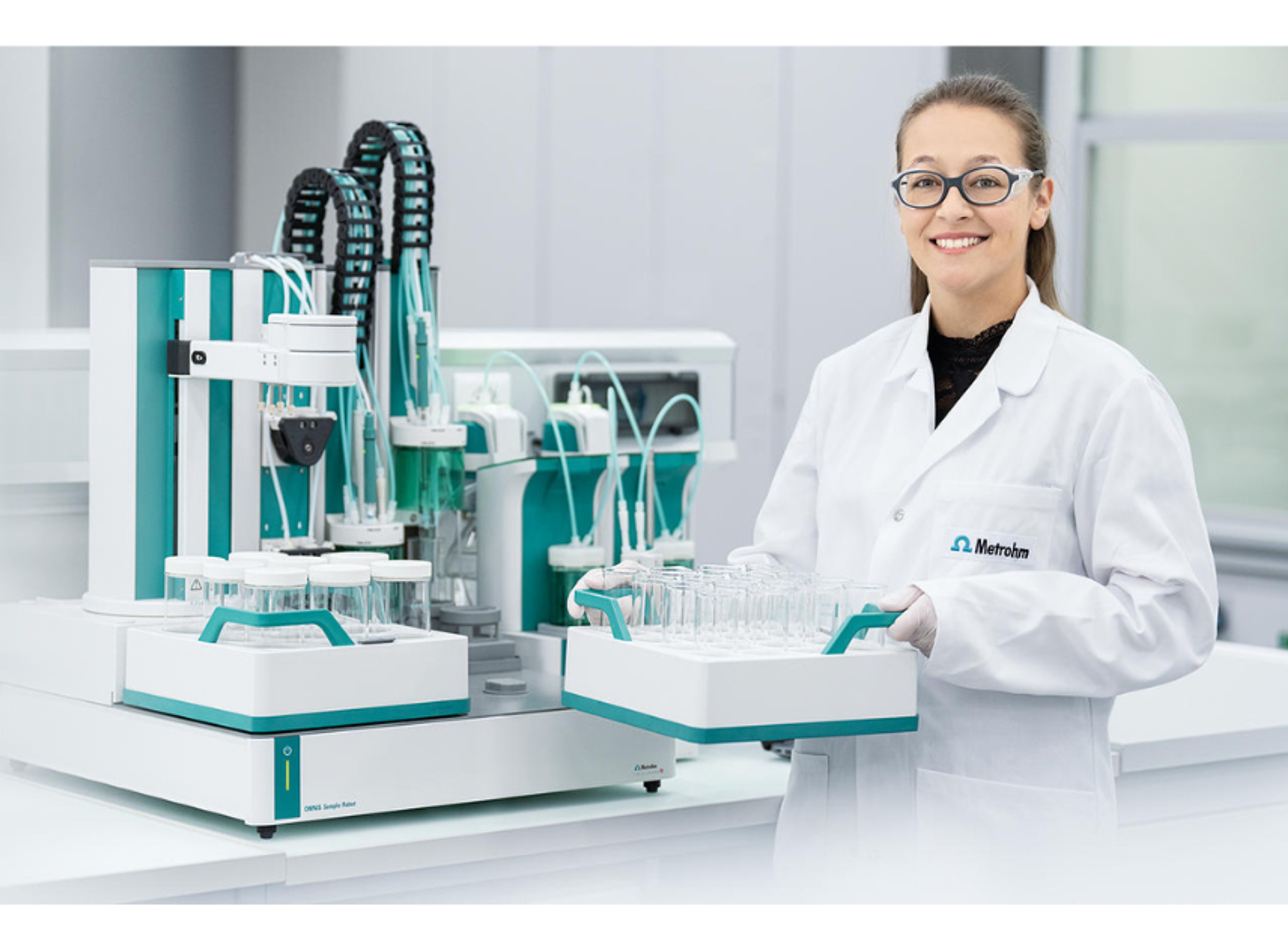
OMNIS
Metrohm AGOMNIS is the universal platform for wet chemical analysis - and beyond. It is modular by design and can be scaled to control potentiometric titrations, volumetric and coulometric Karl Fischer titrations, thermometric titrations, pH and conductivity measurements and – with the OMNIS NIR analyzer – also measurements by near-infrared spectroscopy.