
ARTEL Introduces First Standardized Technology to Verify Serial Dilution Accuracy
5 Feb 2007Product news
ARTEL has enhanced its MVS® (Multichannel Verification System) to provide laboratories with the first standardized technology to verify the accuracy of dilution ratios in serial dilution protocols.
This new capability is essential for drug discovery and other laboratories that rely on data generated from dilution-based liquid delivery procedures. Rapid and easy-to-use, the MVS facilitates liquid handling quality assurance programs and strengthens compliance by providing traceable results. Laboratories benefit from enhanced efficiency, data repeatability and greater confidence in results.
ARTEL is announcing this technology, the first of its kind, at Lab Automation 2007, Palm Springs Convention Center, CA, January 27-31, Booth #438. The company is providing free software upgrades to existing MVS customers.
“It is highly risky and inefficient to assume accurate equipment performance,” says Kirby Pilcher, President, ARTEL. “ARTEL is providing the first technology that can easily and rapidly determine the dilution ratio of each step in a serial dilution protocol. Now, laboratories can fully trust their data without sacrificing productivity.”
To generate a proper serial dilution methodology, during which a sample solution is diluted across a microtiter plate, accurate and repeatable volume transfer and efficient solution mixing are critical. It is also imperative that the sample concentration in the initial solution be known so that the decreasing concentrations of sample across the plate can be correctly determined. Because sample concentration is directly affected by starting concentration and the amount of transferred volume, an inaccurate liquid handler can cause unseen, compounding error in serial dilution applications, which can void the integrity of the dilution assay.
Until now, laboratories typically determined the concentrations of the target samples based on the assumed dilution ratio. This practice is suspect because as sample is being diluted across a plate, volume transfer variability on the micro- and nano-liter levels can significantly affect results, i.e., the concentration of sample will be much different than expected if the transferred volume is inaccurate or if the mixing step is not optimized. In addition, given that a range of critical applications, such as detection limit testing and bacteria counting, rely on interpretations of data from serial dilution procedures, the costs of failure are high. For example, in drug discovery dose response screening, serial dilutions are often used to determine the optimal concentration of target compounds needed to formulate effective drugs for disease treatment. If the dilution ratio is inaccurate, the compound will be too strongly or too weakly concentrated, resulting in an overly potent or ineffective pharmaceutical.
“We developed this new MVS feature in response to customer demands for greater assurance that their liquid handling devices perform accurately throughout the entire serial dilution process,” notes Tanya Knaide, MVS Product Manager, ARTEL.
Previously, the only option available for laboratories to measure dilution ratios in serial dilution protocols were home-brewed methods requiring internally developed sample solutions. This time-consuming process does not allow for inter-laboratory comparability or traceability. By contrast, the MVS technology and range of standardized solutions allow for rapid verification of dilution ratios and provide traceable results for compliance and reproducibility.
The MVS verifies target volumes via ratiometric photometry, which uses the absorbance values of two proprietary dye solutions to calculate dispensed volume. The enhanced MVS now provides traceable measurements for single- or multiple-point dilutions to a concentration endpoint ratio of 1:2000 of the starting material. In addition, the portable MVS can be used to verify volumes dispensed by automated liquid handlers and multichannel handheld pipettes on a tip-by-tip basis in 96- and 384-well microplates.
Related products
Request Quote for All Products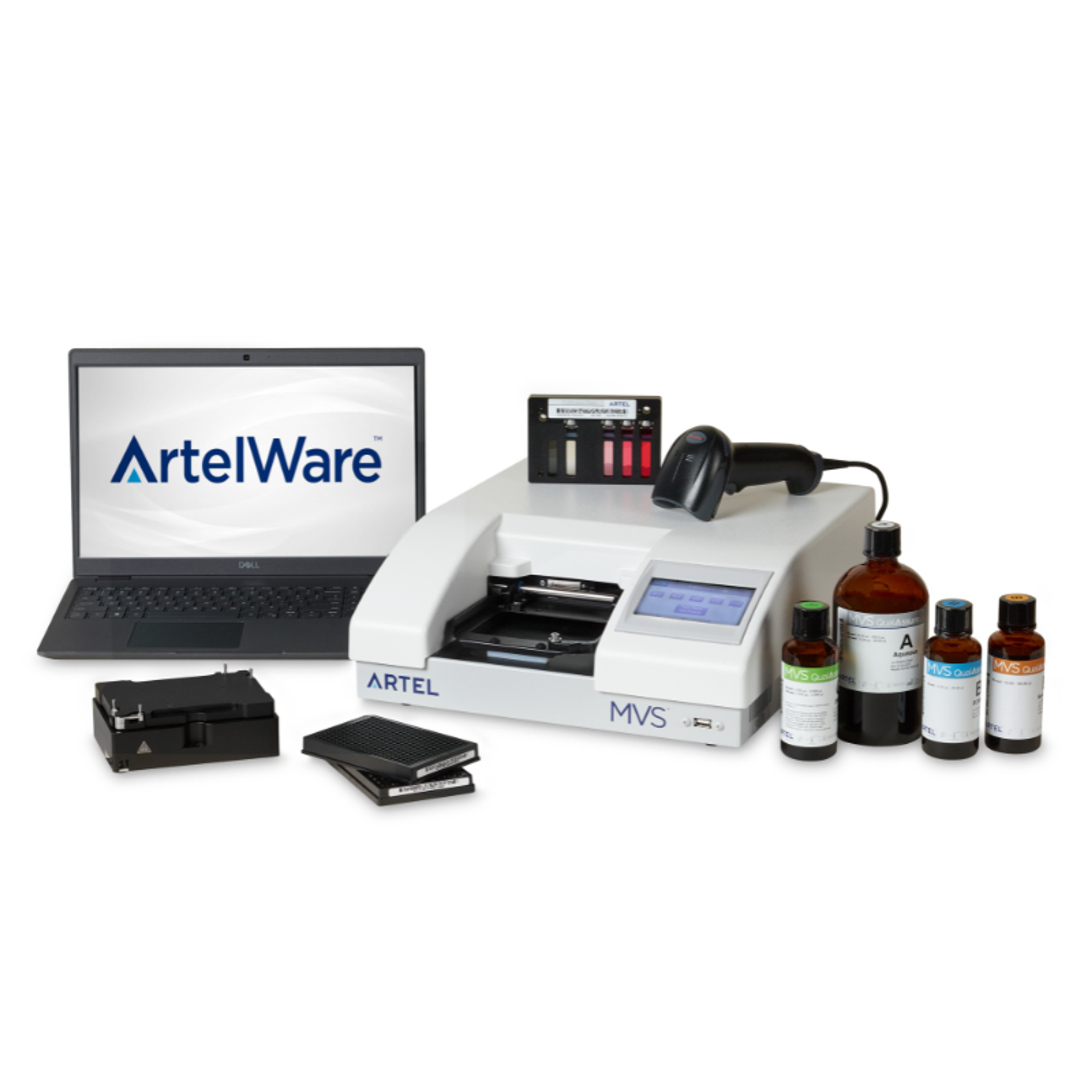
Artel MVS® Multichannel Verification System
Nova Biomedical OsmometersUnderstand and manage the performance of your automated liquid handlers, multichannel pipettes, labware, operators, and more.